As diplomatic initiatives intensify to curb the eight-month US-Israeli conflict with Iran, Tehran continues to rebuff international pressure, holding firm on its strategic demands. The regional urgency follows an announcement from Beijing that it will dispatch an envoy to key nations to mitigate the risk of further escalation. The announcement by China on Tuesday that Beijing will be sending an envoy to relevant countries in the region soon to help avoid another round of escalation highlights the growing urgency of finding a peaceful solution to a conflict that has disrupted global energy markets and spilled over across the region. Giving Tehran considerable leverage over global oil markets, the waterway carried about one-fifth of the world’s energy supplies before the war began on February 28. Towards one in which Middle East countries and other regional nations can exercise greater influence, he added that talks could mark the beginning of a shift away from a regional security order dominated by Washington.
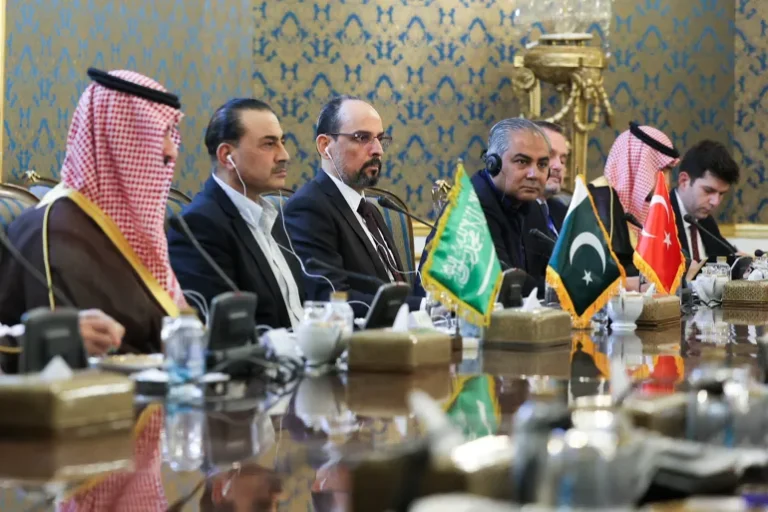
High-level discussions took place on Monday between Iranian officials and representatives from Saudi Arabia, Pakistan, and Turkiye—the coalition behind the August Mecca defence pact. These parties have committed to ongoing dialogues centered on restoring regional peace and security.
Despite these overtures, Tehran has signaled it will not compromise on its core requirements. The country maintains significant leverage over maritime transit in the Strait of Hormuz. According to Negar Mortazavi, host of The Iran Podcast, Tehran’s primary objective transcends a simple ceasefire; it seeks to establish permanent deterrence to break the cycle of military aggression from the US and Israel. “Its deterrence strategy is multilayered, aimed at imposing military, economic and political costs that extend well beyond the battlefield.”.
To secure a potential return to negotiations, Iranian leadership demands an end to the naval blockade of its Gulf ports, the lifting of sanctions, and concrete assurances that US forces will cease future attacks. Officials argue that past diplomatic failures have left them vulnerable, with the US and Israel conducting three distinct strikes on Iran since June 2025, even while formal talks were reportedly active. Including its deep distrust of Washington – which has launched strikes on Iran three times since June 2025 while conducting talks – the belief that continued economic pressure could force more attractive US concessions, and much-anticipated elections in Israel and the US this week and next, experts say Iran’s current calculations are being driven by several factors. Just as peace talks were ongoing in Oman, the US and Israel launched the first strikes of the war on February 28. Last year, Israel launched its 12-day war on Iran in June, which the US joined. According to data collected by the Washington Institute for Near East Policy, october has recorded the highest number of attacks on commercial shipping around Hormuz. While shipping through the strait remains nowhere near pre-war levels, brent crude surged above $117 a barrel last week – compared with about $72 pre-war – following Iranian attacks on tankers. According to chris Beauchamp, chief market analyst at IG Group,, He believes Iran is deliberately exploiting this economic pressure as part of a wider contest of endurance with Washington. “They know they are in an attritional race with the US to see who breaks first,” Beauchamp told. “For now, however, they are happy to keep attacking shipping to push prices higher.”. According to political analyst Rami Khouri, a nonresident fellow at the Arab Center in Washington DC,, The meeting had several objectives, some more immediate than others.
The current hardened stance of the Iranian government reflects the collapse of previous mediation efforts, such as the June memorandum of understanding brokered by Pakistan and Qatar. That agreement, intended to reopen the Strait of Hormuz, failed when both sides resumed combat, leading to weeks of intense US strikes in July and subsequent Iranian retaliation.
Sina Toossi, a senior fellow at the Center for International Policy (CIP), noted that these recurring failures have damaged the credibility of diplomatic processes in the eyes of Tehran. “Iran believes previous negotiations and ceasefire arrangements failed to protect it from renewed military attacks, and it is therefore seeking more tangible and durable guarantees,” he explained.
US President Donald Trump has offered little clarity regarding his future moves, recently questioning whether to pursue a deal or seek a definitive military conclusion. Trump had previously indicated that no further attacks would occur before the November 3 midterm elections, which will decide the control of the US Congress for the remainder of his term. US President Donald Trump, meanwhile, has remained ambiguous over what course of action he will take in the near future. “My question is, do I make a deal with them or do I finish them off. When all 435 House of Representatives seats and 35 of the 100 Senate seats will be up for grabs, will determine which party has control of the US Congress for the final two years of Trump’s presidency, the US midterms next week. Trump told reporters on Sunday.
Mohsen Rezaei, secretary of Iran’s Supreme National Security Council, warned that Iran’s armed forces are prepared to respond to any new aggression by targeting bases involved in US operations or even invading neighboring states. Meanwhile, domestic political pressure in the US is mounting; recent surveys show only 34 percent of Americans approve of Trump’s handling of the conflict, the lowest rating of his presidency. The war, already deeply unpopular with Americans, is becoming an increasingly contentious domestic issue. A Reuters/Ipsos survey earlier this month found just 34 percent of Americans approved of Trump’s handling of the conflict – his lowest rating during either of his presidential terms. Republican majorities in both houses of Congress are already wafer-thin – at 53-47 (including two independents who vote with Democrats) in the Senate and 218-214 in the House. “Iran is willing to negotiate and has already demonstrated flexibility by presenting a proposal to end the war.
The ongoing war has significantly impacted the US economy, with energy costs—specifically diesel—nearly doubling, placing a severe burden on local businesses and the agricultural sector. Analysts suggest Iran may be intentionally stalling talks to deny the Trump administration a political victory prior to the midterms. Which has nearly doubled in price, causing a major burden for farmers and small businesses – adding to concerns about inflation and affordability that are dominating the election campaign, the war has also driven up energy prices – particularly diesel. Particularly if Democrats gain congressional control and increase scrutiny of the administration’s conduct of the war, a Republican setback could further constrain Trump’s room for manoeuvre.
The electoral landscape in Israel also looms over these calculations, with elections scheduled for Tuesday. A potential loss for Prime Minister Benjamin Netanyahu could alter the regional dynamic, though analysts warn that even an opposition victory led by figures like former military chief Gadi Eisenkot might not fundamentally change Israel’s hawkish stance on Iran’s nuclear program.
Ultimately, the restoration of regional stability remains linked to the broader Iran-US confrontation.
Regional powers are increasingly acknowledging that their own national security is inseparable from the developments in this conflict. As Mortazavi emphasized, Tehran is determined to ensure that any future agreement serves as a lasting settlement rather than a fleeting pause, aiming to demonstrate that military strikes against Iran carry significant, long-term costs for the United States. The US wants Iran to give up more before a final peace settlement is negotiated – including making concessions about its nuclear programme.