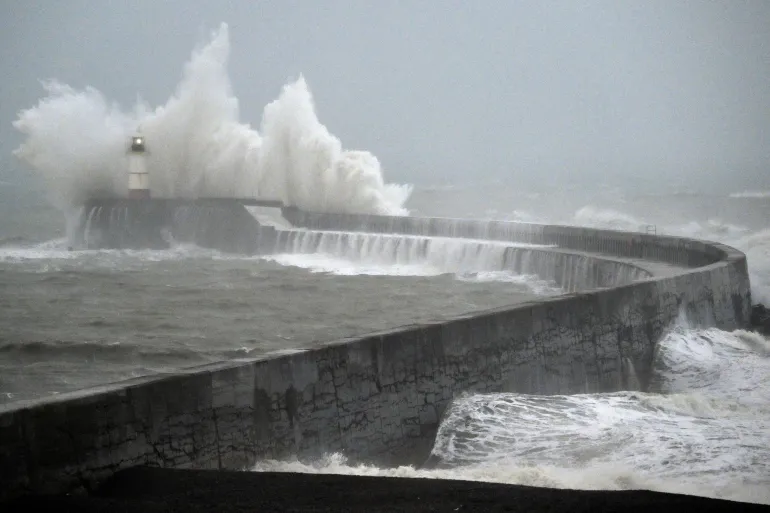
A powerful duo of storms, named Boelo and Austen, has swept across northern Europe within a 24-hour window, resulting in one fatality and severe damage to infrastructure. By Sunday, over 150,000 households were left without electricity, and vital transportation and communications networks faced significant disruption.
Authorities reported that a 60-year-old man died in southwestern Scotland on Sunday after being struck by a falling tree. In a separate incident within central Scotland, two women were injured when a tree collapsed. Regional authorities in Argyll and Bute recorded wind speeds reaching 135 km/h (84 mph). Across Scotland and northern England, the storm debris—ranging from fallen trees to downed power lines—blocked numerous roads and rail lines.
The impact was widespread across the United Kingdom, where more than 82,000 homes remained without power on Sunday. In the coastal town of Brighton, strong winds destroyed an unused pier on Friday. The national forecaster, the Met Office, issued stern warnings regarding the risk to life from flying debris and crashing waves, advising residents to minimize travel and remain indoors.
In France, the energy provider Enedis noted that approximately 288,000 homes lost power during the height of the storm on Saturday. While service was restored for many, roughly 59,000 homes, particularly in the regions of Normandy and Brittany, remained in the dark by midday Sunday. During a race in northern France, a marathon runner sustained minor injuries after a tree was uprooted by high winds.
Germany also suffered the effects of the weather front, with 10,000 homes in the Freiburg-Breisgau area losing electricity on Sunday.
The local hospital had to limit its operations to emergency services exclusively due to the blackout, which also severed mobile phone connectivity. Additionally, police confirmed two individuals were seriously injured in the town of Nastatten when scaffolding collapsed under the pressure of intense winds at a local market.
Further west, Belgium and the Netherlands dealt with their own emergencies. In Brussels, falling trees resulted in injuries to four people. Meanwhile, off the coast of the Netherlands near Schiermonnikoog, three crew members on a freight ship were injured; two required a helicopter evacuation to a mainland hospital for emergency care.
The scale of the disruption led to hundreds of flight cancellations and diversions throughout the continent, including major delays at Amsterdam’s Schiphol airport. With authorities now assessing the damage, climate experts have once again emphasized the increasing frequency and intensity of such extreme weather events globally.