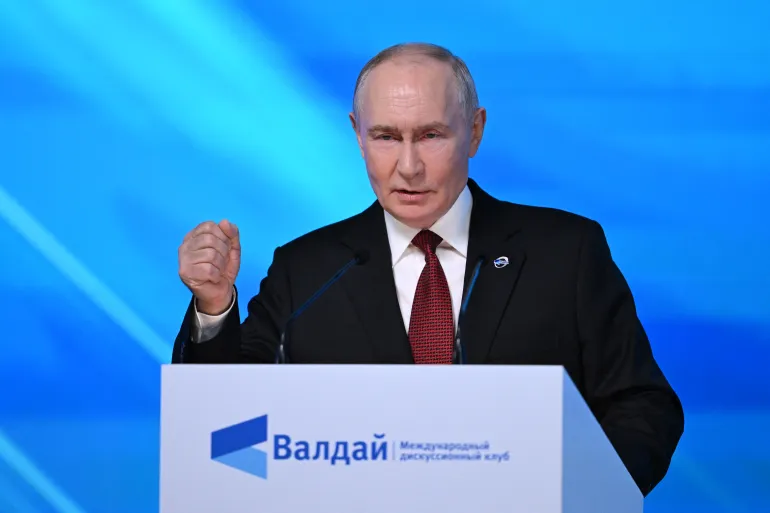
President Vladimir Putin has officially rejected the possibility of a ceasefire regarding long-range strikes with Ukraine, even as his forces intensify aerial campaigns against Kyiv. Speaking at the Valdai political forum in Moscow, the Russian leader dismissed proposals to halt attacks on oil refineries in exchange for a pause in strikes on ships as “simply ridiculous.” These comments follow a September 22 meeting in New York between United States President Donald Trump and Ukrainian President Volodymyr Zelenskyy, where Kyiv signaled a readiness to stop targeting Russian energy infrastructure if Moscow reciprocated. “We are told: ‘Let them stop striking your refineries, and you will stop striking their ships.
Addressing the Moscow-based think tank, Putin acknowledged that Ukrainian strikes on domestic oil refineries had impacted the economy, costing Russia approximately 1 percent of its gross domestic product. He noted that while Ukraine had “partially achieved its objectives,” Russia is now responding with a broader offensive targeting Ukrainian steel companies and rail supply chains. This ongoing aerial bombardment continues to threaten civilian safety, with local officials reporting that a Russian drone struck a school in the capital on Thursday. While no casualties were confirmed due to students and staff being in shelters, the constant threat has left the city on high alert as winter approaches. Ukraine accuses Moscow of deliberately hitting civilian targets and keeping Kyiv on a near-constant state of alert as it braces for another tough winter.
Beyond the immediate battlefield, Putin reiterated his desire to see Ukraine become a neutral nation, though he remained steadfast against current de-escalation efforts. He emphasized that the cycle of retaliatory measures is pushing the conflict toward a “fatal point of no return,” warning that the international community risks reaching a stage where the situation becomes irreversible. Putin added that Russia would prefer to end the conflict in Ukraine through talks and wanted it to be a neutral country after the end of hostilities.
A significant portion of his address focused on the Russian Baltic exclave of Kaliningrad, located between Poland and Lithuania. Responding to a diplomatic note recently received by NATO, Putin warned that Russia would be prepared to deploy its entire nuclear arsenal if the alliance attempted to isolate the territory. “If it comes to a direct attack on the Russian Federation—in this case, we are referring to Kaliningrad, and perhaps other territories as well—the question of the Russian Federation deploying all the weapons at our country’s disposal will, of course, inevitably and immediately be on the agenda,” he declared. Which is wedged between Poland and Lithuania, and pledged to defend it with nuclear weapons if necessary, he warned the West not to escalate the standoff over Ukraine by threatening the Russian exclave of Kaliningrad.
Amid these heightened tensions, Putin offered a nuanced outlook regarding the assets of Western companies seized by Moscow. He suggested that if a “favourable scenario” develops, the holdings of firms like Nestle, Auchan, the former Leroy Merlin chain, and the German wholesaler Metro could potentially be returned to their owners. These assets were taken under official order just last month as part of broader economic countermeasures.