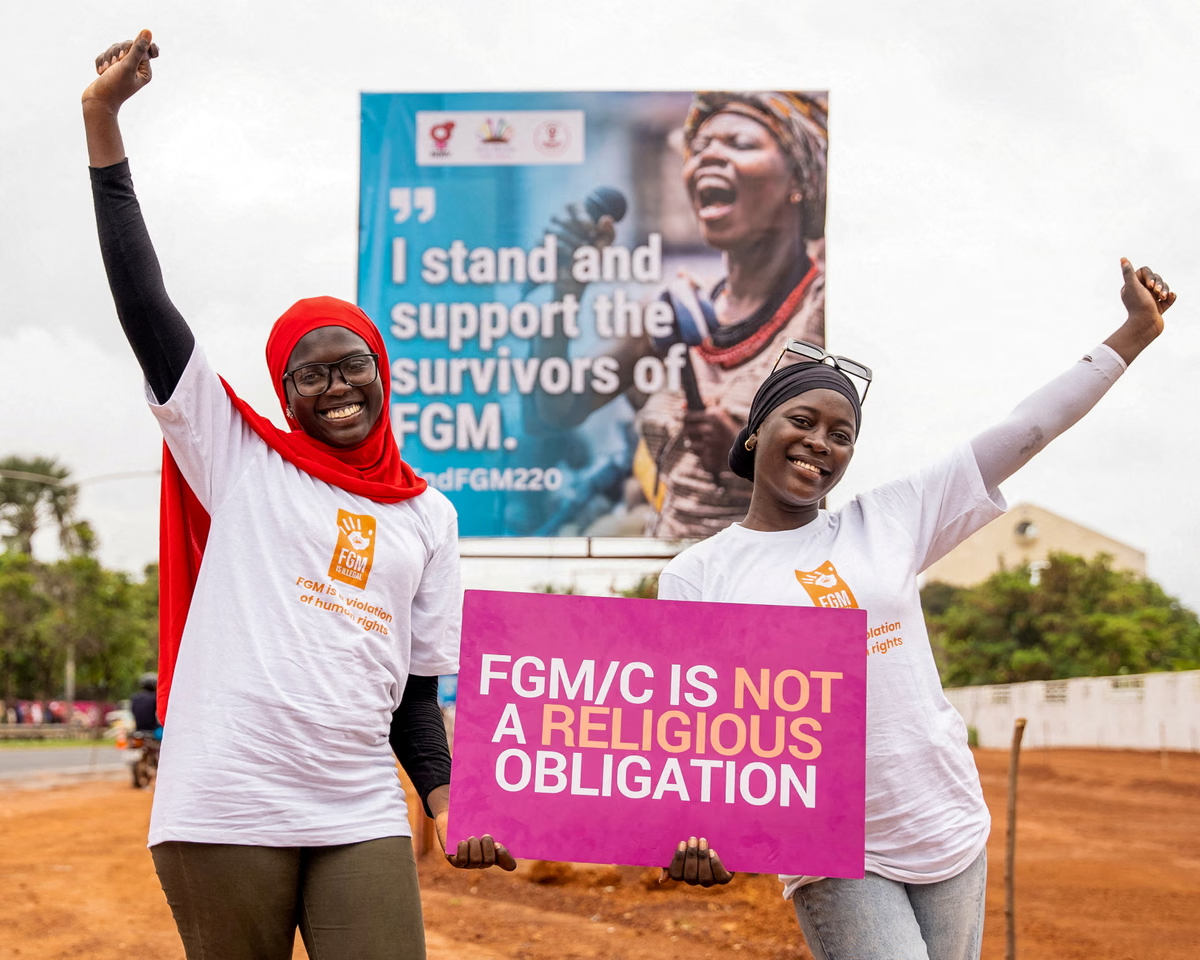
Activists and leaders working on the front lines to eradicate female genital mutilation (FGM) have welcomed the launch of a new $15.5 million (£11.4 million) initiative. Known as the Her Horizon Fund, the project aims to generate the momentum necessary to eliminate a practice that continues to impact more than 230 million women and girls worldwide.
The fund was established by the US-based Wallace Global Fund with an initial $14 million investment, bolstered by a $1.5 million contribution from an anonymous donor. Organizers are now working to pool a total of $100 million from various donors, hoping to reach a critical tipping point that could end FGM within a single generation.
This financial injection arrives at a difficult time for global advocacy, as donor funding for anti-FGM programs has seen a sharp decline. Last year, the largest joint initiative to combat the practice—operated by the UN’s sexual and reproductive health agency, UNFPA, and the UN children’s agency, Unicef—saw its funding drop by 45%, falling from $29.6 million to $16.3 million. This shortfall complicates the United Nations’ goal of total elimination by 2030, especially as legal protections for women and girls face increasing challenges in several nations.
Ifrah Ahmed, a Somali-Irish activist and survivor who founded the Ifrah Foundation, emphasized the importance of this new resource. Despite losing $300,000 in UN funding last year, Ahmed has continued to push for legislative change in Somalia. While the practice remains nearly universal in her home country, three of Somalia’s seven federal member states have now enacted anti-FGM laws, with two others currently awaiting parliamentary approval.
The landscape of progress remains fragile. In the Gambia, the supreme court is currently reviewing a constitutional challenge to the country’s 2015 ban on FGM, following a 2024 parliamentary attempt to repeal the legislation. Similarly, in Sierra Leone, the recently passed Child Rights Act does not explicitly prohibit the practice. These developments underscore the ongoing struggle to protect gains made over the past several decades.
Susan Gibbs, senior adviser on women’s rights and FGM at the Wallace Global Fund, described the situation as a public health emergency and an extreme form of gender-based violence. She noted that while UN data shows a decline in prevalence in many regions, the progress is being countered by political instability and a lack of resources for local organizations. Gibbs, who attended the fund’s official launch at a Justice for Girls gathering in Kenya, expressed confidence that the new capital would be catalytic for frontline groups.
FGM involves the partial or total removal of female genitalia for non-medical reasons and has been endured by 144 million women and girls in Africa, 80 million in Asia, and 6 million in the Middle East. Beyond the immediate risks of severe pain, infection, and excessive bleeding, survivors often face long-term health consequences, including chronic pain and childbirth complications.
The human cost of the practice is profound. A 2025 study estimated that FGM contributes to approximately 44,000 deaths annually across the 15 countries surveyed, positioning it as a leading cause of mortality for women and girls in those regions. By providing direct, sustained funding, the Her Horizon Fund hopes to empower local activists who are best positioned to lead the movement for change within their own communities. The report also notes that funding received by the largest initiative to end the practice – a joint programme operated in 18 countries by the UN’s sexual and reproductive health agency, UNFPA, and the UN humanitarian organisation for children, Unicef – fell by 45% last year, from $29.6m to $16.3m. The report also notes that uN funding worth $300,000 to her organisation was cut by UNFPA last year, but Ahmed managed to raise money from elsewhere. The report also notes that “If we don’t continue to raise money, the dream where this practice will end will have died for young girls,” she added. The report also notes that which lawmakers rejected after months of debate, amid strong resistance from women’s rights groups, the case follows a 2024 parliamentary effort to repeal the ban. The report also notes that and so more direct funding would allow them to sustain and scale [up] their work.”, most frontline organisations have been absolutely starved for resources. The report also notes that “Lasting change must be led by the frontline – it cannot be imposed from the outside.