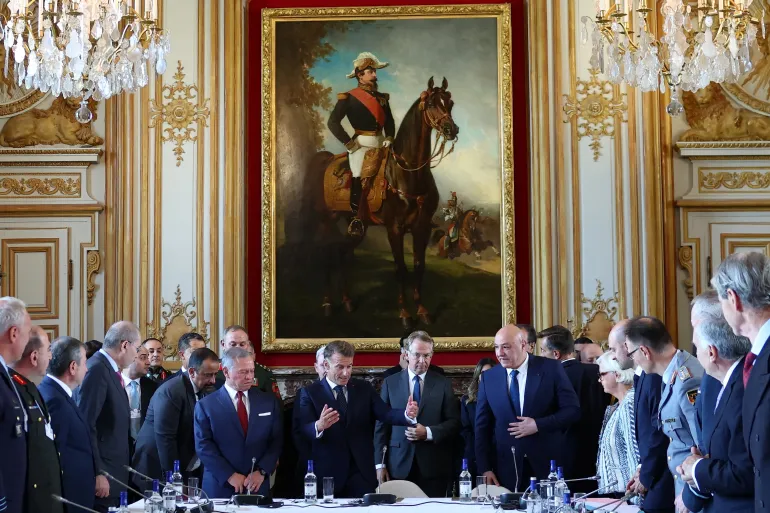
French President Emmanuel Macron hosted Lebanese President Joseph Aoun and King Abdullah II of Jordan in Paris on Thursday to rally international backing for the Lebanese military. The high-level discussions aimed to establish a framework for the Lebanese Armed Forces to assert control over the nation’s territory, following persistent Israeli military operations.
Military chiefs from France, Lebanon, Jordan, the United Kingdom, and Italy, alongside high-ranking officials from the United States and Saudi Arabia, joined the leaders for the summit. Macron emphasized that a stable and sovereign Lebanon is essential for regional peace, stating that the talks were designed to “strengthen Lebanon’s sovereignty and enable it to fully ensure its security.”
The French presidency revealed that the meeting focused on reviewing a deployment plan for the Lebanese military based on a “clear, credible and realistic” framework. Paris has framed this as a necessary precursor to securing robust international assistance, encompassing equipment, training, and financial aid. Macron noted that the Lebanese Armed Forces are “indispensable for asserting the authority of the Lebanese state across its entire territory.”
President Aoun expressed optimism regarding the progress of these talks, highlighting the Lebanese army as the primary pillar for national sovereignty. He stressed that bolstering state authority remains a sovereign Lebanese choice rather than an externally dictated mandate. During the discussions, Aoun and Macron also reviewed efforts to halt ongoing Israeli hostilities, referencing the June framework agreement negotiated with the assistance of the United States.
The talks coincide with the approaching end of the United Nations Interim Force in Lebanon (UNIFIL), which is set to conclude its mandate on December 31, 2026. After nearly 50 years of operations, the UN Security Council decided to terminate the mission under pressure from the US. France and Italy have proposed forming a multinational coalition to replace the current force of fewer than 7,500 peacekeepers from 46 nations.
Aoun has signaled his support for a new international force, potentially European, to prevent a security vacuum in the south once UNIFIL withdraws. Currently, Israeli forces maintain an occupation of a strip of Lebanese territory approximately 10 kilometers (six miles) deep along the border, following an invasion that exacerbated regional instability after the broader conflict began in February.
Despite a US-sponsored ceasefire and framework agreement signed in June—which mandates the disarmament of Hezbollah, the withdrawal of Israeli troops, and the deployment of the Lebanese army—fears of a renewed military campaign are rising. Attacks have continued to escalate, complicating efforts to restore state control.
Aoun has consistently articulated his intent to disarm Hezbollah, emphasizing that this must be achieved without plunging the country into internal confrontation. As the Lebanese military prepares to take a more central role, the international community remains focused on whether these new support structures can effectively stabilize the border region and enforce Lebanese sovereignty. The report also notes that the meetings come after a US-mediated framework deal was agreed between Israel and Lebanon in June. The report also notes that aoun reiterated his affirmation that only the state should have arms and praised the Lebanese army’s role in working towards the country’s stability. The report also notes that the talks also come as the mandate of the United Nations Interim Force in Lebanon (UNIFIL) ends this year after almost half a century of operations dating back to the Israeli invasion of 1978. The report also notes that setting off a war that has spread across the Middle East, including in Lebanon, with Israeli forces fighting Hezbollah, israel and the United States attacked Iran in February. The report also notes that and its forces continue to occupy what is a stretch of Lebanese territory about 10 kilometres (six miles) deep along the border, israel invaded southern Lebanon.