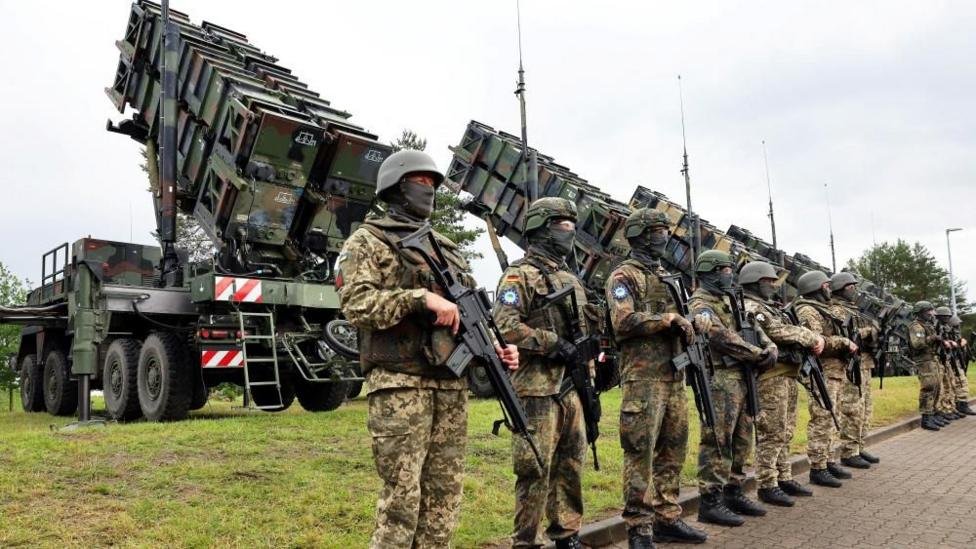
The United States has formally authorized the sale of 500 Patriot missiles to Ukraine, providing a vital defensive capability against the surge in Russian aerial bombardments. The Department of State announced that the advanced PAC-3 interceptor missiles, valued at $2.1 billion, will be fully financed through contributions from Kyiv’s European allies and Canada. No American funding is involved in the procurement, with Lockheed Martin designated as the primary contractor. According to in Friday’s statement, the State Department, “this proposed sale will support the foreign policy and national security objectives of the United States by improving the security of a partner country that is a force for political and economic stability in Europe”. According to it, “Ukraine will pay for this purchase with donations from Canada, Germany, and Norway via the JUMPSTART program and national funds, financed by the European Union’s Ukraine Support Loan”.
Despite the approval, President Volodymyr Zelensky has cautioned that these critical munitions could take several years to reach the front lines.
In an update shared on X late Friday, Zelensky welcomed the announcement but emphasized that Ukraine requires the missile systems immediately to defend against intensified strikes. According to recent reports, Russia has conducted over 30 separate attacks on Ukrainian power infrastructure within the last fortnight, compounding the urgency of the nation’s energy security needs. According to he, Russia was intensifying its attacks on key energy infrastructure ahead of winter with “more than 30 Russian strikes” on “critical parts” of Ukraine’s power grid over the past two weeks.
The logistical timeline remains uncertain, as the global supply of Patriot interceptors is currently constrained by international conflicts, including the US engagement against Iran. The Department of Defence notes that production capacity is limited to roughly 600 missiles annually, suggesting that these new builds will not result in a rapid deployment for Ukrainian forces.
This development follows a period of diplomatic friction between the US and Ukraine, marked by tensions over shifting sanctions policies and previous disputes regarding domestic production rights. Although President Trump previously suggested in July that Washington might license Ukraine to produce its own Patriots, he later walked back that offer. Tensions were only recently eased following direct negotiations between President Zelensky and American envoys in Oslo on October 20. On Friday night Zelensky repeated his calls for the US to speed up the release of its Patriots – the only effective weapon in downing Russia’s deadly ballistic missiles. The latest move comes after a row between Zelensky and Donald Trump earlier this month when the US eased sanctions on Russia as part of a deal to secure Russian diesel. According to the US president, It was time for Ukraine to get a new leader to strike a deal to end the war with Russia. Having earlier seized Crimea and parts of Donbas in the east, moscow launched a full-scale invasion of Ukraine in February 2022.
The broader geopolitical backdrop remains tense, as highlighted by events at the G20 foreign ministers’ meeting in Atlanta.
Hosted by Secretary of State Marco Rubio, the summit saw European diplomats express public disapproval of Russian Foreign Minister Sergei Lavrov by boycotting an official group photograph.
During the proceedings, UK Foreign Secretary Ed Miliband directly confronted the Russian delegation, explicitly labeling Moscow the aggressor in the conflict and accusing its leadership of killing innocent civilians.
As the winter season approaches, Kyiv continues to struggle with critically low stockpiles of air defense interceptors. While the $2.1 billion agreement secures the necessary inventory for the future, the immediate gap in protection against Russian ballistic missiles remains a central challenge for the Ukrainian government.