Twenty-five years after the September 11 attacks, the political architecture established in their wake continues to exert a profound influence on Europe. The Global War on Terror (GWOT) served as a critical turning point, offering far-right factions a platform to transition from the political fringes into the mainstream. While anti-Muslim sentiment had been simmering within these groups for years, the post-2001 global policy climate provided the legitimacy and electoral momentum necessary to elevate their influence.
Prior to the 2001 attacks, Europe’s far-right parties were largely relegated to the margins of multi-party systems. Often stigmatized by their historical ties to fascist ideologies and overt anti-Semitism, these groups struggled to gain credibility. However, the post-Soviet era saw a strategic pivot as parties like France’s Front National—now the Rassemblement National—and the Austrian Freedom Party began identifying Islam as a new, singular “enemy within.” By the late 1990s, figures such as Pim Fortuyn were already publishing works like *Against the Islamisation of Our Culture*, while the Dutch People’s Party for Freedom and Democracy (VVD) had begun framing Islam as a fundamental threat to liberal democracy and immigrant integration.
The September 11 attacks, which claimed 2,977 lives, provided these movements with an unprecedented opening. President George W. Bush’s declaration of a “Global War on Terror” fundamentally altered the political discourse. Although Bush maintained that the conflict targeted terrorists rather than the religion of Islam, the resulting rhetoric and policy frameworks frequently cast all Muslims as inherent suspects. This securitized logic, which insisted that one was either “with us or with the terrorists,” pressured European governments to align with the US-led invasions of Afghanistan and Iraq, despite varying levels of domestic support.
The atmosphere of suspicion was further fueled by media coverage and the subsequent attacks in Madrid and London, which solidified the narrative of an internal threat. During this period, European states implemented extensive counter-extremism and deradicalization strategies, such as the UK’s Prevent program, and participated in controversial practices like hosting CIA “black sites” and facilitating extraordinary renditions to Guantanamo Bay. These policies operated on the assumption that Muslim religious identity itself was a dormant threat, a premise that mirrored the historical marginalization of Jewish communities as untrustworthy outsiders.
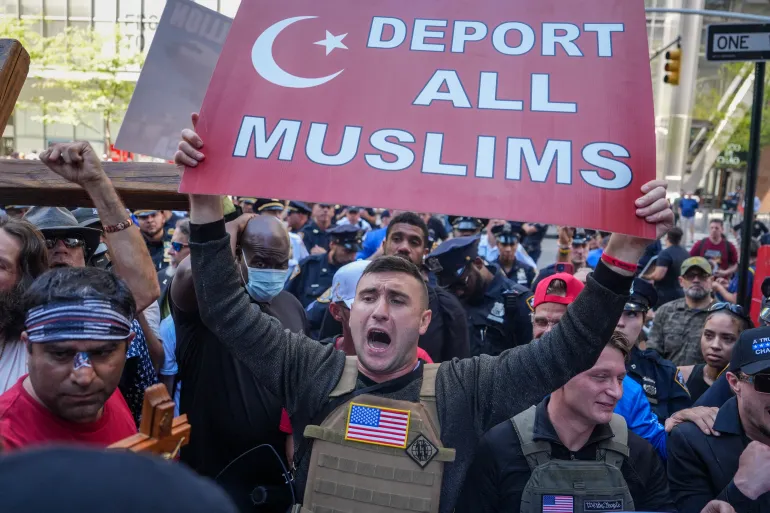
A transatlantic network known as the “Counter-Jihad Movement” emerged to formalize this ideology. Figures including Pamela Geller, Frank Gaffney, Daniel Pipes, and Robert Spencer collaborated with European counterparts to organize against mosque construction and promote the idea that Western civilization was under siege. By 2008, the Cities Against Islamisation initiative had successfully united far-right leaders from across the Netherlands, Belgium, Germany, Austria, France, and Italy with American anti-Muslim activists.
This mobilization eventually yielded significant electoral success. Far-right movements successfully pressured mainstream rivals to adopt their rhetoric, eventually securing roles in national governments across countries including Austria, Bulgaria, Hungary, the Netherlands, Italy, Norway, Poland, and Finland. In nations like Denmark and Sweden, these parties became influential kingmakers, shaping policy from outside the cabinet.
Today, the legacy of this era persists through restrictive policies targeting religious expression, such as bans on full-face veils and hijabs in public sectors, as well as limitations on the construction of mosques. These measures have disproportionately affected Europe’s working-class Muslim populations. Even as many Muslims achieve professional and educational success, the securitized discourse—now fused with “great replacement” conspiracy theories—continues to adapt, ensuring that the “tolerated” Muslim remains defined by their invisibility and silence in the face of systemic injustice. The report also notes that many remained politically stigmatised or excluded from power, and were better known for anti-Semitism and open nostalgia for their fascist origins than as credible contenders for government, even where some won significant electoral support. The report also notes that but the ground was already shifting before the towers fell. The report also notes that the far right’s long-standing racism began to sharpen its focus on Islam specifically, after the collapse of the Soviet Union. The report also notes that the People’s Party for Freedom and Democracy (VVD) was arguing as early as 1991 that Islam posed a threat to liberal democracy and stood in the way of immigrant “integration.” By the late 1990s, Pim Fortuyn had written a book titled Against the Islamisation of Our Culture, introducing a cruder, more overt strain of Islamophobia to Dutch politics. The report also notes that which handed the far right an opening it hadn’t had to build for itself, then came September 11. The report also notes that the Pentagon and a field in Pennsylvania, killing 2,977 people, President George W, when 19 al-Qaeda hijackers crashed four planes into the World Trade Center. The report also notes that media coverage and wars waged across Muslim-majority countries did much of that work for them, the far right no longer needed to manufacture anti-Muslim sentiment on its own; political speeches.