On November 3, roughly 210 million registered voters will head to the polls in a pivotal midterm election that will determine the legislative landscape for the remainder of President Donald Trump’s term. While the president himself is not on the ballot, the composition of the United States Congress—comprising the House of Representatives and the Senate—is at stake. This cycle includes contests for all 435 House seats and 35 of the 100 Senate positions, along with gubernatorial races in 36 states and various local and state-level elections. Made up of the House of Representatives and the Senate, Congress writes the country’s laws and controls federal spending. According to seats are divided among the, By population, based on the US Census conducted every 10 years. Nearly eight in 10 US residents aged 18 or older, according to USAFacts, a nonpartisan organisation that compiles government data, about 210 million Americans are registered to vote. A Pew Research Center survey conducted from September 28 to October 4 found that 44 percent of registered voters backed the Democratic candidate in their district, compared with 36 percent for the Republican. And 15 percent are unsure, five percent support another candidate.
Midterm elections, held halfway through a president’s four-year term, often function as a referendum on the administration’s performance. Historical data since 1946 shows the president’s party typically loses an average of 26.5 seats in the House and a handful in the Senate. According to Todd Belt, a professor of political management at George Washington University, these results serve as a significant check on executive power.
The House of Representatives, where members serve two-year terms representing local districts, requires a party to secure 218 seats for a majority. And the party that wins 218 seats takes control, so a few narrow wins in close districts can decide the majority, each district elects its own representative.
Currently, Republicans hold a narrow lead with 218 seats against 214 for the Democrats. Belt suggests that approximately 35 House races will be decisive in determining which party controls the chamber, with potential for a Democratic gain of around 15 seats. If Democrats manage to flip the House, they would gain substantial leverage to block legislation and launch committee investigations into the administration. Republicans hold majorities in both chambers. According to belt, A Democratic victory could significantly limit Trump’s ability to pursue his domestic agenda. “If Democrats take one chamber, all non-government funding legislation will grind to a halt,” he told. According to he predicts Democrats could gain about 15 seats, despite Republican redistricting that he, Has given the party an advantage in nine additional districts.
In the Senate, where members serve six-year terms, the math is distinct.
Of the 35 seats contested this year—including special elections in Florida and Ohio to fill vacancies left by Secretary of State Marco Rubio and Vice President JD Vance—Republicans hold 22, while Democrats hold 13. This year, 33 seats are being contested in regular elections, alongside special elections in Florida and Ohio.
Currently, the chamber is split with 53 Republicans and 47 Democrats (including two independents). And two independents sit with them, giving the Democratic bloc 47 seats, democrats have 45.
Democrats require a net gain of four seats to reach a majority, whereas Republicans can maintain control with 50 seats because Vice President Vance holds the power to cast tie-breaking votes. Democrats need a net gain of four seats to reach 51 and take control.
The path to a Senate majority is steeper for Democrats than in the House, though competitive races are emerging in states like Georgia, where Senator Jon Ossoff faces Republican Mike Collins, and Michigan, where an open seat is contested. Other key battlegrounds include Maine, Ohio, Alaska, and Iowa. In Georgia specifically, a failure by any candidate to secure a majority will trigger a run-off election on December 1. The graphic below highlights 12 of these key races to watch. While Democrat Chris Pappas faces Republican John Sununu for an open seat in New Hampshire, michigan’s open seat pits Democrat Abdul El-Sayed against Republican Mike Rogers. In Maine, Senator Susan Collins faces Democrat Troy Jackson, who replaced primary winner Graham Platner after he withdrew in July.
Policy priorities weighing on voters include the cost of living, rising fuel prices, healthcare, and housing affordability. Broader national issues such as reproductive rights, immigration, the state of democracy, the US-Israel war on Iran, and the implications of artificial intelligence are also central to the discourse. Georgetown University professor Nadia Brown emphasizes that while national headlines dominate, local propositions on the ballot are often what most directly impact the daily lives of citizens. With rising petrol prices, housing costs and healthcare coverage squeezing household budgets, the cost of living tops voters’ concerns. Jobs and energy costs, the US-Israel war on Iran and the rapid growth of artificial intelligence (AI)` and data centres have raised further questions about security.
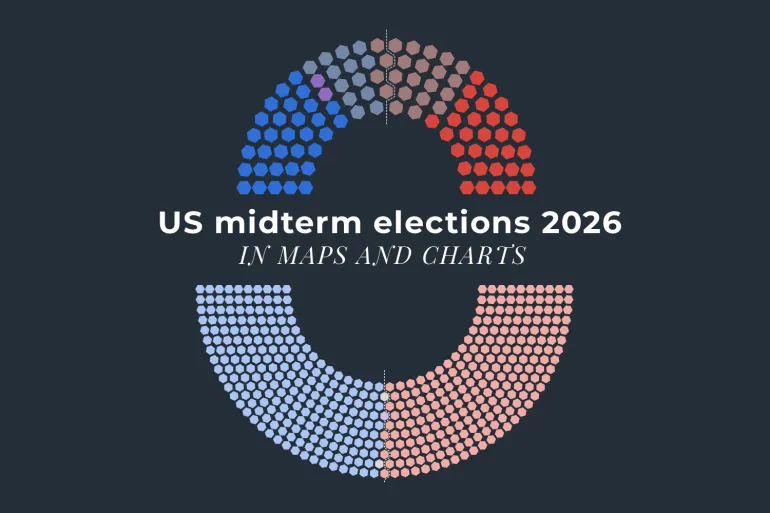
Voting behavior is often characterized by the straight-ticket trend, where voters support all candidates of a single party, heavily influencing down-ballot results. Registration numbers vary significantly by state, with California leading at 23.2 million, followed by Texas and Florida. Conversely, states like Wyoming and Vermont maintain much smaller voter populations. Demographic breakdowns, including gender and education, remain critical factors in turnout projections, which have historically averaged around 42 percent in midterm cycles since 1944. Breaks down how the elections work, which races matter and what the results could mean for either party, in this visual explainer. California, the most populous state, has 52 seats, while the least populous, such as Wyoming and Vermont, have one each. With 23.2 million, followed by Texas (17.4 million) and Florida (13.6 million), california has the most registered voters. Wyoming (278,468), Vermont (459,455) and Alaska (603,310) have the fewest.
Results will begin to surface when polls close at 6pm Eastern time (23:00 GMT), but definitive outcomes may take days or weeks as mail-in and provisional ballots are processed. This extended counting period can create a temporary perception of shifting leads known as the red mirage. Ultimately, the new Congress is scheduled to be sworn in on January 3, 2027.