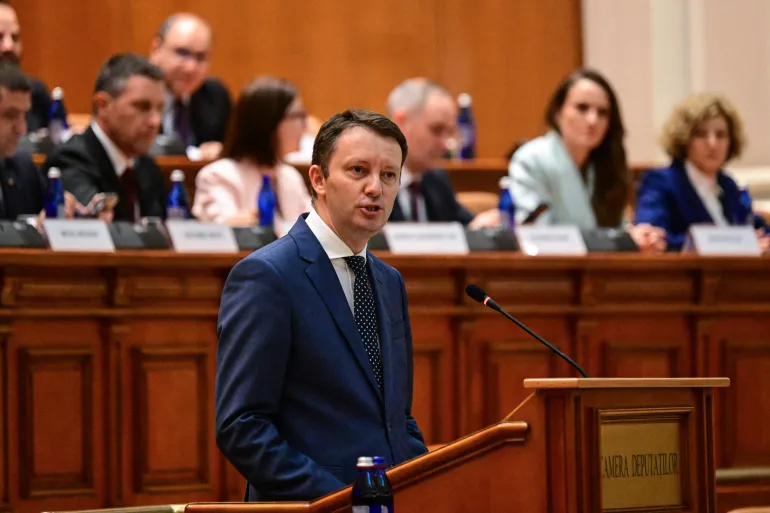
Romania faces an deepening political crisis after Prime Minister-designate Siegfried Muresan failed to win a parliamentary vote of confidence on Wednesday. Muresan, a liberal member of the European Parliament, secured only 182 votes, falling short of the 233 required to secure his position. As the third candidate nominated for the role, his defeat highlights the growing instability in the country, which has been without a stable government since the collapse of a pro-European coalition in May following the ousting of former Prime Minister Ilie Bolojan.
Muresan had proposed a “reform-oriented” governing agenda supported by a coalition consisting of the centre-right National Liberal Party, the Save Romania Union, and the ethnic Hungarian UDMR party. However, the far-right Alliance for the Union of Romanians largely boycotted the vote. This faction, which now occupies approximately one-third of the legislature, has threatened to pursue the impeachment of President Nicusor Dan if he fails to trigger early elections. Which teamed up with the Save Romania Union party, or USR, and the small ethn, the 45-year-old had proposed what he described as a “reform-oriented” governing programme under his centre-right National Liberal Party (PNL).
President Dan has announced plans to meet with parliamentary leaders before naming another candidate on Monday afternoon, specifically aiming to prevent the country from heading to the polls. Romania has not conducted snap elections since the 1989 fall of communism, and the prospect of such a move poses significant risks. Analyst Cristian Pirvulescu warned that early elections would likely produce a deeply fragmented legislature while further emboldening the far-right movement.
The logistical impact of a snap election would be significant, as Pirvulescu noted that it would take approximately four months to finalize a new government once the process begins. This potential vacuum is particularly concerning given the nation’s fragile economic condition. With a population of 19 million, Romania has been battling the European Union’s highest rates of inflation and public deficits for several months.
Given the nation’s strategic position as a NATO and EU member bordering Ukraine, international observers are closely watching the volatility. Pirvulescu emphasized that the ongoing political instability places the country in a precarious economic position, stating that a four-month transition period is an exceptionally long time to wait for a resolution during such a critical period.