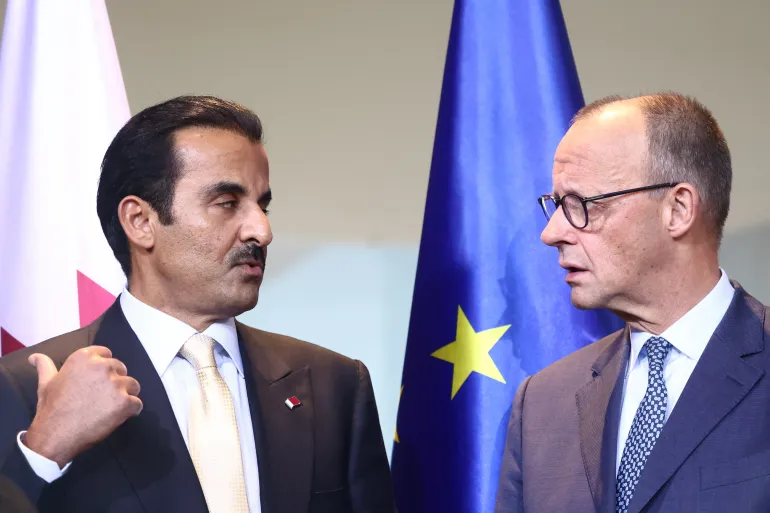
Qatar’s Emir Sheikh Tamim bin Hamad Al Thani has arrived in Berlin to solidify a growing strategic alliance with Germany, marking a departure from a relationship that was once primarily defined by commercial interests. During his visit, the Qatari leadership committed an additional 15 billion euros, approximately $16.5 billion, toward new investments in Germany. While the two countries agreed to work together to improve protection against cyberattacks, he also expressed Germany’s interest in developing defence industry partnerships with Qatar. He also described Germany as an important partner.
German Chancellor Friedrich Merz welcomed the commitment, noting that these funds are earmarked for strengthening cooperation in key sectors, including artificial intelligence, computer chip manufacturing, and aviation. The two governments also reached a consensus to enhance their collaborative efforts in defensive technology and cyberattack mitigation.
Regional security dominated the diplomatic agenda, particularly the ongoing conflict involving Iran and the subsequent disruption of shipping lanes through the Strait of Hormuz. Chancellor Merz praised Qatar’s role as a mediator between Tehran and Washington, emphasizing the necessity of reopening the strategic maritime passage and urging Iran to cease its nuclear development program. According to a joint statement by both countries, their meeting on Friday covered efforts to end the Iran war and restore maritime traffic through the Strait of Hormuz. According to Qatar’s state news agency, QNA, sheikh Tamim told Steinmeier on Friday that Qatar wanted the first round to take place.
President Frank-Walter Steinmeier held separate discussions with the emir, proposing a dedicated regional security conference for the Middle East to facilitate trust-building among local governments. In response, the emir extended an invitation to the president for the Doha Forum, scheduled for December 5–6, where global stakeholders can further deliberate on security proposals. An international policy conference in Qatar on December 5–6, to discuss the proposal further with other countries, the emir invited him to the Doha Forum.
Regarding the path to peace, Sheikh Tamim maintained that progress requires a political agreement, asserting that dialogue remains the only viable mechanism for achieving sustainable security. This diplomatic push builds upon a formal 2023 agreement to launch strategic consultations between the two nations, a process the emir is keen to initiate immediately.
Experts observe that this evolution in ties stems from shared contemporary security vulnerabilities. Sheikha Alanoud bint Hamad Al Thani, a fellow at the Middle East Council for Global Affairs, noted that the pivot toward a strategic dialogue is driven by mutual concerns over threats such as drone attacks and hybrid warfare, which have increasingly impacted both European and Middle Eastern interests.