Mass protests have erupted across multiple European nations as citizens take to the streets to voice frustration over the escalating cost of living, housing shortages, and cuts to public services. These demonstrations, ranging from student-led initiatives to union-backed strikes, underscore deepening economic insecurity across the continent.
In France, the Ministry of Interior reported that 82,500 people participated in Saturday’s nationwide demonstrations, with 21,500 gathering in Paris.
These figures represent a decline from the 106,000 recorded the previous weekend, though organizers contested the official count, estimating a turnout of 150,000.
These protests mark the sixth consecutive weekend of activity, tracing their roots to September student demonstrations that eventually drew in trade unions and the Yellow Vests movement. The protests, now in their sixth consecutive weekend, began in September with students demanding better schools before expanding to include trade unions and the Yellow Vests, a movement that emerged in 2018 over rising fuel prices and living costs.
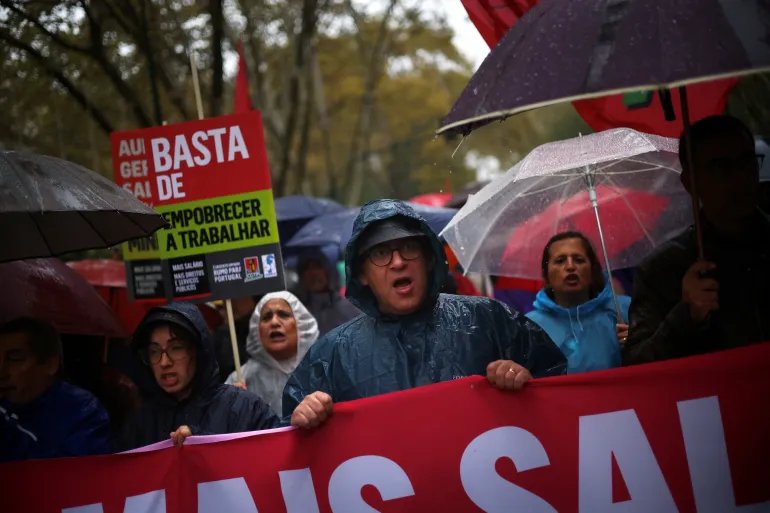
Beyond economic grievances, French protesters have focused their anger on reports of police violence and a controversial new law that increases legal protections for officers who discharge firearms. Meanwhile, in Portugal, thousands braved heavy rain in Lisbon to demand higher wages, expanded pension benefits, and more affordable housing. The rally was spearheaded by the CGTP, the country’s largest trade union federation.
Housing affordability has become a flashpoint in Portugal, where property prices have more than doubled since 2017. Economic data from Eurostat reveals that average annual earnings in 2025 remained 37 percent below the European Union average, exacerbating the financial strain on households.
The wave of unrest extends to Italy, where a massive strike on Friday—organized by the CGIL trade union—impacted transport, education, and healthcare sectors. Union leader Maurizio Landini claimed that more than one million people took part in demonstrations across 100 cities. Similar actions unfolded in Germany, where the youth campaign Gen Z regelt—meaning “Generation Z takes charge”—coordinated protests in 73 locations, alongside a gathering of 4,000 in Berlin.
Further North, Helsinki saw a march of approximately 200 participants organized by student and left-wing groups. Organizers of an international youth strike indicated that coordinated actions were planned across at least 25 countries. Their demands are diverse, spanning calls for greater education funding and climate policy to opposition against compulsory military service. Education and future opportunities, although their demands and scale differ considerably between countries, the gatherings reflect overlapping concerns about economic insecurity. Others grew out of established national campaigns, bringing different groups onto the streets over concerns about living standards and government spending, while some protests were linked through the international youth initiative.
In a separate development, thousands of people protested in Zagreb, Croatia, on Saturday. The demonstration was prompted by the death of a man in a psychiatric hospital, an incident that has led to an ongoing investigation into four medical technicians suspected of aggravated murder.