Visitors entering the Museum of Contemporary Art in Sydney are met with a curious collection of industrial fans, glowing light arrays, and mechanical speakers. This installation forms the core of Philippe Parreno: 5 Moons, the French artist’s first major exhibition in Australia. The title references the five lunar cycles over which the show will run, ending on April 26, 2027. There are several expensive looking lamps; a massive industrial fan; a couple of speakers; marquee-style lights; a glowing assemblage of power adapters. Taken by itself, it’s deceptively underwhelming – a spectacle without a story, as an installation. At the MCA, Parreno has created a series of connected environments across the museum’s three levels, featuring works made over his four-decade career. His ecosystems risk seeming frustratingly opaque or worse, inane, backstory is important for Parreno’s art: without it. Without narrative, thanks to their aesthetic or mise en scene, some parts of the MCA exhibition stand alone.
Parreno, a figure long celebrated for his imaginative takeovers of institutions like the Palais de Tokyo and the Tate Modern’s Turbine Hall, treats the exhibition itself as his medium. Rather than static pieces, he constructs holistic ecosystems. Within these spaces, items respond to one another in unpredictable ways, leaving the audience to navigate a environment that feels almost supernatural. These spaces feel like haunted houses; machines operated by ghosts or powered by supernatural energy.
The invisible hand guiding these displays is located 17,000km away. Sensors placed on an abandoned almond farm in Spain’s Tabernas desert—a landscape famous as the filming location for classic spaghetti westerns—track real-time environmental data including wind speed, temperature, and humidity. An algorithm translates this information into physical changes within the Sydney gallery, modulating the lighting, airflow, and soundscapes. A silvery light slides up and down a pole, at the back of the gallery.
In a third-floor gallery, an 11-hour film features footage shot at the Spanish farm. The immersive experience allows viewers to witness the passage of time under the desert moon. Soundscapes from the remote location are broadcast live into the room, creating a surreal blend where nocturnal Spanish insect noises might occasionally mingle with the faint, distant sounds of Sydney Harbour. And there’s a low hum of machine noise, overlaid with bird song and distant barking, the bulbs are flickering erratically. A giant luminescent cuttlefish gazes out impassively from a screen, its fins and arms gently undulating, as ambient electronic noise emanates from large swiveling speaker banks, on another floor. Visitors can, if they choose, sit and watch a night pass under the Spanish moon. Making for an uncanny mix: during my visit, nocturnal insect noises from Spain are punctuated by the toot of an ocean liner docked outside in Sydney Harbour, live sound from this terrain is also played in the gallery.
Explaining his philosophy, Parreno states, “What I normally try to do for exhibition is to try to create sort of a milieu, or an ecosystem, where things are responding to each other.” He notes that his own family history traces back to the same Spanish region before migrating to Algeria, where he was born.
Fiction remains a cornerstone of his work.
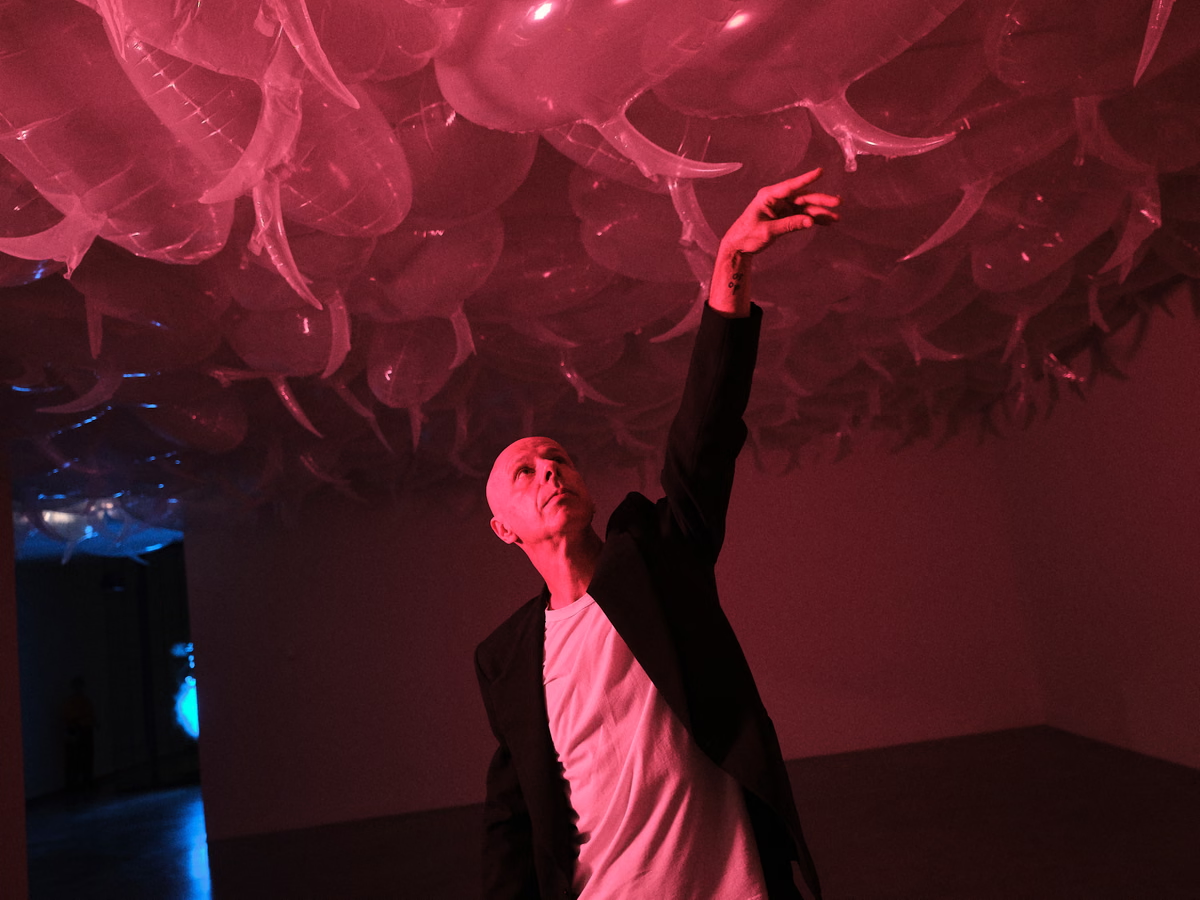
While some installations, such as a room filled with helium-charged speech-bubble balloons, are visually arresting, they gain depth when the viewer understands the context—in this case, lighting sequences acting as Morse code for a narrative by René Daumal. Upstairs, there’s an orange-carpeted gallery populated by floating, helium-filled, fish-shaped balloons in citrus tones, in which a grand piano plays an enigmatic score.
During his famous 2016 Turbine Hall project, Parreno utilized the biodata of yeast from a hidden laboratory to influence the space, once noting that much of his output requires the audience to “endorse a fiction.” Staring at a perplexing assortment of objects, i ’m standing in a massive white-cube space. His 2016 takeover of the Tate’s Turbine Hall, delighted some and frustrated others, parreno’s most famous artwork.
This reliance on narrative is not merely a stylistic choice but a philosophical inquiry into how human perception transforms a subject. When presenting an earlier version of the 5 Moons film in Munich in 2024, Parreno asked how we might address landscapes in the face of climate change, positing whether it is humanity transforming the earth or the earth watching us in return. It’s deeply philosophical, and 5 Moons is underpinned by ideas of how our perceptions of a thing change it; how the way we imagine land, by knock on effect, influences and, his interest in fiction is more than a gimmick. According to when Parreno showed an earlier iteration of the 5 Moons film at Munich’s Haus der Kunst in 2024, he, The work was designed to feel as if the land was “speaking to you”. “With the ways climate change is changing the w.
Reflecting on his career trajectory, Parreno recalls the revolutionary fervor of his early work in the late 1980s and 90s, when his goal was to produce a new reality and change the world. Today, his focus has shifted toward creating rare, unburdened spaces. In a world defined by the pressure to respond to constant external signals, Parreno aims to provide an environment where visitors are free to let their attention drift, unscripted by the demands of the system. And you spend the time you want.”, you just float with your own attention.