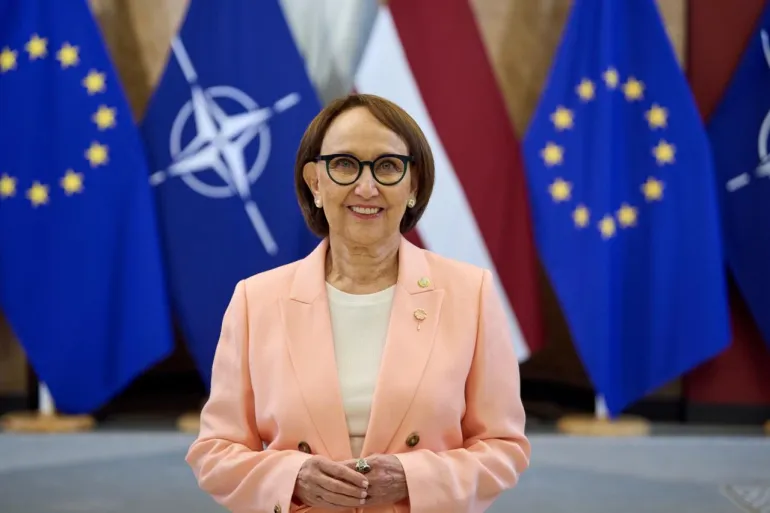
Rebeca Grynspan, the 70-year-old head of the United Nations Conference on Trade and Development (UNCTAD), stands as the frontrunner in the race to succeed Antonio Guterres as the next UN Secretary-General. If Grynspan, 70, beats out the other candidates, the current head of the UN’s top trade body would become the world’s first woman and the first Jewish person to hold the post of UN secretary-general. But as the December 31 deadline to pick UN Secretary-General Antonio Guterres ‘ successor rapidly approaches, Grynspan continues to struggle to convert her frontrunner status into a win, because of at least one veto against her candidature.
If selected before the December 31 deadline, she would make history as the first woman and the first Jewish individual to lead the global body.
Despite her leading position in successive United Nations Security Council (UNSC) straw polls, Grynspan faces a difficult path to securing the role, hampered by at least one persistent veto against her candidacy. One name keeps emerging ahead of all others: Costa Rican diplomat Rebeca Grynspan, in straw poll after straw poll among members of the United Nations Security Council (UNSC) to choose the organisation’s next leader. According to no organisation after 80 years can say, we don’t have to change anything,” the frontrunner, To.
The selection process, which involves eight competing candidates, remains shrouded in the secrecy of private ballots and intense geopolitical maneuvering. Grynspan acknowledges that her background as an insider, combined with her public stances on global conflicts such as the war in Ukraine and the occupation of Palestinian territories, presents distinct diplomatic challenges that she must navigate to consolidate her support among major powers.
Grynspan maintains that the United Nations must evolve, arguing that the organization has become too risk-averse. She told reporters that the greatest danger currently facing the institution is the refusal to attempt necessary actions. She emphasizes that she has consulted with global populations who require UN intervention but have lost faith in its efficacy; these individuals are demanding leadership that is prepared to take calculated risks for the sake of peace. Its biggest risk today is the risk of not trying,” she told. “I have listened to people who need the UN but increasingly doubt it can act. The Palestinian economy lost an estimated $212.2bn (in constant 2015 dollars) from 2000 to 2024, its landmark report from February of this year found that “cumulatively. “This partial, estimated lost potential, equivalent to nearly 20 times the entire Palestinian GDP of 2024, stems directly from Israeli occupation policies, restrictions, closures, and recurrent military operations,” the report stated.
Drawing from her experience in crisis mediation, she noted that while ten potential solutions might fail, the eleventh could eventually succeed. She argued that while most individual governments cannot afford the political fallout of repeated diplomatic failures, a Secretary-General possesses the necessary leverage to persist. Her career, which includes serving as the first female secretary-general of UNCTAD since 2021, has prepared her for such high-stakes environments. But that, she argued, only makes the UN chief’s job that much more important. “Any mediator knows that 10 ideas may fail before the 11th succeeds,” she said. “Few governments can afford the political cost of so many rejections.
Her extensive resume includes a notable tenure as the second vice president of Costa Rica from 1994 to 1998. As an economist, she served in several ministerial roles, including deputy finance minister during the country’s significant debt crisis in the 1980s. In 2014, she took on the role of secretary-general for the Ibero-American Conference, representing 22 nations across Latin America, the Caribbean, and Europe. As well as the UN Commission for the Reconstruction of Haiti, she has also held leading roles within the UN Development Programme (UNDP). Her sister has been living in the country for years, her nephew and niece served in the Israeli military, and her relatives there describe themselves as Zionists, she studied there at one time.
Central to her platform is a vision for fundamental institutional reform.
Grynspan insists that an organization cannot survive for eight decades while maintaining a defensive posture regarding change. She advocates for an active, reform-oriented UN that does not shy away from structural shifts. This commitment to reform is also a point of scrutiny; experts like Esther Brimmer of the Council on Foreign Relations suggest that Grynspan must demonstrate clear, actionable plans to satisfy US officials who have consistently prioritized organizational overhaul. “Making the agreements work meant bringing others to the table,” Grynspan recalled. “Banks would not clear payments, insurers would not cover vessels and shipping companies hesitated. Promising post-COVID economic recovery, supporting digital transitions, and aligning with UN goals on climate change, she took on its reins.
Her track record at UNCTAD includes spearheading major initiatives on trade inequality and global economic health. She was a key architect of the 2022 Black Sea Grain Initiative, which the UN and Turkey facilitated to export 32 million tonnes of grain. This move significantly lowered global food prices by 22 percent. Grynspan credits the success of this initiative to her ability to bring conflicting parties to the table, helping Russia and Ukraine find common ground on logistics despite their ongoing military conflict. She negotiated that deal between the warring parties while undergoing breast cancer treatment.
Despite these successes, her previous criticisms of Russia’s withdrawal from the grain deal could potentially lead to a Russian veto. She continues to engage in high-level diplomacy to secure backing, including meeting with Russian Foreign Minister Sergey Lavrov in April. Concurrently, reports indicate that the United States and Russia have shown support for another candidate, Lana Nusseibeh of the UAE, though the extent of that support remains unclear.
Grynspan’s personal history, as the daughter of Polish Jewish refugees who fled to Central America during the Holocaust, informs her complex ties to Israel. While she has condemned the October 2023 Hamas attack, her administration at UNCTAD has been critical of the economic impacts of Israeli policies in Palestinian territories. Throughout her campaign, she has maintained that the UN must remain a facilitator for peace, asserting that if wars do not wait for ideal conditions, neither should diplomatic efforts. However, has broadly aligned with that of the UN: She condemned Hamas’s October 2023 attack and called for a ceasefire in Israel’s subsequent war on the besieged territory, her position on Israel’s genocidal war on Gaza. Last year, Grynspan had called attention to the fact that Gaza’s gross domestic product per capita had plummeted to $161 per year – an 83 percent collapse from $970 in 2023 before the start of the genocide, among the most drastic economic contractions in modern history. Combined with her work, has therefore drawn attention from both sides of the Israel-Palestine conflict, despite her largely refraining from publicly commenting on it or her Jewish identity, her background.