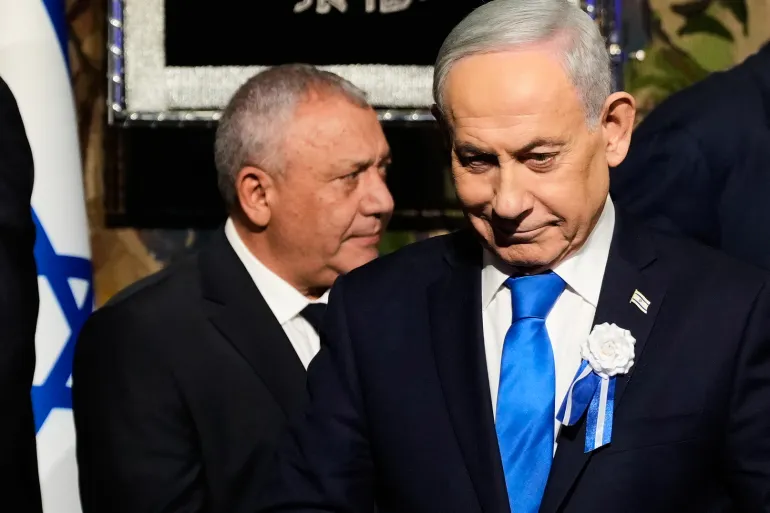
Caretaker Prime Minister Benjamin Netanyahu has formally renewed his appeal to opposition leader Gadi Eisenkot to join a national unity government. Netanyahu, who currently leads the country in a caretaker capacity, framed the proposed coalition as a critical necessity for Israel’s national security. However, both served in the government formed in 2021, when Ra’am became the first Arab party to formally join an Israeli governing coalition.
Following a meeting between the two leaders on Thursday, Netanyahu stated in a video release that their discussion “only strengthened the conviction that it is essential to form a national unity government.” He asserted that such a coalition could effectively “eliminate the Iranian threat once and for all,” further claiming that Tehran would not hesitate to deploy nuclear weapons against Israel.
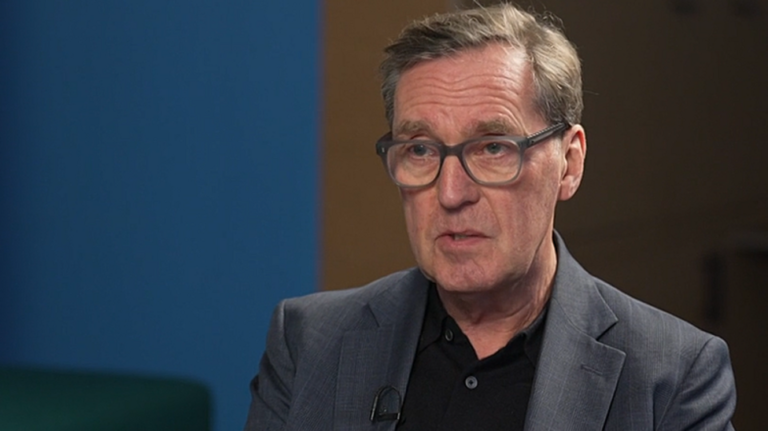
Eisenkot, head of the Yashar party and currently tasked by President Isaac Herzog with forming the next government, flatly rejected the invitation, labeling it a “bluff.” He told reporters that the proposal was a mere trick that would not deceive him or the Israeli public. Despite his vocal opposition to the idea, Eisenkot confirmed that representatives from Yashar and Netanyahu’s Likud party are scheduled to engage in formal discussions regarding the potential for a shared government. Experts say, that gives him an incentive to exploit divisions among Eisenkot’s potential partners and wait for his mandate to run out.
The current parliamentary math presents a complex landscape following the October 27 election. The four-party bloc spearheaded by Eisenkot holds 48 of the 120 Knesset seats, while Netanyahu’s alliance of right-wing and religious parties secured 53. The remaining 19 seats are occupied by two Palestinian-led factions, the Joint List and the United Arab List, or Ra’am. How do the numbers in the Knesset add up.
Last week, the Eisenkot bloc demonstrated its legislative potential by securing a 63-to-50 vote to establish an Arrangements Committee, which manages the parliamentary agenda during the coalition-building period. The bloc subsequently moved to form temporary committees focused on defense, foreign affairs, and finance.
Political experts suggest multiple paths for forming a government, though each faces significant hurdles. One option involves a coalition between the Eisenkot bloc and the two Palestinian-led factions, which combined command 67 seats. Alternatively, a minority government backed by Ra’am’s eight lawmakers could theoretically provide Eisenkot with 56 votes, provided the Joint List’s 11 members abstain. Six more than needed for an outright majority, eisenkot’s bloc and the two Arab-led factions hold 67 seats combined. But it would depend on how all three groups voted, that would allow a government to take office with fewer than 61 votes in favour.
Internal friction remains a major obstacle for Eisenkot. While Yair Golan of the Democrats is open to Palestinian-led support, Naftali Bennett and Avigdor Lieberman have historically resisted such alliances. Yasser Manna, a researcher at the Jerusalem Center for Studies on Israeli Affairs, noted that this resistance restricts Eisenkot’s options but does not necessarily guarantee a unity government with Netanyahu. “Nice try, but these tricks don’t work on me. So what, if anything, would it take for them to govern together, and what other options does Eisenkot have.
Another potential scenario involves Eisenkot’s bloc integrating with Shas and United Torah Judaism, the ultra-Orthodox parties currently aligned with Netanyahu. However, this path is complicated by demands for legislation that would exempt seminary students from military service—a measure Eisenkot and his allies largely oppose. Meanwhile, President Herzog has set a December 6 deadline for Eisenkot to present a government, with a possible 14-day extension available. Advisers from one faction of United Torah Judaism have reportedly sought a written commitment from all 48 lawmakers in Eisenkot’s bloc to pass a law exempting Jewish religious seminary students from military service and. Which would take the deadline to December 20, herzog can grant an extension of up to 14 days. Instead, it increases the importance of negotiations with other parties, particularly the ultra-Orthodox parties.”.
Eisenkot has signaled that his door remains open to members of the Likud Party and Bezalel Smotrich’s Religious Zionist Party, provided they support his leadership and platform. “If members of Likud and the Religious Zionist Party truly believe this is a time for unity, I cannot conceive of any reason why they would not support a government under my leadership,” Eisenkot stated.
Analysts suggest that both leaders may use these meetings as tactical leverage. Daniel Levy, president of the US/Middle East Project, remarked that the coalition-formation period is often characterized by political spin aimed at gaining advantage, where leaders meet to appear reasonable before blaming the other side for impossible demands.
The historical context between the two men adds further complexity. Having served as military chief from 2015 to 2019 and as an observer in Netanyahu’s war cabinet for eight months during the Gaza conflict before resigning in June 2024, Eisenkot shares similar security-oriented priorities with the Prime Minister, even amidst a profound crisis of trust. He left the emergency government in June 2024.
A critical test for the current political atmosphere arrives on Tuesday, when Eisenkot’s allies intend to replace Knesset Speaker Amir Ohana, a Likud member, with Yashar’s Matan Kahana. Eisenkot has challenged Netanyahu and Smotrich to support the move, characterizing their response as a litmus test for their stated desire for cooperation.