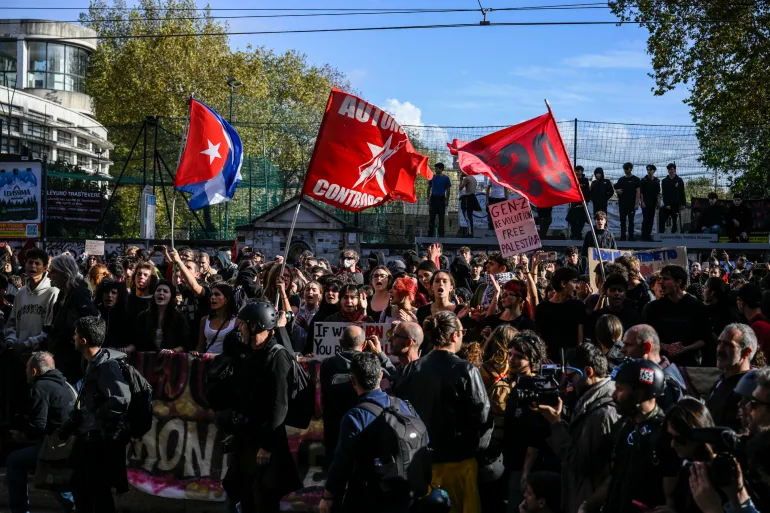
A wave of public discontent is sweeping across 25 European countries, as protesters take to the streets to challenge political leaders over issues ranging from soaring living costs and climate policies to increased military expenditure. The demonstrations, which reflect deep-seated frustration among younger generations, signal a mounting pressure on governments accused of ignoring public concerns.
These protests are largely inspired by recent mass movements in France, where unrest has persisted since September. French authorities and labor organizers have reported significant turnout, with the Interior Ministry estimating 146,000 participants nationwide on Tuesday, while the CGT trade union claimed the figure exceeded 500,000. According to on Tuesday, France’s Interior Ministry, A total of 146,000 people took part in protests across the country, with 28,000 in Paris alone.
Italy emerged as a major epicenter of the unrest, where tens of thousands participated in strikes across more than 100 cities. The action, led by the CGIL trade union, impacted both private and public sectors, including healthcare and education. Maurizio Landini, the union’s leader, stated at a Rome rally that the demand for societal change is growing among ordinary citizens.
Tensions in Italy escalated as demonstrators in Rome targeted the Ministry of Education with debris, while confrontations with police were reported in Bologna. In Milan, protesters burned effigies representing United States President Donald Trump and Israeli Prime Minister Benjamin Netanyahu. These demonstrations follow a tense period marked by a mid-October mobilization that saw clashes, leading the government of Prime Minister Giorgia Meloni to authorize increased security measures and military deployments. The Italian rallies followed a nationwide mobilisation on October 17 that descended into rioting and looting and prompted the right-wing government of Prime Minister Giorgia Meloni to approve sweeping security measures.
Critics within the political sphere have targeted the current administration’s fiscal path. Elly Schlein, who heads the centre-left Democratic Party, argued that the 2027 Budget Law lacks a coherent vision for the nation’s future, specifically criticizing cuts to education and public healthcare funding while industries remain unsupported.
Meanwhile, activism intensified across other regions. In Germany, the advocacy group “Gen Z regelt” coordinated actions across 73 cities. A significant rally in Berlin drew approximately 4,000 participants to Alexanderplatz, while thousands gathered in Cologne. Protesters largely focused their calls on increased education funding and expressed strong opposition to potential mandates for compulsory military service. According to meanwhile, in Germany, campaign group “Gen Z regelt” (German for “Gen Z sorts it”), It was organising protests in 73 cities and towns. In Berlin, roughly 4,000 people attended a protest in the city’s Alexanderplatz square.
The push for shifting national priorities was also evident in Austria and Croatia. In Vienna, authorities used pepper spray and made multiple arrests to disperse a student-led demonstration that demanded lower weapons spending in favor of academic investment. Similarly, students in approximately a dozen Croatian cities staged boycotts and protests to advocate for housing, education, and public service resources. With opposition to higher military spending also emerging as a rallying cry, student groups have since continued protests and occupations at schools and universities.
Underlying the widespread unrest is a sharp economic disparity tracked by official statistics. Data from Eurostat indicates that the cost of essential goods—including food, transport, and energy—has surged between 59 and 78 percent since 2000 across France, Italy, Spain, and Portugal. When adjusted for inflation, real wages for full-time workers in Italy have actually declined by nearly 5 percent over the last 25 years. The average full-time wage in Italy fell by almost 5 percent between 2000 and 2025, once inflation is taken into account.
In contrast, wage growth has remained stagnant or marginal elsewhere; OECD data adjusted by Eurostat shows that real wages grew by only 7 percent in Spain, 11 percent in France, and 20 percent in Portugal during the same quarter-century period.