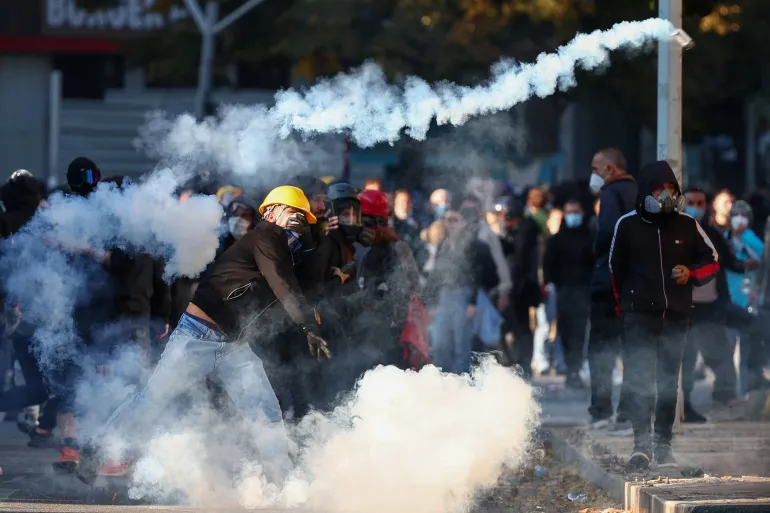
Tirana has experienced six consecutive days of intense unrest as demonstrators take to the streets to demand the resignation of Prime Minister Edi Rama. The fourth-term leader has remained steadfast in his refusal to step down, maintaining a tense standoff with thousands of citizens. On Sunday, crowds converged near the Ministry of Education, shouting slogans against the Prime Minister before being met with rubber bullets, tear gas, and water cannons deployed by law enforcement to disperse the gathering. Who is serving his fourth term, ruled out resigning, violent protests have rocked Albania’s capital Tirana for the sixth consecutive day as Prime Minister Edi Rama.
The scale of the unrest has strained the city’s infrastructure, with businesses and state institutions boarding up windows with metal shutters. City maintenance crews have also removed paving stones from public walkways, a move intended to prevent protesters from using them as projectiles during the ongoing confrontations.
Addressing the nation during a live social media broadcast on Sunday, Rama characterized the unrest as an event that does not challenge the government’s core authority. He suggested that the instability could hinder Albania’s aspirations for European Union membership by 2030, questioning whether the public prioritizes current protest activities over national integration goals. Despite his firm stance, he signaled a willingness to negotiate student concerns regarding the financial burden of education. Albania is hoping to achieve membership status by 2030.
Journalist Lindita Karadaku noted that the situation remains highly unpredictable, with neither the protesters nor the government showing signs of backing down. According to lindita Karadaku, a journalist for Albanian news outlet TV Klan,, On Sunday that it was difficult to see how the unrest could unfold or how long it could last.
According to political analyst Mentor Nazarko, Rama’s perceived inability to grasp the gravity of the situation has left a void in leadership.
Nazarko noted that the Prime Minister has effectively lost his political legitimacy, leaving the police force as the only barrier between him and the public—a force he describes as poorly paid and susceptible to corruption.
Health officials confirmed that 65 people sustained injuries during Sunday’s encounters, including 37 police officers, with 12 individuals requiring hospitalization. Cumulative figures since Tuesday indicate that 272 people have been injured, a tally that includes 169 members of the police force. Prime Minister Rama has blamed the escalation on external influences, though he maintains his administration is actively working to mitigate systemic corruption. “Prime Minister Rama is determined and has made it very clear that he will not resign, but also the young people who are protesting are determined and make it clear that they will not give up so easily,” she said. “At this moment, no one is clear what tomorrow will bring.”. “Albanians need to think very clearly,” Rama said. “Do they want this, or do they want the EU?”.
The current volatility follows a broader trend of public dissatisfaction that began earlier this year. Known as the “Flamingo Revolution,” the initial movement emerged in May, driven by widespread opposition to a luxury tourism project in southern Albania linked to Jared Kushner, son-in-law of US President Donald Trump. Protesters are currently focused on a multifaceted agenda, calling for job creation, improved education standards, and an end to government corruption.