A detailed intelligence investigation has surfaced evidence indicating that Russian military satellite assets are being utilized to assist the Iran-aligned Houthi movement in executing precision strikes against targets inside Saudi Arabia. The findings illuminate an increasingly sophisticated intelligence apparatus supporting the Yemeni armed group amidst ongoing regional warfare. According to why can’t Saudi Arabia, the most powerful of the Gulf, Is backed by the US, hold back a group of rebel fighters. “It is increasingly moving beyond its domestic dimensions and becoming intertwined with wider regional dynamics.
Hostilities between the Saudi-backed, internationally recognized government of Yemen and the Houthi movement have persisted for years. However, recent technical assessments highlight a major evolution in how the Houthis acquire battlefield intelligence and execute deep strikes into neighboring territory. Last week, the Saudi Foreign Ministry’s deputy minister for public diplomacy, Rayed Krimly, told reporters that the Houthis receive intelligence from Russia and China. “We do discuss these matters regularly with China and Russia, and we will continue to do so,” he had said.
Investigative Details on Satellite Integration
An investigation originally reported by The Associated Press revealed that between July 1 and October 19, the firm AURORA Geosignal Intelligence evaluated 40 distinct missile and drone strikes conducted by the Houthis against Saudi Arabia. In every single analyzed instance, analysts detected clear patterns involving Russian government satellite activity aligned with the attack timelines. The bottom line is that the Houthis are benefitting from increasingly diversified external support involving several countries,” he added.
Nawaf Obaid, the founder of AURORA Geosignal Intelligence, explained to that his firm reconstructed Moscow’s military orbital infrastructure to reach these conclusions. By calculating orbital trajectories and establishing direct observation windows, the researchers identified specific spacecraft involved in gathering intelligence over the Arabian Peninsula. The extent of that preparation has become evident over the past few weeks.
Identified Orbital Spacecraft
The investigation pinpointed several distinct Russian government space platforms operating in coordination over the region
- Bars-M SeriesDedicated military mapping satellites used for high-resolution topographical intelligence.
- Persona PlatformsHigh-altitude optical reconnaissance systems designed for detailed photographic intelligence.
- Lotos-S1 SpacecraftSpecialized electronic intelligence (ELINT) gathering platforms.
- Pion-NKS UnitsMaritime reconnaissance systems capable of tracking naval movements and coastal positions.
- Kondor-FKA SpacecraftAdvanced radar-imaging satellites providing all-weather surface surveillance.
Speaking on the operational synergy of these orbital platforms, Obaid noted that “the critical finding was not the presence of individual Russian satellites, but the sequencing and integration of their complementary intelligence capabilities,” emphasizing how raw data is merged across multiple domains.
Impact on Regional Infrastructure and Battlefield Dynamics
Obaid confirmed to that the technical evidence points to a broader cooperative network. According to his assessment, “Russian military geospatial and signals intelligence has supported the Iranian-led intelligence architecture assisting Houthi operations in Yemen.” These developments point to a broader expansion of Russian engagement with the group,” he added, taken together.
This integrated intelligence network has produced measurable operational results on the ground. A primary example cited by researchers includes the sustained Houthi push along the western coast of Yemen toward the strategic Bab al-Mandeb strait. In that sector, the fusion of Russian orbital intelligence, Iranian command structures, and local ground observers directly precipitated “the rapid deterioration of opposing Yemeni forces’ battlefield coordination.” I don’t think that distinction is important.
Obaid stressed that high-level space capabilities provide distinct tactical advantages, noting that Russian military reconnaissance provides capabilities far beyond ordinary commercial satellite imagery, particularly when optical, radar and electronic intelligence are integrated.
Petroline Pipeline Attack Case Study
The operational precision of this intelligence loop was highlighted during major strikes against Saudi energy infrastructure. “The September attacks against Saudi Arabia’s East-West Petroline illustrate the sophistication of the targeting problem,” Obaid observed during his technical breakdown of the strikes. Forcing the postponement of Saudi Arabia’s flagship investment conference until 2027 and disrupting travel plans for thousands of passengers, the attacks led to the airport’s temporary closure.
During that operation, Houthi long-range assets precisely hit three separate pumping facilities along the pipeline network
- Pumping Station 8 (PS8)Located near Afif.
- Pumping Station 9 (PS9)Situated at Al-Dhekra.
- Pumping Station 11 (PS11)Positioned at Al-Mesba’ah.
All three hit facilities were located within the pipeline’s critical high-elevation western section. Assessing the selection of these assets, Obaid noted that “their selection reflected an understanding of the infrastructure’s engineering vulnerabilities and strategic importance,” demonstrating access to granular structural intelligence.
Analytic Debates Over Transfer Mechanisms
Independent military experts have weighed in on the wider implications of the AURORA report while debating how the data actually reaches frontline units. Brussels-based defense analyst Elijah Magnier remarked that while the technical correlations are compelling, they do not automatically clarify the exact supply chain of the satellite data. They also examined the EKS/Tundra infrared early-warning constellation.
“Inability to intercept an intelligence transmission doesn’t establish who had access to the Russian satellite information, whether Russia deliberately shared it, or whether Iran obtained it independently,” Magnier explained. He outlined multiple potential pathways for the data flow
- Direct State TransferMoscow may have chosen to directly supply target data to Iranian intelligence units.
- Commercial AcquisitionTehran could have procured specialized imagery via secondary commercial agreements or satellite imagery vendors.
- Intermediary NetworksIranian intelligence might have accessed the data through third-party cutouts or indirect intelligence partners.
- Cyber OperationsIranian cyber units could theoretically have intercepted or exfiltrated raw Russian orbital streams without direct state authorization.
However, Obaid emphasized that establishing the broader presence of a multi-tiered intelligence relationship remains the essential takeaway, even as specific transmission methods remain shielded by operational security.
Strategic Asymmetry in the Yemen Conflict
The revelation of advanced space-based intelligence aiding the Houthis underscores severe structural shortcomings within opposing military forces. Despite purchasing tens of billions of dollars in modern Western weaponry, Saudi-backed coalitions have repeatedly struggled to neutralize Houthi operational capabilities or secure decisive battlefield control.
Magnier pointed out fundamental flaws in the Saudi-led coalition’s strategic framework, stating that “nobody wins a war by air bombing.” He argued that massive aerial expenditures cannot compensate for ground-level deficits, adding that if ground forces lack the motivation to advance and absorb heavy losses, air superiority alone cannot alter the strategic outcome.
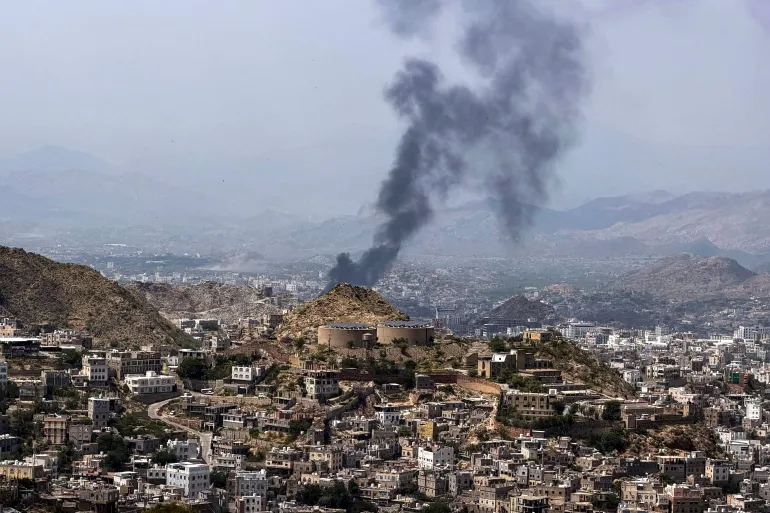
Defense analyst Saj Ahmad similarly noted that heavy financial investments in advanced hardware have failed to yield tactical proficiency against asymmetric forces. He observed that over years of conflict, Riyadh acquired extensive military hardware but demonstrated limited tactical skill in deploying those systems effectively against an elusive guerrilla force like the Houthis. Ahmad added that under persistent pressure, Saudi forces might ultimately seek an exit strategy from the combat zone, echoing the prior drawdown executed by the United Arab Emirates. According to ahmed Nagi, a senior analyst on Yemen at the International Crisis Group,, Moscow reportedly supporting Tehran’s allies like the Houthis is particularly significant because it would mean a shift in the trajectory of the Yemeni conflict. Spanning from the eastern and western coasts to the capital and southern regions, since fighting escalated over the summer, yemen’s Houthis have attacked multiple locations across Saudi Arabia. According to saree, The Houthis targeted the Ras Tanura oil refinery with a ballistic missile, an Aramco facility in Abqaiq with a missile, King Khalid International airport in Riyadh with multiple missiles, King Fahd International airport in Dammam with a drone, the Rabigh oil refinery with a ballistic missile and a Saudi military headquarters in the Najran region. According to Saudi officials, a severe strike on King Khalid International airport in Riyadh earlier this month killed at least 12 people and injured 300. An October 21 attack on King Fahd International airport in Dammam also killed two people and wounded eight. Since seizing Yemen’s capital, Sanaa, and swaths of northwest Yemen in 2014, the Houthis have demanded to be recognised as the legitimate governing authority in Yemen. According to saj Ahmad, chief analyst at StrategicAero Research,, Besides learning the art of weapons assembly, the Houthis have scoured international black markets for components and carried out many military eng. Many within the Yemeni government expected it to pave the way for a political settlement, Nagi said, when a truce between the Houthis and the Saudi-led coalition took effect in 2022 and continued until earlier this year. The Houthis gained access to large arsenals belonging to the Yemeni military and formed an alliance with forces loyal to former President Ali Abdullah Saleh, after taking the capital and state institutions. “The Houthis, meanwhile, were preparing for the possibility that the conflict would resume.