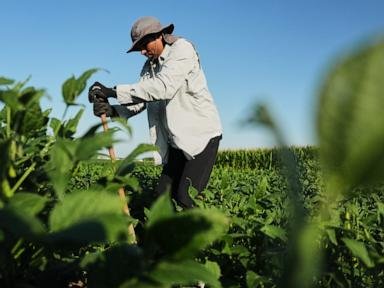
At a field site in Champaign, Illinois, researchers are evaluating a promising new approach to climate mitigation: genetically modified soybeans with specialized, deeper root systems. Research scientist Ashish Rajurkar recently demonstrated the plants’ unique structure, where roots grow straight downward rather than spreading laterally, a shift intended to help crops survive drought while burying carbon deep underground.
This initiative, led by the Salk Institute for Biological Studies, aims to address the dual challenges of food security and atmospheric carbon removal. By editing the DNA of row crops, scientists hope to capture gigatons of carbon dioxide annually, potentially mitigating the heat-trapping effects of fossil fuel emissions.
The project received a significant boost through an $18 million grant from the Bezos Earth Fund. This funding supports extensive field testing to determine plant resilience, carbon storage capacity, and the feasibility of large-scale agricultural adoption. Wolfgang Busch, director of the institute’s Harnessing Plants Initiative, emphasized the urgency of the work, stating that the current trajectory is concerning and that maintaining global food production will become increasingly difficult.
The effort follows a six-year project during which Salk researchers compiled a comprehensive encyclopedia of plant genomes, identifying 347 specific genes linked to root growth and carbon sequestration. Research professor Todd Michael explained that the team focused on leveraging natural genetic variation to create hybrids with enhanced root penetration.
Beyond atmospheric carbon, these deeper roots could offer practical benefits for farmers. Researchers hypothesize that the crops could access moisture trapped in lower soil layers during dry spells. Furthermore, they are experimenting with increasing suberin, a carbon-rich, cork-like substance in roots that decomposes slowly, ensuring carbon remains stored longer.
Environmental researchers also suggest that larger, deeper root systems could reduce fertilizer runoff, which currently triggers harmful algae blooms in aquatic ecosystems. By absorbing more nitrogen, these modified crops could help protect water quality.
Preliminary estimates suggest that one hectare of these deep-rooted soybeans could sequester an additional metric ton of carbon dioxide per year. However, the exact lifespan of this stored carbon remains subject to field validation. Initial data from experiments this fall will be critical in confirming these lab-based projections.
Testing is currently underway at multiple sites across Illinois, Missouri, Kansas, and Iowa. At the University of Illinois Urbana-Champaign, scientists are using specialized rain-exclusion canopies and underground sensing equipment to monitor root growth and soil carbon in real-time under simulated climate stress.
A 2025 study co-authored by Busch suggests that if these deep-rooted varieties of soybean, corn, cotton, and canola were widely adopted, they could sequester approximately one gigaton of carbon dioxide annually by 2040. Because these crops utilize existing agricultural infrastructure and land, researchers believe that rapid adoption is possible if the seeds prove beneficial to farmers.
Busch noted that the success of such agricultural technology often hinges on corporate interest. He pointed to the rapid industry adoption of herbicide-resistant crops as a model for how quickly beneficial innovations can spread. While acknowledging the need for more testing regarding crop yields and trade-offs, he stressed that accelerating the development of these solutions is a race against critical environmental tipping points. The report also notes that which slope straight down instead of out to the side like typical soybean plants, he knocks away pieces of earth from the plant’s roots. The report also notes that driving human-caused climate change, carbon dioxide released by burning fossil fuels traps heat in the atmosphere. The report also notes that for years, scientists have explored ways to remove some of that carbon from the atmosphere, including through direct air capture, changes to ocean chemistry so seawater can absorb more carbon, and reforestation. The report also notes that an $18 million grant from the Bezos Earth Fund will help Salk researchers test those questions in the field by measuring how resilient these plants are to drought and other climate stressors, how much carbon they can store and for how long, and how to get the plants onto farms at scale. The report also notes that “We are actually steering in a direction that is very concerning,” he said. “It will become harder to grow enough food for enough people.”. The report also notes that “We wanted to leverage the natural variation of a given plant,” Michael said. “We just have to be able to make the right crosses to bring in those genetics.”.