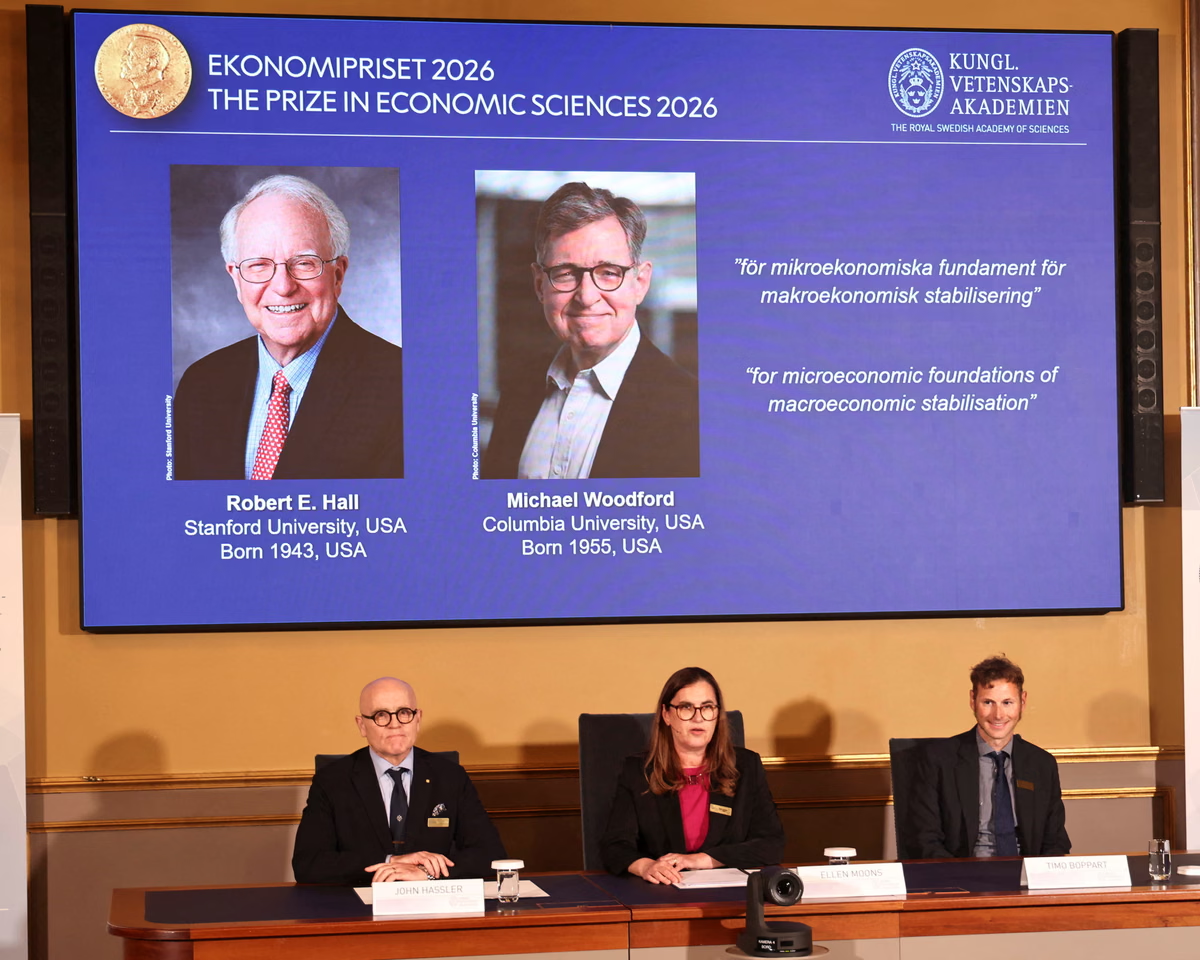
The 2026 Nobel Prize in Economics has been awarded to two American scholars, Robert Hall of Stanford University and Michael Woodford of Columbia University. The Royal Swedish Academy of Sciences recognized the pair for their foundational contributions to macroeconomic stabilization, specifically for developing models that provide central bankers and finance ministers with the tools to navigate business cycles, mitigate recessions, and combat runaway inflation.
The Nobel committee highlighted that the laureates’ work generated a paradigm shift in economic policy, earning them a shared prize of 1.2 million dollars, or approximately 900,000 pounds. These “New Keynesian” models improve upon original frameworks established by John Maynard Keynes, which historically struggled to address the simultaneous challenges of high inflation, stagnant growth, and rising unemployment experienced during the 1970s oil shocks.
Hall and Woodford effectively reconstructed traditional macroeconomic theory by grounding it in microeconomic behavior, emphasizing how the collective decisions of individual households and businesses drive economic trends. Hall pioneered the shift toward analyzing forward-looking consumer behavior rather than relying on the rigid, mechanical rules that previously linked variables like inflation and GDP. Woodford subsequently integrated these insights into a comprehensive framework that serves as a primary tool for modern policy. A full macroeconomic stabilisation framework that is the main tool for policymakers now, woodford built on this work to create the New Keynesian model.
This analytical approach proved vital following the 2008 financial crisis, offering a path to steer the global economy away from a potential second Great Depression. Committee chair John Hassler noted that the laureates provided a stable theoretical bedrock for today’s central banks, better equipping nations to manage unforeseen shocks, such as energy crises or sharp fluctuations in consumer spending.
The duo’s research also catalyzed the use of “forward guidance,” a policy tool where central banks signal their future interest rate expectations to the public. This practice became increasingly prominent following the 2008 crash and during the Covid-19 pandemic when interest rates were pushed to record lows. However, the strategy has faced scrutiny; current US Federal Reserve chair Kevin Warsh has cautioned that it should remain limited in normal times to avoid creating unnecessary ambiguity.
Historical challenges also persist with such communications, most notably in 2014, when former Bank of England governor Mark Carney was labeled an “unreliable boyfriend” for offering interest rate guidance that failed to materialize. Beyond his prize-winning work, Hall is well-regarded for his taxonomy of American economists, famously dividing them into “freshwater” and “saltwater” schools based on their geographic and philosophical leanings. And in 2014, the then Bank of England governor, Mark Carney, was labelled an “unreliable boyfriend” for dropping hints over interest rate rises that never came to pass. It’s a surprise but I’m feeling very good about it,” he told reporters in Stockholm by phone after receiving the news.
Freshwater economists, typically based near the Great Lakes, generally emphasize free markets, monetarism, and rational expectations. Conversely, saltwater economists, concentrated at coastal institutions like MIT, Harvard, and Columbia, tend to favor New Keynesian approaches that incorporate government and central bank interventions into demand management. Reflecting on his selection, Woodford expressed his elation, describing the recognition as a tremendous and surprising honor. Though, cluster at coastal universities, such as Harvard, MIT, UC Berkeley, Yale, Princeton, UCLA and Columbia, salt water economists. Believing that governments and central banks can affect demand in their economies, they tend to be Keynesians and New Keynesians.
Columbia University president Jennifer L. Mnookin praised the award, noting that the duo’s research fundamentally reshaped the theoretical landscape of stabilization policy. It is worth noting that while often grouped with the original awards, the economics prize is technically the Sveriges Riksbank Prize in Economic Sciences, established in memory of Alfred Nobel rather than by the creator himself.