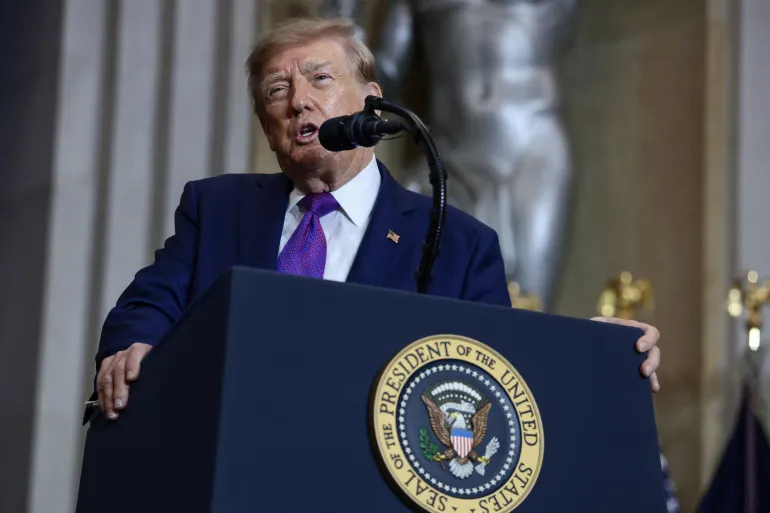
United States President Donald Trump has reaffirmed his commitment to the death penalty, using an event at the Department of Justice to launch a scathing attack against California Governor Gavin Newsom. Joined by victims’ families and Attorney General Todd Blanche, the President declared that the most severe crimes warrant the ultimate punishment, describing capital punishment as a foundational element of successful societies throughout history. “This afternoon, we come together to stand against the travesty and to wrap our arms around the families of victims who were so cruelly betrayed by bad government and our political system,” Trump said. “When victims are this divided, the death penalty shouldn’t be the answer.
During the Monday briefing, President Trump signed a directive ordering the Department of Justice to aggressively pursue the death penalty in cases involving child victims, human trafficking, and rape. The order also mandates that the attorney general expedite the execution process for inmates currently on federal death row. Furthermore, the President urged Congress to approve the Just Punishment for Murder Act, legislation proposed by Republican Representative Brandon Gill intended to fortify federal death penalty statutes. Death penalty cases also typically tend to result in longer court battles and higher costs.
A significant portion of the President’s address focused on criticizing Governor Newsom, a Democrat whose second term concludes on January 4. Due to term limits, Newsom was ineligible for the 2026 midterm elections, yet he remains a prominent national figure and a vocal critic of the current administration. Trump specifically denounced Newsom’s recent decision to commute the sentences of 548 inmates on California’s death row to life imprisonment without the possibility of parole. “Under the Trump administration, we are bringing it back, and we will not stop in our pursuit of justice. A Democrat widely seen as a possible contender for the 2028 presidential race, but he dedicated much of his remarks to slamming Newsom. Still, the governor and former San Francisco mayor has carved a national profile for himself as a proxy for Democrats during high-stakes political campaigns — and as a critic of Trump. Two days after the midterms, Newsom announced that the 548 people sentenced to death in California would instead be sentenced to life without the possibility of parole, on November 5. He nevertheless denounced the harm the 548 people had caused. “ When it comes to defending the lives and safety of American people, there can be no compromise,” he said.
Newsom, who initiated a moratorium on executions upon taking office in 2019, framed the mass commutation as a moral necessity. In an open letter, the governor stated that while he acknowledges the brutal nature of these crimes, he believes the state cannot morally justify taking lives. He urged the public to remember the victims while allowing the perpetrators to live out their sentences in obscurity. He described the action as an extension of the moratorium on executions he put in place after taking office in 2019. “Many Californians feel that those who commit brutal crimes deserve to die,” Newsom wrote. “But as Governor, I have concluded the state cannot morally kill them.”. Trump, however, framed the mass commutation as an effort to help “evil monsters” escape justice.
The President characterized this commutation as a betrayal of justice, labeling Newsom a poor governor who deprived grieving families of closure. During the event, family members of crime victims appeared on stage to share their opposition to the governor’s decision, with Sandra Friend, mother of eight-year-old murder victim Michael Lyons, accusing the state of abandoning families. Calling him “ a terrible governor” who “ stole away the only closure” the victims’ families “might ever have”, the president proceeded to launch barbs at Newsom.
Conversely, Newsom’s office provided statements from other families who support his stance, arguing that the death penalty is not an effective form of justice. Jess Nichol, the sister of murder victim Polly Klaas, suggested that survivors require tangible support, such as counseling and financial aid, rather than vengeance. These differing perspectives highlight an ongoing national debate as public support for capital punishment, according to recent Gallup polling, has reached its lowest levels since 1971. The lowest rate since 1971, a November poll released by the research firm Gallup found that 49 percent of US adults support the death penalty. Tangible support.”, i want something better for survivors: real.
The debate is further complicated by concerns regarding the integrity of the justice system. The Death Penalty Information Center reports an exoneration rate of approximately one for every eight executions carried out in the US, with roughly 202 individuals having been removed from death row due to wrongful convictions. These cases frequently entail extensive litigation and significant financial burdens. Opponents of the death penalty have frequently pointed to the prevalence of botched executions and the possibility that innocent people may be executed.
Before the commutation, California maintained the largest death row in the Western Hemisphere. The governor-elect, Xavier Becerra, has committed to maintaining the state’s execution moratorium. This position creates a sharp ideological divide with the federal government, which has been working to revitalize its execution protocols since Trump’s inauguration on January 20, 2025.
In the lead-up to these current developments, the administration has sought to expand the use of capital punishment for crimes including the killing of law enforcement officers and cases involving undocumented defendants.
Earlier this year, officials announced plans to prioritize the death penalty by diversifying execution methods, including the potential use of firing squads. In October, Trump’s Defense Secretary Pete Hegseth announced that one execution by firing squad — that of the Fort Hood shooter, Nidal Hasan — would be livestreamed to the public, prompting backlash.
While the administration previously considered livestreaming the execution of Nidal Hasan, the plan was retracted following reports regarding the inmate’s physical condition.
During his first term, President Trump oversaw the execution of 13 federal prisoners, and he has consistently framed such actions as common-sense measures for public safety.