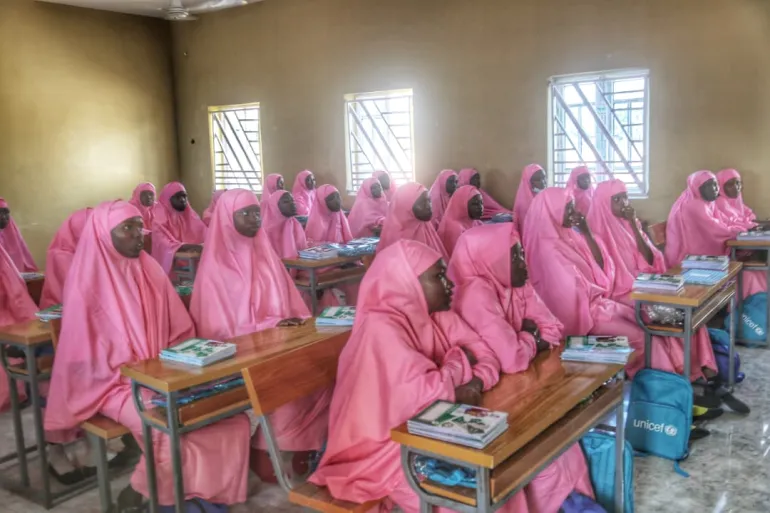
In Maiduguri and across Borno State, the educational landscape is showing signs of recovery after over a decade of devastation caused by the Boko Haram insurgency.
Teacher Maryam Umar, who witnessed the closure of the Higher Islamic College in Baga during the height of the conflict, noted that current efforts to reopen classrooms and distribute learning supplies are vital for restoring stability in the region.
Since 2009, when the armed group began its campaign in northeastern Nigeria, many communities have faced extreme instability, with schools frequently targeted and families forced to flee their homes. Displacement and a prolonged lack of security forced families to abandon their homes, schools were among the institutions affected as attacks.
State data reveals a notable rise in student participation. According to the Borno government, the number of pupils in public and private schools climbed to 1,418,279 in 2025, compared to 766,551 during the 2017-2018 academic session. Governor Babagana Umara Zulum, speaking at an event in Maiduguri this past March, highlighted these figures as evidence that parental and community trust in the school system is being rebuilt. He emphasized that the growth is not merely statistical, but a sign of societal resilience. Released in September, recorded 1,801,295 learners across the wider education sector, the state’s annual school census. Separately, enrolment in public primary and secondary schools stood at about 1.3 million during the 2025-2026 academic session.
To support this resurgence, the state administration has prioritized infrastructure, completing the construction of 104 new schools and the rehabilitation of 2,931 classrooms. These facilities were essential to accommodate returning families and provide a safe environment for students. Consequently, government estimates suggest the number of out-of-school children has dropped from approximately 2.2 million at the peak of the crisis to fewer than 800,000 today. According to without consistent information on the age groups and methodology used, the, Decline from 2.2 million cannot be independently assessed from the figures provided.
However, officials acknowledge that major challenges persist.
While nearly 800,000 children are no longer excluded from the system, this figure remains a significant concern.
Education Commissioner Lawan Abba Wakilbe noted that high enrolment numbers do not automatically equate to consistent attendance or high-quality instruction. There is limited data on whether schools can sufficiently support children who have faced years of disrupted learning, nor is it clear if the supply of teaching staff and materials matches the surging student population.
For students like 12-year-old Fatima Mahmud Umar, a pupil at Junior Secondary School One in Maiduguri, schools represent a critical pathway to personal ambition. Despite her hope for a bright future and gratitude for parental support, she is part of a generation still negotiating the long-term impact of violence. Many families, particularly in rural areas like the Gubio Local Government Area, continue to grapple with poverty and safety concerns that make regular schooling an uphill battle. Wearing a blue and white chequered hijab and her school uniform, Fatima spoke to about her hopes for the future.
Local residents, such as 49-year-old Bukar Abdullahi, have pointed out that while government investment is welcome, geographical distance and economic hardship remain severe barriers. The progress made in urban centers like Maiduguri may not be evenly mirrored in remote villages, where the lack of resources is most acute. Students who have missed years of education often return to classrooms with vastly different levels of preparation, placing immense pressure on teachers to bridge the learning gap. Bukar Abdullahi, 49, highlighted the need to enrol more children during a town hall meeting in Gubio.
Borno is also attempting to diversify its educational offerings through the Borno State Arabic and Sangaya Education Board. By integrating traditional Islamic learning with a standardized curriculum—approved by the National Board for Arabic and Islamic Studies—the state aims to create an inclusive environment. Governor Zulum stated that this approach reflects a commitment to merging spiritual development with academic and vocational advancement, granting students access to recognized qualifications.
While recent statistics show continued growth, experts suggest that true success will depend on more than just building schools. Addressing the remaining disparities requires a comprehensive strategy involving qualified educators, updated learning materials, and sustained community outreach to ensure that children, especially those in underserved rural zones, remain in the classroom. As the state moves forward, the focus remains on transforming these initial gains into a consistent, sustainable educational system for all residents. More recent government statistics indicate further expansion of Borno’s education system although differences in the categories counted make direct comparisons difficult.