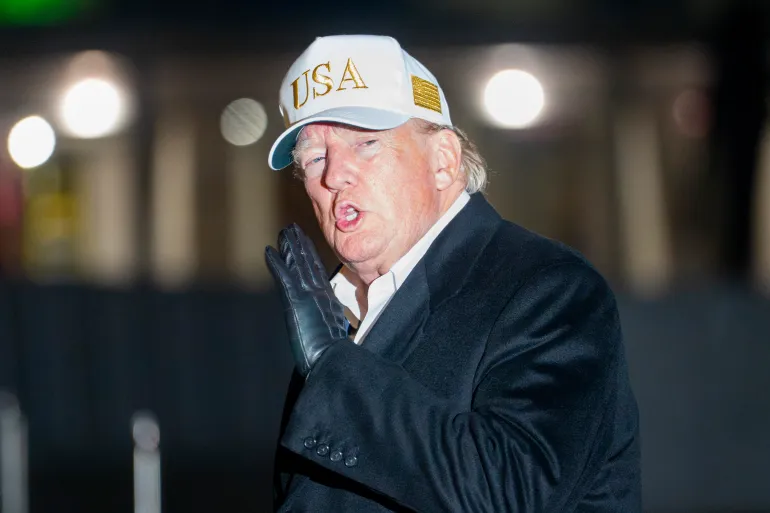
President Donald Trump has formally announced that the United States intends to pursue financial compensation from nations it shielded during the recent military conflict with Iran. In a Sunday interview with CBS News correspondent Ross Douthat, the president asserted that these countries are obligated to reimburse the US for all war-related expenditures. Trump emphasized a firm stance on the matter, stating, “We’re going to get all that money back. They’re going to do it, 100 percent. Because without us, they wouldn’t exist.” How much has the Iran war cost the US.
For the first time, Trump specifically identified Israel as a target for reimbursement, arguing that the nation would not have survived without American military intervention.
He claimed the operation successfully decapitated Iran’s nuclear capabilities, insisting that Israel would have been destroyed otherwise. While declaring the military campaign “effectively over,” Trump continues to defend the initiation of the war as a strategic success, despite the political fallout from recent midterm elections where public discontent over the conflict played a significant role. “We decapitated their [Iran’s] nuclear arsenal,” he said. “If I didn’t do that, there would be no Israel right now.
The US military reports that the war’s costs reached $47.1 billion by mid-October. This figure is considered a conservative estimate, as it excludes the expenses associated with repairing damaged American military infrastructure throughout the Middle East. Furthermore, the Congressional Budget Office projected in September that the ongoing conflict incurs an additional $2 billion to $3 billion in costs every month.
Beyond Israel, the president has previously singled out several Gulf nations, including Saudi Arabia, the United Arab Emirates, Qatar, Bahrain, and Kuwait. He argues these states should contribute because the US military provides essential protection for regional shipping routes, specifically near the Strait of Hormuz. In a July press briefing, Trump maintained that the US is protecting a wealthy portion of the world and deserves financial compensation for those security efforts. According to gulf, Also pay for the maintenance of several large bases that the US uses for military operations in the region. According to “While Israel and the United, Continue to share intelligence and coordinate on regional security issues, any request for Israel to shoulder a meaningful share of the financial burden would run against established practice and Israel’s present resource constraints,” she said.
Despite these declarations, geopolitical analysts largely dismiss the prospect of direct repayment. Neil Quilliam of Chatham House characterized the president’s rhetoric as political signaling meant for a domestic audience rather than a concrete policy framework. This sentiment was echoed by Bader al-Saif of Kuwait University, who noted that Gulf states likely view the demands as domestic posturing intended to deflect criticism from recent election results. Analysts say, probably not directly. According to neil Quilliam, an associate fellow at Chatham House’s Middle East and North Africa Programme,, Trump’s comments are “best understood as political signalling rather than a serious policy proposal.”. Al-Saif added that Trump’s “condescending language does not bode well for partners long invested in the relationship with the US”.
Experts suggest that Washington is unlikely to secure direct payments from Arab allies. Stefan Lukas, a security analyst, noted that the Gulf states, which were not consulted on the war plans and suffered significant infrastructure damage during Iranian retaliatory strikes, are expected to resist such financial requests. Al-Saif suggested that if Trump persists, he might attempt to creatively redefine repayment by targeting existing investment pledges or trade agreements, rather than seeking direct transfers. And what it could mean for the US and its allies, here’s what to know about Trump’s demand for repayment. Portraying them as payments or gifts to the US, trump has repeatedly made misleading claims about foreign investment and trade agreements in the past.
Historical precedent complicates the feasibility of these demands. During his first term, Trump frequently claimed that Mexico would pay for a border wall, a project that remained incomplete and was never funded by the Mexican government. Similarly, he has previously framed trade pacts with the European Union and Japan as “gifts” or “signing bonuses,” assertions that analysts argue misrepresent standard commercial investments as government-to-government payments. According to “This will most likely be indirect and take the form of commercial investments in the US, buying of US weapons systems – on top of what has already been ordered – and investments into close associates of Trump’s financial dealings,”, Boussaid. After a July 2025 trade deal with the European Union, Trump claimed the bloc had given the US a $600bn “gift” that could be invested in “anything we want”. However, the framework agreement referred only to an expectation that European companies would invest $600bn across strategic sectors in the US through 2028. The same month, Trump described a $550bn investment pledge from Japan, under a new US-Japan trade agreement, as being “like a signing bonus that a baseball player would get”.
For Israel, the situation remains distinct yet equally unlikely to yield cash.
Marzieh Kouhi Esfahani, an assistant professor of politics, noted that Israel has traditionally operated as a recipient of US support rather than a provider.
Any effort to shift this long-standing financial dynamic would contradict established security cooperation protocols.
While some analysts believe Trump might leverage economic concessions from Israel—citing his recent decision to halt aid—a meaningful financial contribution for the war effort faces significant structural and diplomatic hurdles. However, he suggested that Trump could be more serious about seeking economic concessions from Israel, particularly after announcing that the country would no longer receive US aid after the end of this year.