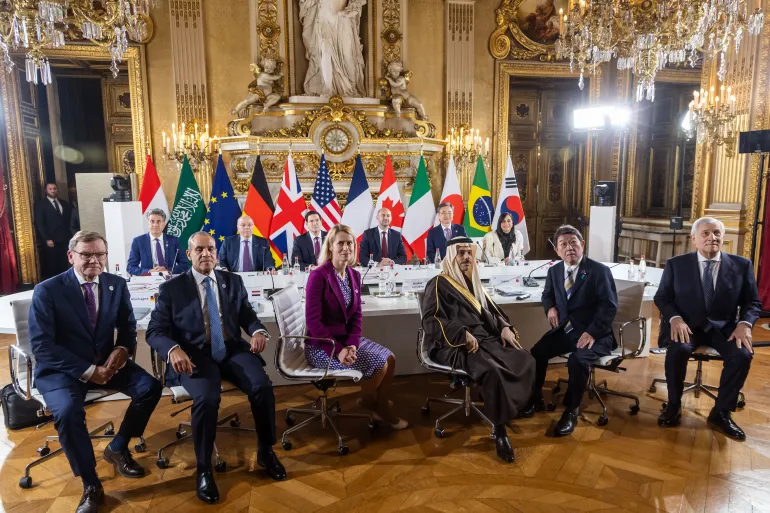
European foreign ministers insisted on Monday that Europe must be directly involved in any diplomatic settlement ending Russia’s war on Ukraine. The stance was communicated to US Secretary of State Marco Rubio during a G7 summit in Paris, coinciding with the launch of US-brokered talks between Kyiv and Moscow in Abu Dhabi.
German Foreign Minister Johann Wadephul addressed Rubio directly following their bilateral discussion, challenging Washington’s recent rhetoric regarding European security. He emphasized that alterative security arrangements cannot be imposed on the continent without its explicit consent. “But there is something bigger up for discussion, too: The future of the multilateralism that has dominated relations among these countries for decades.”.
“It is certainly neither necessary, nor right, nor appropriate to make a fundamental change” to Europe’s security architecture, Wadephul stated. He added, “Europe belongs at this table. There can be no solution without Europe – only with Europe.”
The two-day G7 gathering in Paris—which includes top diplomats from Canada, France, Germany, Italy, Japan, the United Kingdom, and the United States—overlaps with the two-day diplomatic sessions scheduled in Abu Dhabi for Tuesday and Wednesday.
Skepticism remains high regarding Moscow’s commitment to the UAE talks. Wadephul cautioned against a potential “negotiation show” in Abu Dhabi, urging Russia to abandon its maximalist demands. He noted that ongoing Russian strikes against Ukrainian civilian infrastructure demonstrate a lack of serious momentum from Moscow toward genuine peace.
Ukrainian Foreign Minister Andrii Sybiha is scheduled to attend a targeted session on the conflict in Paris on Tuesday. Before departing for the summit, Sybiha reinforced Kyiv’s stance, asserting, “No one has the right to decide our fate behind our backs.”
The Paris discussions highlight growing friction between Washington and its traditional allies. G7 members have expressed deep concern over the direction of US foreign policy following recent midterm election losses for President Donald Trump’s Republican Party, particularly regarding US reductions in aid to Ukraine, the scaling back of anti-Russia sanctions, and increasingly unilateral decision-making. According to rebecca Collard, reporting from Paris,, The first day of talks had wrapped up with little clarity on US policy after the midterm elections.
The summit has expanded its scope by inviting guest ministers from Saudi Arabia, Egypt, South Korea, and Brazil. Agenda items for Tuesday focus heavily on Middle East instability and the US-Israeli conflict with Iran, an escalation that G7 partners fear could exacerbate regional turmoil rather than resolve it.
Reporting from the summit indicated that the opening sessions left US strategy uncertain, shifting broader diplomatic attention toward the long-term viability of international multilateralism.