Israeli ground forces have launched a significant offensive in central Gaza, pushing into areas previously marked as the limit for their military presence. This movement, which has forced many Palestinian families to flee their homes once again, represents the first major ground operation publicly announced by the Israeli military since the current ceasefire began on October 10, 2025. On Saturday, an Israeli attack killed Samir Abu Younis, the Qassam Brigades’ Rafah commander.
The military maneuver follows a stern warning from the United States-backed Board of Peace, which recently informed the United Nations Security Council that the 13-month-old agreement is nearing a breaking point. In its assessment, the board accused Israel of obstructing humanitarian aid and delaying the arrival of Palestinian police, while simultaneously alleging that Hamas has continued to engage in armed activities and the taxation of goods entering the territory. Senior Hamas representative Basem Naim has strongly denied these allegations, describing the report as pure disinformation. According to israel, Hamas has been regrouping and rearming, and it has stepped up attacks.
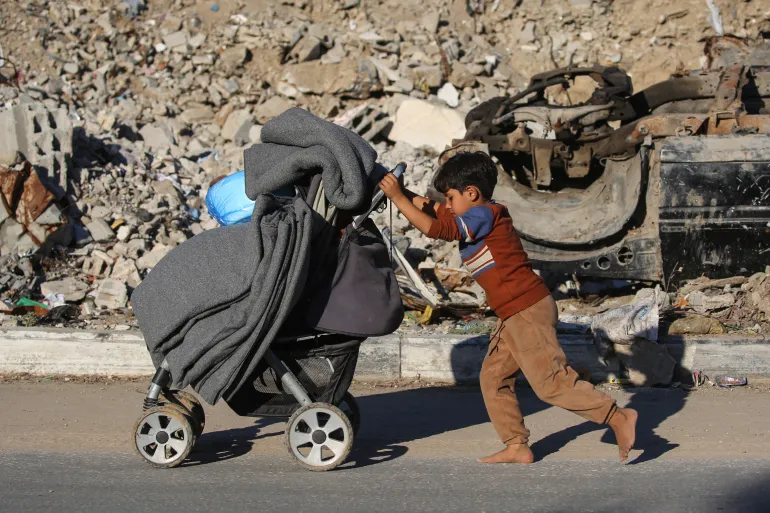
On Wednesday, residents observed Israeli tanks and bulldozers advancing toward the vital Salah al-Din Street—Gaza’s primary north-south artery—positioned east of the Nuseirat refugee camp and north of the Bureij camp. The incursion was accompanied by heavy artillery fire and persistent shelling, triggering an immediate exodus of civilians from the area. The Israeli military body COGAT has officially declared the affected stretch of Salah al-Din Street closed and ordered residents to evacuate the perimeter until further notice, though no timeline for the operation was provided.
Casualties have already been reported as a direct result of the escalation.
An Israeli strike on al-Mughraqa claimed at least one life and left several others wounded, according to representatives at al-Awda Hospital.
Furthermore, separate tactical strikes in Gaza City, Deir el-Balah, and Nuseirat have resulted in the deaths of three additional individuals. Local residents, such as 27-year-old Mahmoud al-Saafin from Bureij, expressed profound anxiety, fearing that this latest military push signals the beginning of a wider conflict that will once again uproot a population struggling to recover from previous waves of displacement. “We fear this may be the start of a broader operation and that displacement will begin anew, as we have not yet recovered from the effects of the previous war and displacement,” Mahmoud al-Saafin, a 27-year-old resident of Bureij, told the AFP news agency.
The targeted regions are situated west of the so-called “Yellow Line,” a boundary established during the initial phase of a peace plan initiated by Donald Trump. While that agreement initially left Israeli troops in control of approximately 53 percent of the enclave, Israel has gradually shifted these lines, with the restricted zone now encompassing nearly two-thirds of Gaza. With more than two million Palestinians currently living in the remaining pockets, mostly in temporary tent settlements, the space for displacement is shrinking rapidly. And Prime Minister Benjamin Netanyahu’s caretaker government of escalating to escape its domestic crises, it accused Israel of “systematically” squeezing Palestinians into a narrow area of Gaza.
In defense of the maneuver, the Israeli military characterized the incursion as a precise operation intended to neutralize immediate security threats and dismantle established Hamas infrastructure. The army stated it retains the freedom to maneuver whenever necessary to address violations of the ceasefire. Defense Minister Israel Katz affirmed that Israel will not withdraw until Hamas is fully dismantled, even suggesting that if tensions continue to rise, the military is prepared to seize additional territory and expand the permanent security perimeter. According to the army hasn’t, How long the operation will last. “We reserve the freedom to act and manoeuvre whenever necessary to eliminate any immediate threat in the Gaza Strip,” the army said.
Palestinian factions have reacted with strong condemnation. Hamas officials termed the forced evacuations and military advancement a dangerous development and a blatant breach of the ceasefire, urging international mediators to take immediate action. The group also criticized the Board of Peace for equating the actions of the occupying force with the suffering of the Palestinian victims. Meanwhile, the Popular Front for the Liberation of Palestine described the operation as a prelude to a larger effort to forcibly displace the local population. Hamas also condemned the Board of Peace for having “unacceptably equated the occupation’s ongoing aggression with the suffering of the Palestinian victim”.
The situation remains volatile, with Gaza’s Ministry of Health reporting 1,658 fatalities and 6,000 injuries since the ceasefire was enacted. Official Israeli figures cited by Reuters indicate five soldiers have lost their lives during the same timeframe. Daily life remains crippled by restricted aid, with the International Organization for Migration noting that roughly 100,000 tents remain stuck outside the territory, stalled by security checks and crossing closures.
Despite the initial halt to major hostilities, the comprehensive roadmap for the region—which includes full Israeli withdrawal, systemic reconstruction, and the disarmament of Hamas—remains largely unimplemented. Israel has rejected a July proposal from Hamas to hand over governance and weapons, and the deployment of an international stabilization force has stalled as the board’s technocratic administration has not been permitted to begin work. The Board of Peace has warned that the total collapse of these efforts would leave no viable roadmap for future stability or rebuilding.