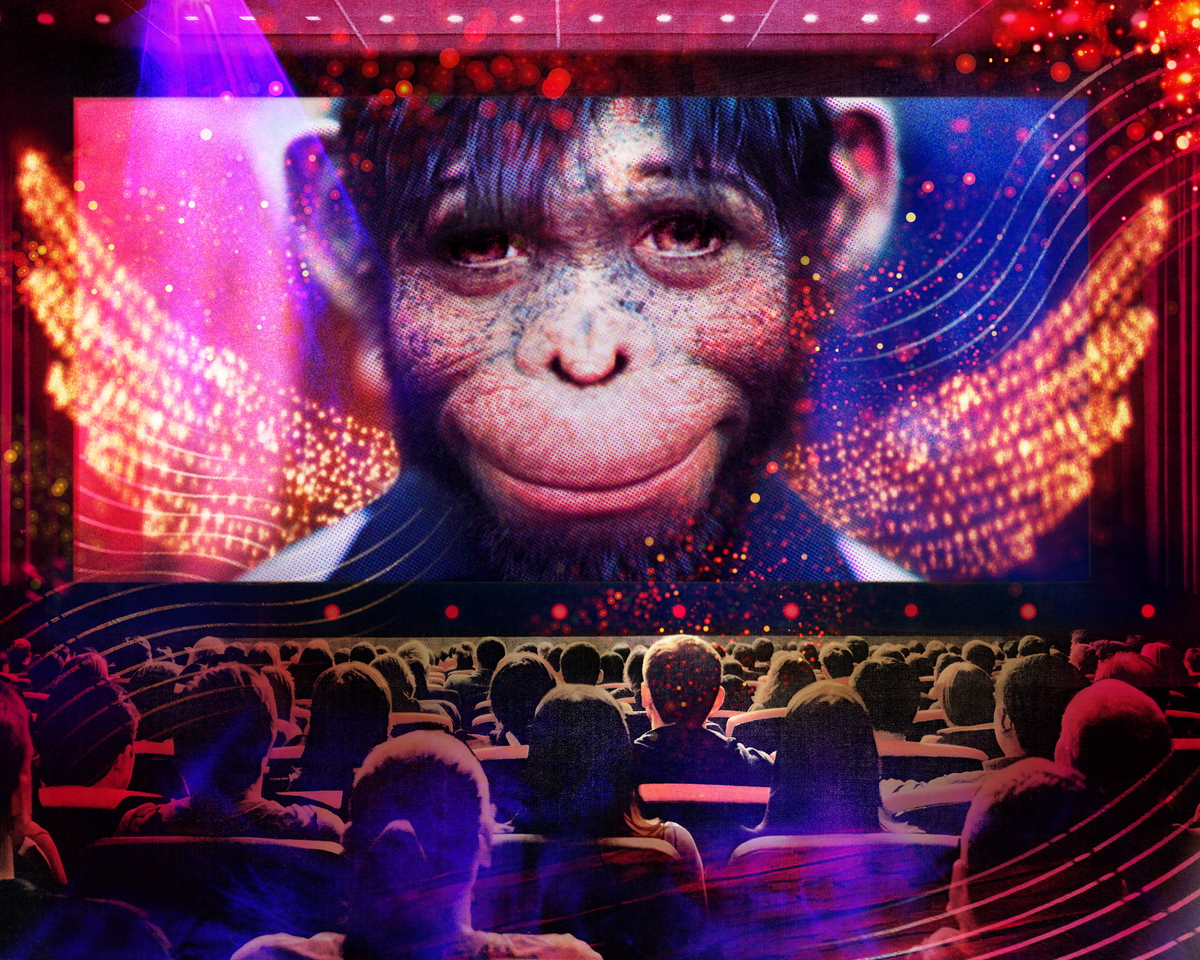
I never considered myself a Robbie Williams fan, so when I accompanied my wife to see the 2024 biopicBetter Manin which the singer is portrayed by a CGI chimpanzee, my expectations were low. I remained skeptical of the creative choice throughout, yet the film unexpectedly offered a profound reflection on my own life experiences. Born two months premature in Winnipeg, Canada, in 1961, I lived with severe, undiagnosed hearing loss until age seven. The 1969 move to Woking, Surrey, brought further instability; my father departed and my mother struggled with alcoholism, leaving me isolated. During my school years, I faced relentless bullying from peers and teachers alike. I turned to literature and comics likeThe BeanoandBeezeras survival guides to help me navigate a world that felt alien. To be honest, I was sceptical about the ape but tried to meet the film with an open mind. I wasn’t looking for anything in particular but what I found was something that seemed to explain my life. In my desperate isolation, I turned to reading: book reading, lip-reading, and reading the room. Forget TV, forget music – the Beano andBeezer were my survival manuals: the Numskulls taught me how my brain worked with broken ears. A fact I’m extraordinarily proud of, he just nodded his head as I dreamed aloud; I never aspired to sing but certainly aspired to be a great engineer – and I became one. My large head and my slow development, they were investigating my inadequate responses. A young man who believed he could do anything, at 16 I left school and became Bob. I felt the invitation to veer my car sideways.
Seeing young Robbie on screen, lonely yet supported by friends, brought back memories of my own confidant, Nick, who accepted my dreams of becoming an engineer.
My formative years were also marked by a close relationship with my grandmother on my father’s side. From age 13 to 18, I visited her weekly, sharing tea and Scrabble. She would greet me with open arms and twinkling eyes, calling out, “Aaah, Bobbie!” a term of endearment my mother also used before a difficult period in 1965. At age four, I was left at the Montreal Neurological Institute for two weeks while doctors investigated my developmental delays and hearing issues. That period of abandonment deeply scarred me; my mother eventually stopped calling me the baby name Bobbie, shifting instead to Bobby, which morphed into Bob by the time I entered college and began working as a forklift driver. A formidable presence and formative influence on the aspiring pop star, then came Robbie’s grandmother. From 13 to 18 I walked half an hour to see her every Sunday. We talked about everything while playing Scrabble; I drank her tea from poorly cleaned mugs. I remember letting out a primal scream as she left. What I did was drive a forklift to pay my way through college before going on to study engineering at uni. And, my life on a knife’s edge, i remember the temptation.
My path shifted drastically at age 26. Just a week into my PhD studies, I was involved in a car accident in a Ford Granada that left me with memory loss and total hearing loss in my left ear. A doctor told me the damage was permanent, leaving me with a sense of immense rage that nearly led to a tragic decision while driving on the M1. Remembering my mother’s advice to wait 24 hours before acting on extreme emotions saved me. Years later, watching the depiction of Robbie’s own breakdown after leaving Take That, I found myself weeping, finally processing that long-suppressed trauma. At 26, a week into a PhD (which I completed against the odds), I was a passenger in a Ford Granada that spun like a catherine wheel into a gate. In the fast lane, overtaking an articulated lorry, my rage exploded, driving home to Woking on the M1. Then I remembered my mother’s advice whenever I was inconsolable: wait 24 hours and see if you feel the same. Weeks later, a stubbled, hungover doctor I couldn’t lip-read told me, in under five minutes, that it was permanent. Years later, as I sat watching Robbie’s fury boil over after Take That sacked him, prompting him to contemplate a similar drastic decision to the one I almost made, I bawled my eyes out.
My life changed again after meeting my wife, Birgitte, in Denmark in 1992. My first cochlear implant in 2011 finally allowed me to experience the nuances of human voices. However, when my wife was diagnosed with breast cancer in 2012 and we returned to the UK a year later, the stress of supporting our three children while commuting triggered a gambling addiction. Although I had long been accused by my wife of having an “addictive streak,” the film helped me realize this was a symptom of unresolved fear and past trauma. Through counseling, I successfully quit gambling, and today, living back in Denmark with a second implant providing 95% hearing in both ears, I am learning to reconcile my past identities. I had met my wife, Birgitte, in Denmark in 1992, on the last day of a job that was meant to last two weeks and ran for two years.
If you or someone you know is struggling with gambling, help is available. In the UK, the NHS National Problem Gambling Clinic can be reached at 020 7381 7722 or GamCare at 0808 8020 133. In the US, contact the National Council on Problem Gambling at 1-800-MY-RESET. In Australia, support is available via Gambling Help online at 1800 858 858 or the National Debt Helpline at 1800 007 007.