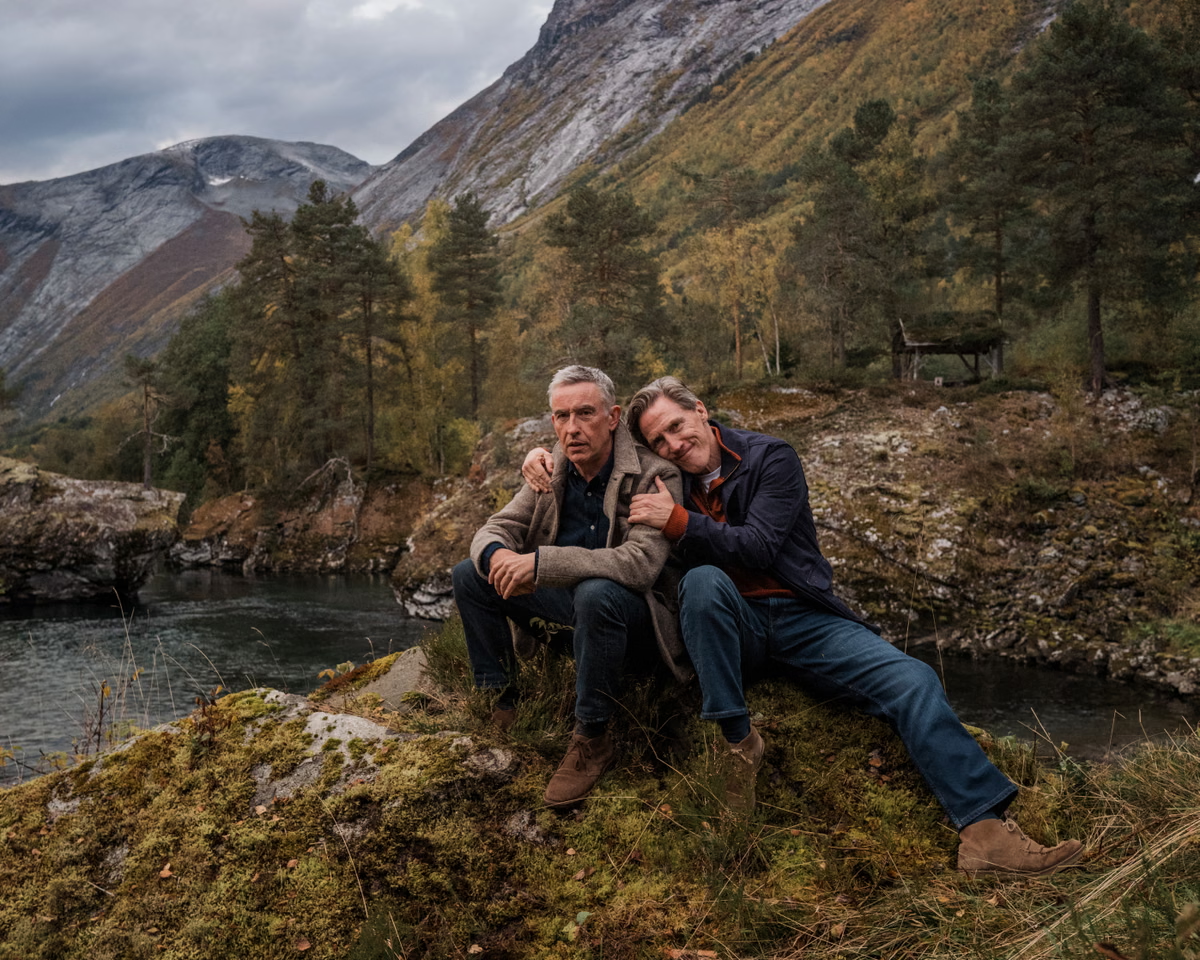
In the quiet of a September morning at the Juvet Landskapshotell in Valldal, Norway, Steve Coogan and Rob Brydon sit down for breakfast amidst the towering mountains and pine forests. This setting serves as the latest backdrop for the fifth and final series of The Trip, a semi-autobiographical comedy directed by Michael Winterbottom that has followed the pair’s fictionalized adventures for over 16 years. From their origins in Northern England to tours of Italy, Spain, and Greece, the duo has now reached the Arctic Circle, navigating the scenic landscapes of Sweden and Norway. And in the pale September light, the Juvet Landskapshotell stands quite still amid mountains, pines and yellowing birch, m orning in Valldal. The edges of Coogan’s mouth begin to flicker. Heading through Sweden and Norway and up to the Arctic Circle, taking in luxury hotels, fishing huts, brown cheese and reindeer, now they have reached Scandinavia.
Reflecting on their journey, Coogan admits surprise at the final result of the series.
Having watched the completed episodes, he finds the output to be more charming and less haphazard than he remembered during filming. What I wasn’t expecting was to find it so warm and welcoming.
The pair, whose real-life friendship spans 30 years, are careful to distinguish their actual dynamic from the strained, often competitive versions of themselves portrayed on screen. In person, their conversations tend to revolve around the preoccupations of middle age, touching on subjects that Coogan describes as “achingly middle-class,” such as the struggles of managing staff or the specific desire for comfort while traveling. It has a real humanity.”, throughout all the cynicism and arguments and spikiness. As ever, to differentiate between their onscreen relationship and a real-life friendship that has run for 30 years, they are keen.
As they discuss the show, the topic of age becomes a recurring theme. Now in his 60s, Coogan expresses a preference for comfort—specifically noting his desire to be a passenger in a Mercedes because it allows for reclining seats, a necessity he attributes to his age. Brydon, currently 61, balances these discussions with his own evolving perspectives. They joke about how they are managing the aging process, aiming for a equilibrium between a sense of wonder and the increasing need for rest. Hosting gameshows and voicing Julia Donaldson adaptations, even writing a children’s book of his own, brydon is an established national treasure. With more nuanced projects – playing Jimmy Savile, for instance, and writing and producing Stephen Frears’s film The Lost King, coogan has combined a broad populism – revisiting his comic creation Alan Partridge and a turn in The White Lotus. Jabs about the directions of their respective careers, the appeal of light entertainment, the allure of politics, their differing relationships, some established elements of the show remain: there are the famed impressions. According to these days, Brydon, The pair “get together and talk about middle-aged things”.
The filming process itself is a mix of structure and improvisation. In one scene recorded at a hotel spa, the two discuss the historical figures of August Strindberg and Henrik Ibsen, specifically referencing Ibsen’s attraction to a teenager when he was 60. This prompts a playful exchange, with Brydon launching into an extended impression of Melvyn Bragg presenting In Our Time, barking at Coogan to “expand” on his thoughts. Such moments underscore the spontaneous humor that defines their collaboration. In the hotel dining room, Steve Coogan and Rob Brydon are taking breakfast; coffee and muesli and compote spread out before them as they settle into a discussion of the playwrights August Strindberg and Henrik Ibsen, and their enduring infatuations with much younger women. “When Ibsen was 60, he fell in love with a teenager called Emilie,” Brydon says. “Can you imagine doing that. Under the guise of a journalistic commission; this time, the conceit is that Brydon is making a podcast for, and Coogan has agreed to tag along, each season sends them on a kind of Epicurean road trip. It is the following summer when we meet again: a wildly hot day in a central London hotel. Complaining about staff. “You see, when I was young and from a lower middle-class background, people used to laugh and joke and say: ‘Oh, you just can’t get the staff …’” he says. “And now I’m 60, and I’m in a different socioeconomic position, I do know what that means.”, he reels off a couple of examples: second homes. You’ll be 61,” he says. “It’s probably better to say 61, brydon looks up. “By the time this comes out.
Beyond the comedy, both actors address the shift in their personal priorities as they enter their 60s. Coogan notes a change toward a more “carpe diem” mindset, particularly since becoming a grandfather. He describes this as a visceral, animal-like feeling that centers on living in the moment. Brydon highlights a broadening fascination with the world, suggesting he feels he is evolving as a person, even if he jokes that the sentiment might sound pretentious to others. Though it only seemed to gather pace as he reached 60, and became a grandfather. “It’s a visceral, animal thing,” he says. “I’ve got a granddaughter, and I just want to see her, I just want to be with her, in a way that transcends all of the stuff, he noticed this growing feeling in his late 50s. I want that almost like a child wants something.
Their conversation often drifts into current affairs, with the pair discussing the political climate, including the resignation of Nigel Farage from his Clacton seat. Coogan, who has been publicly supportive of political figures like Andy Burnham, uses the opportunity to comment on the state of Westminster-centric politics. He argues that the rise of movements like Reform UK stems from long-standing frustrations in post-industrial, provincial areas, framing the current political landscape as a continuation of games played over the last 40 years. Taking in the persecuted genius of Galileo, a short exhortation on the subject of Palestine, and how the aurora borealis has just been spotted in the skies above Great Yarmouth, the conversation shifts. Too: subtle turns in subject matter, the old prickliness of their exchanges often giving way to a kind of tenderness, but there are shifts in this series.
Brydon’s background provides a contrast to Coogan’s trajectory. Growing up in Baglan near Port Talbot as the son of a car salesman and a teacher, his career success arrived later in life, after he had spent years working in Welsh radio and television. While Coogan achieved fame in his 20s, Brydon spent his 30s navigating the industry before finding broader recognition. They emphasize that despite their success, they remain grounded in their shared history and the reality of their long-term professional partnership.
The filming of the final season involved a wide array of activities that did not all make the final cut, including James Bond references and bracing plunges into cold rivers. Despite these behind-the-scenes moments, the core of the show remains the unique, often comedic friction between two performers who have spent three decades in each other’s company. The Trip to the Northern Lights is scheduled to begin airing on December 10 via Sky Atlantic and Now, marking a final chapter in their long-running travelogue. Meanwhile, the crew fold themselves into tight corners, hover behind camera lines, try not to laugh.