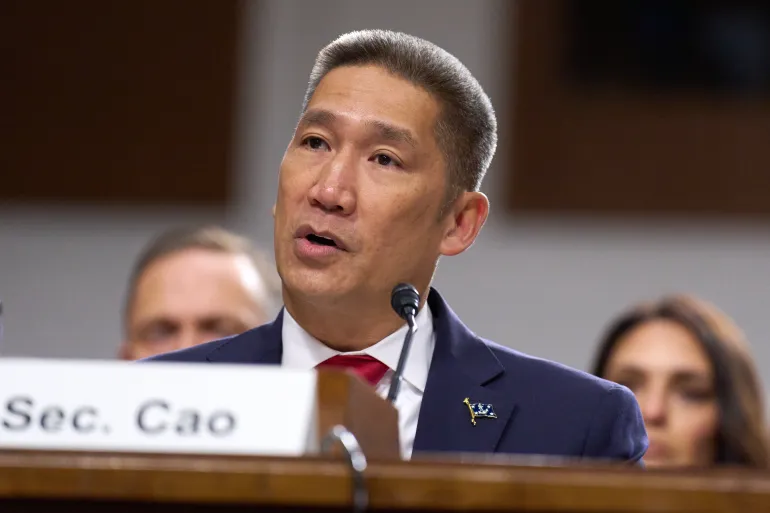
United States Acting Navy Secretary Hung Cao acknowledged during his Senate confirmation hearing on Tuesday that the ongoing conflict with Iran has placed significant strain on the nation’s maritime forces. Testifying before the Senate Armed Services Committee, Cao addressed concerns regarding the cumulative human and material toll of the war, which has persisted for nine months.
While characterizing the conflict as a burden, Cao maintained that joint military efforts have successfully hindered Chinese strategic objectives in the region. Cao, a retired Navy captain and former Virginia Senate candidate, has led the department in an acting capacity since April 2026, following his previous role as under-secretary. He is now seeking confirmation for the permanent top civilian position, a move supported by President Donald Trump. According to “Sustained investment in our people will increase readiness, improve retention and recruitment, and enable our ability to support national objectives,”, Cao.
The hearing unfolded against a backdrop of political turbulence following the recent midterm elections, which saw the Republican party lose control of both the House and the Senate. Which were widely seen as a repudiation of the war and ultimately cost the Republicans control of both the House and the Senate, voter frustration over the war — and its economic sting — proved decisive in the November midterm elections.
The 120th Congress is set to take office on January 3, 2027.
Senator Jack Reed, the committee’s ranking Democrat, expressed skepticism regarding Cao’s leadership record, specifically questioning the handling of personnel dismissals overseen by Defense Secretary Pete Hegseth. According to “I am concerned, frankly, about your leadership record as acting secretary,”, Reed, who called on the acting US Navy secretary to speak to Hegseth ‘s ongoing and planned dismissals of numerous naval officers over the past year, pressing Cao on whether he would “defend the military leaders in the future from partisan meddling in their careers”. According to his, Intent to safeguard individuals’ careers was promptly rebuked by Reed, who maintained that privacy does not justify shielding information from congressional oversight.
Democratic lawmakers also scrutinized the decision to relieve the entire command team of the USS South Dakota—comprising the commander, executive officer, and command master chief—following an underwater collision with the seabed in October. The vessel returned to Naval Air Station North Island in San Diego, California, in early October after the USS George Washington arrived on station to relieve it. The US is temporarily massing three carrier strike groups to bolster regional maritime security and tighten the months-long naval blockade against Iran, together with the USS George HW Bush and the newly arrived USS Theodore Roosevelt.
Cao defended the decision-making process, asserting that leadership changes are necessary to uphold naval standards of conduct, though he faced criticism for the lack of public transparency surrounding these removals.
A significant portion of the hearing focused on the health and welfare of sailors aboard the USS Abraham Lincoln. Following a record-breaking 265-day deployment across the Pacific, Indian, and South China Seas, the crew faced intense scrutiny regarding morale, supply shortages, and mental health struggles. Senator Richard Blumenthal criticized Cao’s oversight, suggesting a lack of empathy for the challenges faced by service members and their families.
Cao rejected claims of personal negligence, stating that he does not unilaterally determine the duration of ship deployments, which have frequently stretched toward a year, well beyond the traditional six-to-eight-month standard seen during previous conflicts. When pressed on the issue of suicide attempts among personnel, Cao described the incidents as cases of successful mitigation rather than a failure of care. “We relieve commanding officers for everything from negligence to even just fraternisation or, you know, harassment,” Cao said, making the case against the US Navy’s traditional policy of publicly announcing the removal of commanders. “I want to make sure that we’re protecting their livelihood afterwards as well.”.
Regarding the broader strategic picture, President Trump indicated last week that further major military strikes against Iran are unlikely, though he emphasized that forces remain prepared if conditions shift. This assessment followed high-level discussions with the Prime Minister of Qatar. He noted, however, that the US military remains “locked and loaded” if conditions change.
To secure his permanent appointment, Cao must navigate a challenging political path. Because he transitioned out of active-duty service only in October 2021, he is currently ineligible under federal law, which requires a seven-year separation period to ensure civilian control of the military. He will need to obtain a rare congressional waiver and secure 60 votes in a deeply divided Senate to move forward. Who must clear the hurdle by meeting a 60-vote threshold, which may prove tricky in a polarised Washington, securing that exemption poses a steep political climb for Cao.
Committee Chair Roger Wicker expressed support for the nomination, emphasizing the need for robust leadership during a volatile period for global maritime security. Despite this, the path remains precarious as Cao continues to face intense bipartisan questioning regarding his performance and the future of the naval fleet.