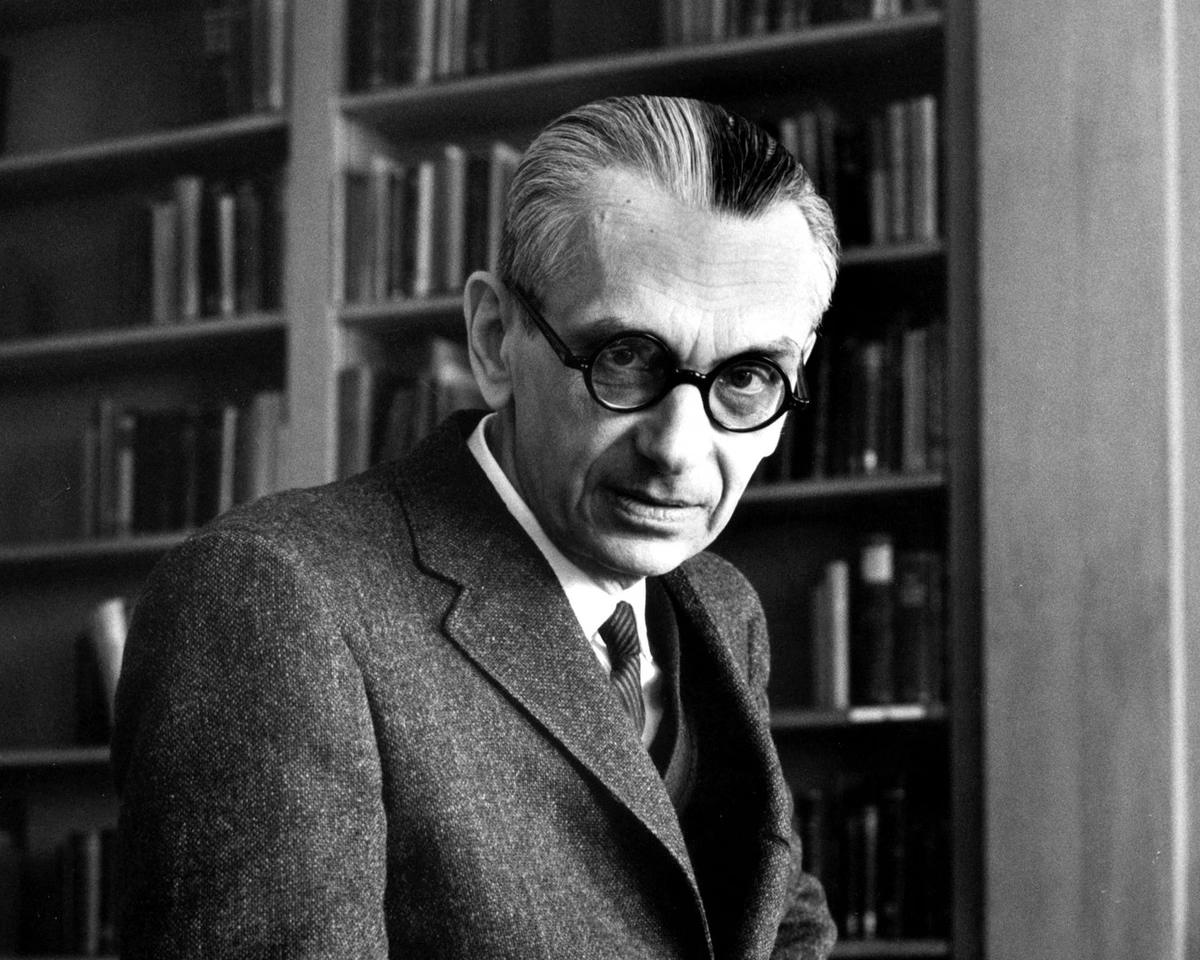
Austrian logician Kurt Gödel, one of the 20th century’s most original thinkers, fundamentally transformed mathematics and laid the groundwork for the digital era with his 1931 incompleteness theorems. Beyond these famous results, Gödel left behind an extensive collection of unpublished material that continues to intrigue historians of science.
Since 2017, Finnish logician Jan von Plato has spearheaded a research project at Helsinki University to decode 16 of Gödel’s notebooks from the early 1940s. These “workbooks” comprise 1,009 pages of dense notes covering logic and mathematics, much of it recorded in the Gabelsberger shorthand, a German system that was already obsolete during Gödel’s lifetime. According to von Plato, He had started his Gödel project in 2017 because he was facing mandatory retirement from Helsinki University. “What should I do to make myself indispensable. “What strikes me especially is that he starts from ideas. He has very, very clear ideas, and then he’s methodical. His physics and cosmology notebooks are an unknown territory I plan to start exploring once I am finished with my present logic projects.”.
Although progress in transcribing the text was historically sluggish—averaging just one page per week—the research pace accelerated dramatically in September after von Plato utilized the AI model Claude. In just two days, the AI generated a comprehensive synthesis of the entire manuscript, exposing that Gödel had derived hundreds of theorems previously unknown to the mathematical community.
“I was flabbergasted,” von Plato remarked, noting that Gödel’s workbooks contained dozens of results that were not formally discovered until the 1970s and 80s. The AI analysis also highlighted over a dozen unexplored themes in logic that have remained untouched for more than 80 years. According to “I was flabbergasted,”, Von Plato. “The workbooks not only contain dozens of anticipations of results not known until the 70s and 80s, but they also contain 14 themes in logic that have not been pursued.
Gödel’s career was marked by his profound insight into the boundaries of mathematical knowledge.
His theorems demonstrated that all mathematical systems contain true statements that cannot be proven or disproven within those systems. This discovery influenced figures like Alan Turing, whose 1936 work helped establish the foundations of modern computing. After fleeing Nazi-occupied Austria in 1940, Gödel moved to Princeton, New Jersey, where he befriended Albert Einstein at the Institute for Advanced Study before his death in 1978. Who had hoped that all truths were verifiable, Gödel’s work pushed the field in new directions, inspiring Alan Turing to write his 1936 paper that began the theory of modern computation, yet while this result was a blow to previous generations of logicians. In 1940, Gödel fled Austria under the Nazis. He refused to eat food that was not cooked by his wife, and died of starvation in 1978, increasingly paranoid in his later years. We just are not able to keep in mind all the different parts. He’s not like someone who plays with formulas and hopes to arrive somewhere. Step after step he goes ahead and he manages to fulfil the aims that he has in this formal work.”.
Von Plato, who secured a €2.5 million European Research Council grant for the project, is one of the few individuals worldwide capable of reading the Gabelsberger shorthand. He sought the assistance of Claude after discussions with computer scientists at a conference in France. By feeding the AI transcriptions of the workbooks alongside his own previous scholarly writings on Gödel, he enabled the model to synthesize the fragmented notes into a coherent whole. Taught himself Gabelsberger shorthand – “I am one of only six people who can read it in the world” – and assembled a small team, he received a €2.5m (£2.1m) grant from the European Research Council. Showing Claude his transcriptions of the workbooks, as well as six books he had previously written on Gödel and other secondary scientific literature, on his return to Helsinki he began the process.
The AI’s ability to connect distant sections of the 1,000-page archive proved transformative. Where human researchers struggled to retain the context of individual pages over long periods, the model analyzed the material as a unified body of work, providing a 650-page explanation within days. But it’s basically a work that is impossible to do for human beings,” he said. “Humans read one page at a time and we tend to forget things, it had to be controlled page for page.
A primary objective for the team was to verify if Gödel had truly anticipated the independence of the axiom of choice, a result for which American mathematician Paul Cohen won the Fields Medal in 1966. While Gödel claimed to have proven this in the 1940s, he could never reconstruct the proof for his peers. The AI analysis revealed that Gödel was nearly correct, requiring only a minor adjustment to a definition that he had, in fact, utilized accurately in earlier notes. Which would reveal that Gödel had been telling the truth in 1966, the first task von Plato set Claude was to discover if Gödel’s workbooks had a proof of the independence of the axiom of choice. According to the answer came back: yes, almost. “He was just one step away,”, Von Plato. “There’s one definition that Gödel got wrong, but he had the right definition two years earlier, and so the thought is that he would have arrived at the right definition anyway if he had just continued for a few months. He would have won the 1940 Fields medal. “Maybe he felt that when Cohen got the medal, that that was something he sort of missed.”, von Plato believes that had Gödel published his work on the axiom of choice.
To ensure academic rigor, von Plato ran the AI-reconstructed proofs through Coq, a tool for validating mathematical consistency. Of 663 potential theorems identified by the AI in the workbooks, approximately 400 were verified as stated, while 200 required minor corrections or additional assumptions. Only about 50 were identified as false, a margin of error that Gödel himself occasionally flagged in his own notes with remarks like “falsch” or “schlecht.” About 200 were repaired, meaning that perhaps the statement of the theorem had to be made more precise, or some assumption had to be added, when these results were put into Coq: “About 400 were verified as stated.