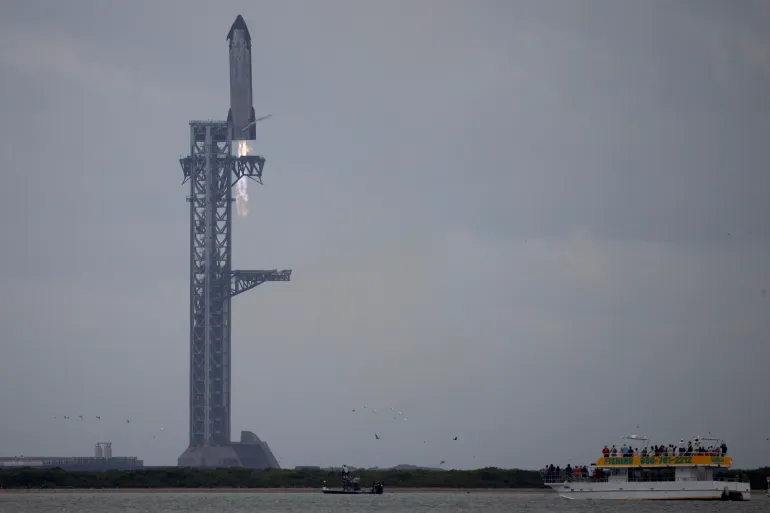
SpaceX has achieved a significant engineering milestone by successfully catching its massive Starship spacecraft midair using giant mechanical arms at its Texas Starbase facility.
This operation occurred 22 hours after the vessel’s departure, as it descended from a cloudy sky on Saturday and slipped precisely between the “chopstick arms” at Launch Pad 2.
This event marks the first time a Starship has been captured upon returning from space, a success that SpaceX officials note is vital for the company’s objective of achieving full, rapid, and cost-effective reusability.
Following the successful retrieval, SpaceX founder and CEO Elon Musk praised the “incredible team” responsible for the feat. The 124-metre-tall behemoth—the world’s largest and most powerful rocket designed for future Moon and Mars missions—performed well during its journey, with all systems, including its heat shield, appearing to function as intended. NASA Administrator Jared Isaacman commended the achievement on social media, describing the capture as “almost magic.”
The mission, which represents the 15th flight of a full-scale Starship since 2023 and only its second orbital trip, saw the craft complete 14 orbits around the Earth at an altitude of 265km. This duration significantly outpaces the one or two laps achieved during the previous mission. During the flight, the spacecraft successfully separated from its booster before reaching orbit, where it proceeded to deploy 26 advanced Starlink satellites. The upper-stage spacecraft soared into orbit and released 26 advanced Starlink satellites, separating neatly from its booster before things went awry. Starship completed 14 laps around the Earth, 265km (165 miles), outshining the previous mission’s one to two laps.
However, the mission experienced a technical setback regarding the first-stage booster. Shortly after Friday’s liftoff, the booster encountered an issue, as the guidance system detected incorrect positioning and automatically initiated a self-destruct maneuver over the water. SpaceX representative Kate Tice noted that the booster’s engines ceased firing prematurely on its return path. Engineers are currently investigating the specific cause, though the company has successfully performed three prior booster recoveries to validate the technique. The booster’s guidance system sensed it was not in the right position and automatically initiated the watery detour and self-destruction.
This mission remains a critical component of SpaceX’s broader objectives, particularly as the company prepares to launch from the Kennedy Space Center in Florida in the coming months. NASA, which has invested billions in the Starship program to facilitate the transportation of Artemis astronauts to the lunar surface later this decade, viewed the successful capture as a pivotal advancement in space flight technology.