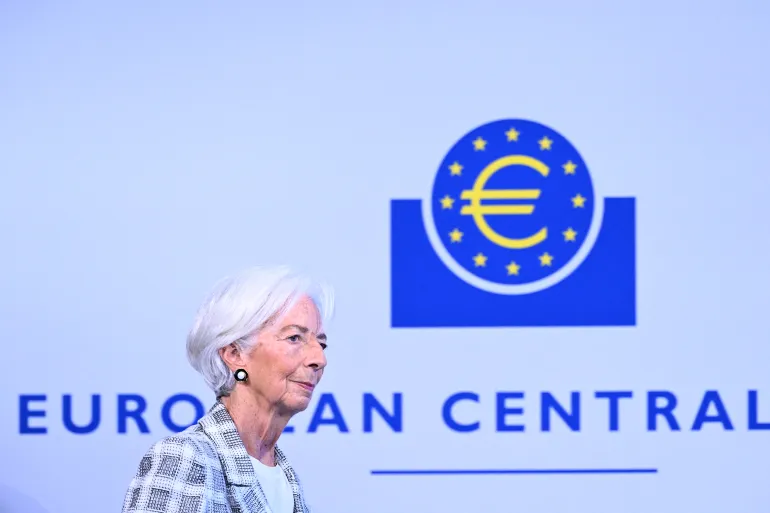
European Central Bank (ECB) President Christine Lagarde has announced she will step down from her position on February 7, ending her term approximately nine months earlier than originally planned. In a recorded video statement shared on X, Lagarde remarked that she is departing “with a sense of good work done and an ECB that is fit for the future.”
Her early departure has immediately prompted speculation regarding the selection of her successor. The timing of the announcement allows European leaders, including outgoing French President Emmanuel Macron, to engage in the appointment process before France’s upcoming presidential election, which polls indicate could see a victory for far-right candidate Marine Le Pen.
Macron expressed gratitude for Lagarde’s leadership, noting the “determined action she led at the head of the European Central Bank” during an era defined by consecutive crises. He emphasized that the transition of leadership must be handled in an “orderly and balanced manner” alongside European partners. German Chancellor Friedrich Merz also commended her, stating she managed the bank “with great aplomb during challenging times,” while EU Commission President Ursula von der Leyen thanked her for her contributions to Europe and the euro.
The announcement has drawn mixed reactions from political figures. Markus Ferber, a German member of the European Parliament, cautioned that the timing of the resignation could raise concerns about institutional independence, stating that it risks damaging trust in the bank if the departure is perceived to be linked to domestic political calculations. Conversely, French Finance Minister Roland Lescure praised her as an “exceptional President” who successfully modernized and fortified the institution during turbulent years.
Market participants appeared largely indifferent to the news. Simon Dangoor, head of fixed income macro investing at Goldman Sachs, indicated that institutional norms at the ECB are expected to remain consistent regardless of the leadership transition. Marcel Fratzscher, who leads the German Institute for Economic Research, suggested the vacancy provides a vital window for governments to choose a successor committed to protecting the ECB’s independence and European values.
Lagarde, who assumed the role in October 2019, navigated the financial institution through a series of unprecedented challenges, including the COVID-19 pandemic, the Russian invasion of Ukraine, and the conflict between the United States, Israel, and Iran.
Her tenure, however, was not without controversy. The ECB faced significant criticism for its perceived slow response to the 2022 inflation spike, which stemmed from post-pandemic supply chain issues and the impacts of the war in Ukraine. Currently, inflation remains nearly double the bank’s target rate of 2 percent, further complicated by concerns regarding France’s fiscal stability. Inflation is currently running at almost double the bank’s 2 percent target amid worries over France’s public finances.
As the first ECB chief to serve without formal economics or central banking training, Lagarde faced skepticism from market participants upon her arrival in Frankfurt. Nevertheless, she proved capable of using political diplomacy to manage historic market shocks, most notably in March 2020 when she navigated a crisis in sovereign debt markets. Sources close to the situation told the AFP news agency that stepping down early will grant her the freedom to express her perspectives more openly, fueling rumors that she may engage in the French presidential debate to advocate for a stronger European voice. A former French finance minister and head of the International Monetary Fund, Lagarde arrived in Frankfurt in 2019 as the first ECB chief with no formal economics training or central banking experience, prompting some market participants to warn of a “credibility risk”. According to in March 2020 as the pandemic shook sovereign debt markets, she, The bank was not there to narrow the gap between Italian and German borrowing costs.