20. Ring (1998): As the 20th century drew to a close, filmmakers faced an overreliance on CGI that threatened the impact of special effects. Japanese director Hideo Nakata countered this trend by utilizing old-school practical methods, culminating in a chilling moment where Sadako’s vengeful ghost exits the television screen after crawling out of a well. Just when you think the cursed VHS tape has claimed its last victim, Sadako’s vengeful ghost emerges from the well, comes closer … and climbs out of the television screen.
19. The Phantom Carriage (1921): Swedish director Victor Sjöström pioneered in-camera double exposure to visualize Death’s soul-collecting carriage, long before optical printing existed. Sjöström also starred in this folk-horror classic as the dissolute driver seeking redemption. Condemned to be the spectral vehicle’s driver unless he can mend his ways, sjöström also plays the dissolute antihero.
18. The Student of Prague (1926): This expressionist take on the Faust legend features Conrad Veidt as a student who strikes a deal with the devil, Werner Krauss, leading to the theft of his reflection. The doppelganger menace concludes in a notable split-screen showdown.
17. Nosferatu (1922): F.W. Murnau employed various in-camera techniques, including sped-up motion, flipped negatives, and stop-motion to create an uncanny atmosphere. The masterpiece ends with Count Orlok, played by Max Schreck, disintegrating into smoke upon sun exposure.
16. Dawn of the Dead (1978): Jim Krut is forever immortalized as the “Helicopter Zombie” in George A. Romero’s classic. Using splatter makeup effects by Tom Savini, the character meets his demise when a rotor blade slices off the top of his head.
15. Tetsuo: The Iron Man (1989): Shinya Tsukamoto introduced a low-budget, cyberpunk nightmare where a man’s body parts metalize. Through jump-cuts, stop-motion, and time-lapse photography, the film depicts a transformation that ends with a surreal drill-penis sequence. Finally, his penis turns into a giant drill and destroys a coffee table. His shrieks of agony turn into a howl, as his skeleton painfully reconfigures itself.
14. The Invisible Man (1933): James Whale’s adaptation features Claude Rains in his Hollywood debut. John P. Fulton utilized innovative special effects to show the character unwrapping his bandages to reveal an empty space beneath.
13. Dr. Jekyll and Mr. Hyde (1931): Fredric March secured an Oscar for his role in this film. Director Rouben Mamoulian achieved the transformation effect using Wally Westmore’s makeup paired with clever colored camera lens filters, a secret kept for 38 years. Sexy pre-code adaptation of Robert Louis Stevenson’s novella, fredric March won the best actor Oscar for his performance in this violent.
12. Eyes Without a Face (1960): Georges Franju’s black-and-white arthouse horror depicts a surgeon removing the faces of young women to heal his daughter. Once dismissed, it is now considered a highly influential work.
11. The Exorcist (1973): William Friedkin’s film is famous for the term “projectile vomiting” and the 360-degree head rotation. The latter effect relied on a life-sized animatronic dummy created by Dick Smith and Marcel Vercoutere. And the deleted “spider-walk” became legendary before its restitution, the pea-coloured puke popularised the term “projectile vomiting”.
10. The Birds (1963): Tippi Hedren’s attic attack scene, which required seven days to film, remains iconic. While editing provided much of the terror, live birds were attached to her clothing, with one beak narrowly missing her eye. The schoolchildren, the gas station are impeccable set pieces, but the attack on Tippi Hedren in the attic is particularly terrifying, the climbing frame. One of the psychic teenagers the scumbag has been trying to control zaps him with her full telekinetic force and kaboom.
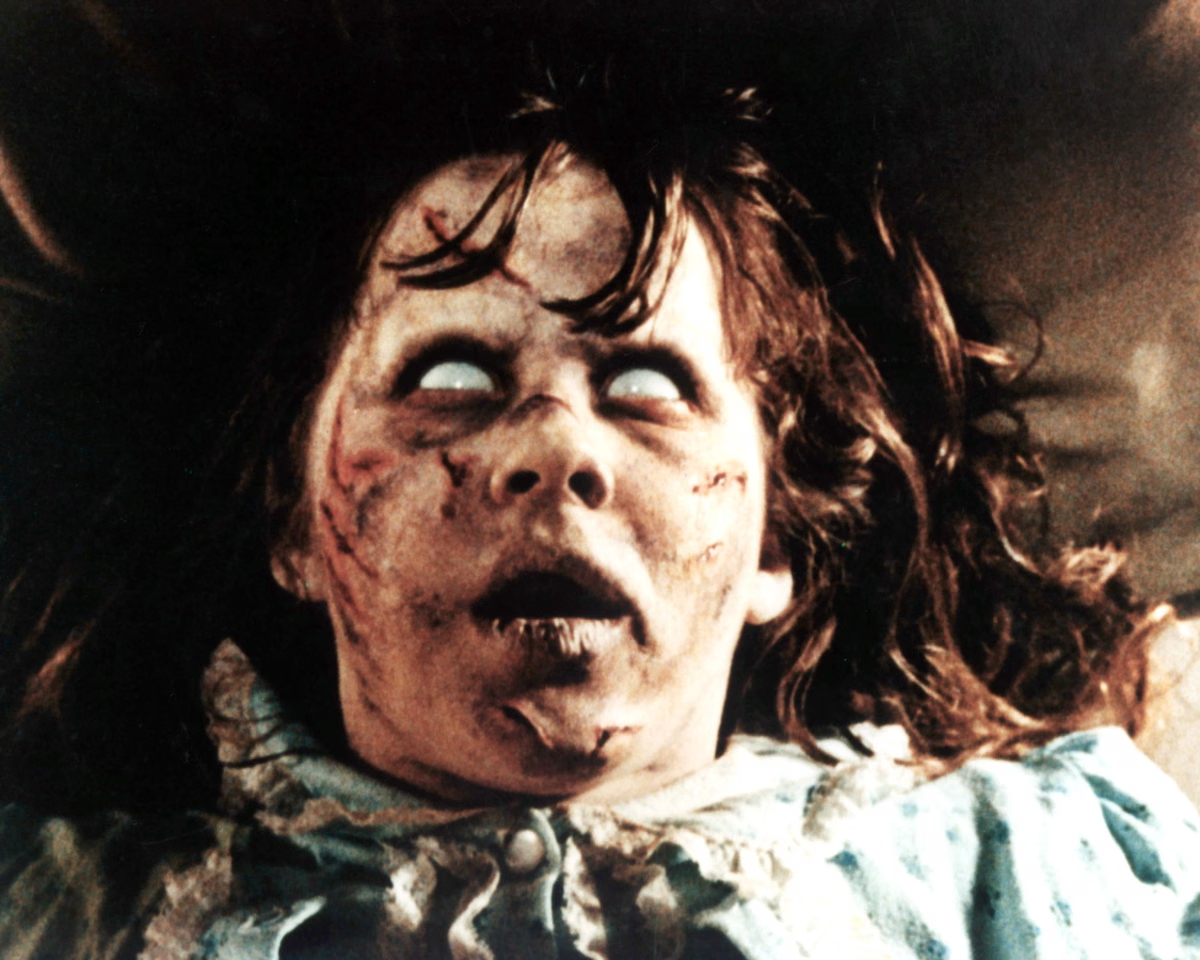
9. Eraserhead (1977): David Lynch designed the mutant baby creature for his feature debut, reportedly constructing it from an embalmed calf foetus with mechanical parts. The prop was ceremonially buried after filming. Where Jack Nance, he of the tumbleweed hair-do, ends up having to look after a chittering mutant baby, david Lynch’s first full-length feature is set in an industrial hellscape.
8. The Omen (1976): John Richardson supervised the scene where photographer Keith Jennings, played by David Warner, is beheaded by a sliding sheet of glass. The prop head remained with Warner for years until his divorce. The only weapons effective against Damien the Antichrist – and is beheaded by a sheet of glass sliding off a runaway truck, photographer Keith Jennings (David Warner) stoops to retrieve the Daggers of Megiddo.
7. The Howling (1981): Rob Bottin’s first solo effect effort featured a transformation using pulsating air bladders. Robert Picardo’s character delivers a grisly line about sharing his brain before turning into a beast. Co-written by John Sayles, shows Robert Picardo (AKA Star Trek’s holographic doctor) saying “I’m gonna give you a piece of my mind” and offering a bit of his own brain to a horrified Dee Wall, joe Dante’s werewolf satire. Take another bow, Rob Bottin, who riffs on elements of human and animal anatomy in surreal sculptures that are simultaneously repulsive and beautiful.
6. The Fury (1978): Brian De Palma’s film includes a memorable climax where a psychic teenager uses telekinesis to cause a villain’s head to explode, a sequence featuring practical effects by Rick Baker.
5. Society (1989): Brian Yuzna’s satire features an orgiastic “shunt” sequence at the end, where the wealthy elite merge into a singular mass. The surreal effects were created by Screaming Mad George.
4. Scanners (1981): David Cronenberg’s thriller contains an iconic scene where Michael Ironside’s character causes another’s head to explode. Dick Smith and Chris Walas achieved this by packing a plaster skull with scraps of food and blasting it with a shotgun. One telepath’s demonstration of his ability is hijacked by a more powerful scanner (Michael Ironside) who makes his head explode. A geologist’s head separates from his body, sprouts spider-legs and tries to scuttle away, in one of the highlights.
3. An American Werewolf in London (1981): Rick Baker won an inaugural makeup Oscar for his work on this film. The scene of David Naughton’s painful, bone-shifting transformation into a werewolf remains a benchmark of the genre. As Sam Cooke’s Blue Moon plays on the radio, David Naughton stares aghast at his hand turning into a werewolf’s paw.
2. Alien (1979): The chest-burster scene features an eruption from John Hurt’s torso that genuinely shocked the cast. Ridley Scott designed the creature, while Roger Dicken constructed the mechanical torso filled with animal entrails. But didn’t know precisely what, so when a critter erupts out of John Hurt’s chest, their shock is almost as extreme as the audience’s, the rest of the cast knew something was about to happen.
1. The Thing (1982): A shapeshifting alien infiltrates an Antarctic research station, where the tension boils over as characters like “Palmer the pothead,” played by David Clennon, react to the horror with the line: “You’ve gotta be fucking kidding.”