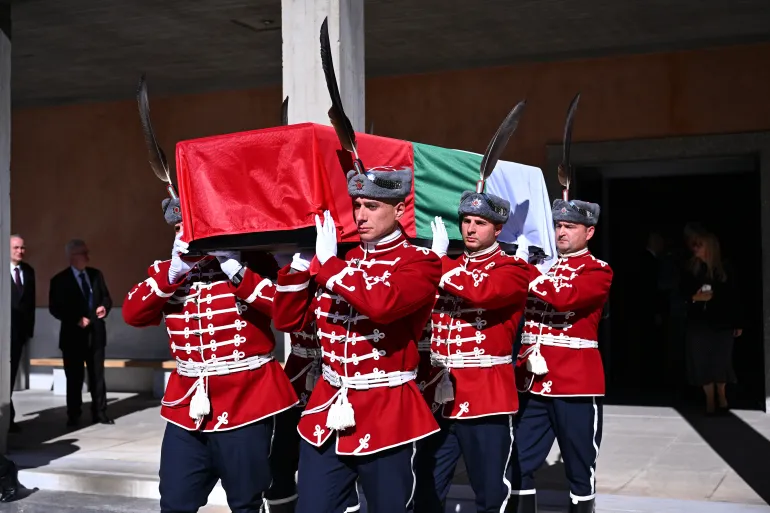
More than 1,000 years after his passing, the remains of Czar Samuel, a prominent medieval ruler, have been repatriated to Bulgaria. The warrior emperor, a central figure in the nation’s identity, spent his life battling the Byzantine Empire to expand his kingdom before his eventual defeat and death in 1014. His supposed remains were discovered in the 1960s within a Greek border region. A 42-year-old software engineer, told the AFP news agency he attended the ceremony “to welcome Czar Samuel back to Bulgaria, where he belongs”, martin Nestorov.
To mark the homecoming, the remains were transported on Saturday to Sofia via a military aircraft escorted by fighter jets, drawing thousands of spectators to a public square. The formal ceremony included a 21-gun salute and the performance of the national anthem, with political leaders from across the spectrum in attendance to honor the historic return. Crowds cheered as fighter jets performed a flypast.
Bulgarian Prime Minister Rumen Radev addressed the crowd, emphasizing a forward-looking perspective. “Today, we Europeans are learning to read history with a desire to belong not only to our homeland, but also to the culture that unites us across the entire European continent,” he noted. Radev further stressed that the continent must move past old divisions, adding, “That is why Europe must not reopen old wounds but must work for peace as the supreme good.” “I am here because I am Bulgarian, and a Bulgarian is returning to his homeland,” added Tsanka Zlatkova, 65, a retired art historian.
The return of the czar’s remains follows intensive diplomatic negotiations between Bulgaria and Greece. Under the terms of the agreement, Bulgaria is returning 48 artifacts to Greece that were seized from churches and monasteries by Bulgarian troops during the First World War. For local citizens, the event was a deeply emotional moment, with many describing the return to the Church of Saint Sofia—where the czar was reportedly baptized—as a significant homecoming. Which capped years of fraught negotiations between Bulgaria and Greece until an accord was reached this week, thousands of people poured into a public square to honour the czar’s arrival.
The diplomatic significance of the transfer extends beyond regional relations. Greek Prime Minister Kyriakos Mitsotakis noted that the repatriation effort aligns with broader international discussions regarding cultural heritage. He expressed hope that such successes would bolster Greece’s ongoing campaign to recover the Parthenon Marbles, which were removed from the Acropolis in Athens and are currently held in the British Museum.
“The global community is essentially re-evaluating its longstanding stance on protecting cultural heritage,” Mitsotakis remarked, asserting that such heirlooms cannot be viewed as the spoils of war. Despite the historic significance of the ceremony, the legacy of Czar Samuel remains a subject of regional debate. His prominence is such that North Macedonia also claims him as a national ruler, evidenced by a large statue dedicated to the czar located in the capital city of Skopje.