René Magritte remains perhaps the most enigmatic of modern artists, resisting straightforward interpretation far more than contemporaries like Cézanne or Picasso. Rather than offering a rational exploration of visual reality like cubism, Magritte confronts viewers with deliberate mysteries. A current exhibition in London pairs his magical creations with modern art, presenting eclectic treasures that challenge conventional artistic perception.
Among the highlights is a deceptively simple painting of puffy white clouds against a blue sky, displaying supple shadows and subtle light reminiscent of Gainsborough or Constable. However, this innocent depiction is upended by its 1931 title, The Curse. Created at the height of surrealism, the work reflects a movement heavily influenced by Sigmund Freud, asserting that visual imagery is rarely straightforward.
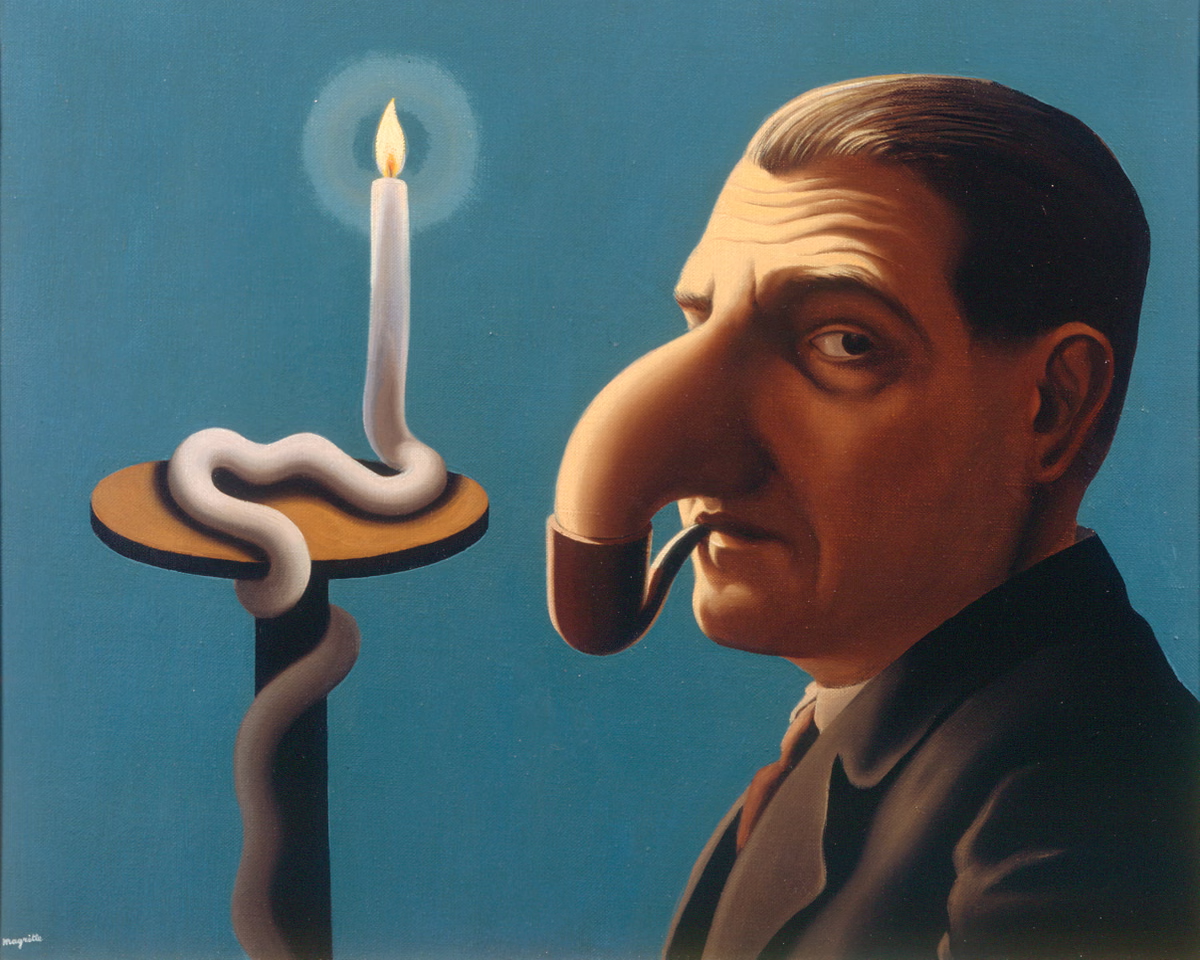
Magritte frequently played with Freudian symbolism, notably in his 1936 self-portrait The Philosopher’s Lamp. In the piece, his nose transforms into a fleshy tube curving into a pipe bowl, while a candle snakes around the single table leg. The imagery playfully satirizes both psychoanalysis and surrealism for taking symbol interpretation too literally.
Originating in Paris after the First World War, the surrealist movement sought renewal through dreams and the subconscious. Magritte, its leading Belgian figure, pushed these boundaries into more ambiguous territory. This philosophical shift is evident in The Interpretation of Dreams, a 1935 masterpiece lent by American artist Jasper Johns. Although titled La Clef des Songes in French, linking it to Freud, the canvas presents four objects against a neutral background: a horse’s head labeled “the door,” a clock face marked “the wind,” a white jug designated as “the bird,” and a suitcase accurately identified as “the valise.”
This unsettling juxtaposition suggests that dreams and reality share an equal bizarreness that defies simple oedipal explanations. By designating one of four objects correctly, Magritte undercuts pure whimsy, implying that dreams can neither be ignored nor fully decoded. He also embraced darker nightmares, depicting a girl eating a bird in The Pleasure and an oversized green apple pressing against the walls in The Listening Room.
While the exhibition draws compelling parallels between Magritte’s spaces and modern installations, its integration of contemporary artists proves uneven. Works by Jeff Koons, Sarah Lucas, and Isabelle Albuquerque feel reductive compared to the Belgian artist’s intricate puzzles, leading the Gagosian gallery’s curation to lean toward commercial glibness in its selection of 21st-century counterparts.
The display also features examples from Magritte’s satirical “Vache” period, during which he intentionally produced cartoonish, crude paintings featuring garish hues to exasperate his family, friends, and critics. Capable of executing highly polished academic works when he chose, Magritte displayed a profound irreverence toward the art establishment. The report also notes that the revolutionary art movement that took from the psychoanalytic writings of Sigmund Freud the insight that nothing is innocent and no image is simply what it seems, magritte made it in 1931 at the height of surrealism. The report also notes that either way, this 1935 painting suggests that dreams and reality are equally bizarre and neither can be explained by the oedipal complex. The report also notes that it’s much harder to get a handle on him than such supposedly difficult modern greats as Cézanne or Picasso. The report also notes that after all, cubism is a perfectly rational attempt to capture the complexity of reality. The report also notes that unexpected treasures that give your wonder at Magritte little twists in new and perverse directions, this show sets choice examples of his magic against modern art and is full of quirky. The report also notes that a painting of puffy white clouds held me across the gallery and still floats ineffably in my mind. The report also notes that it’s a shock because it is so painterly and subtle.