In her latest feature, director Jane Schoenbrun tackles the complexities of intimacy and personal discovery through a unique blend of horror and romantic comedy. The film, titled “Teenage Sex and Death at Camp Miasma,” serves as both an homage to 1980s slasher cinema and a bold critique of the genre’s traditional tropes. Rather than framing sexual activity as a precursor to doom, the narrative posits that true sexual fulfillment is linked to one’s ability to be fully present within their own body and identity.
Schoenbrun, a 39-year-old trans filmmaker, describes the project as a direct reflection of her own journey, noting that she spent many years prior to her transition feeling dissociative and avoidant regarding intimacy. She suggests that achieving healthy sexual connections is difficult without a grounded sense of self, an insight that drives the film’s central narrative arc. After receiving the Queer Palm at the Cannes Film Festival, the film has gained significant attention as a mainstream evolution for the director, featuring a notable cast including Hannah Einbinder and Gillian Anderson.
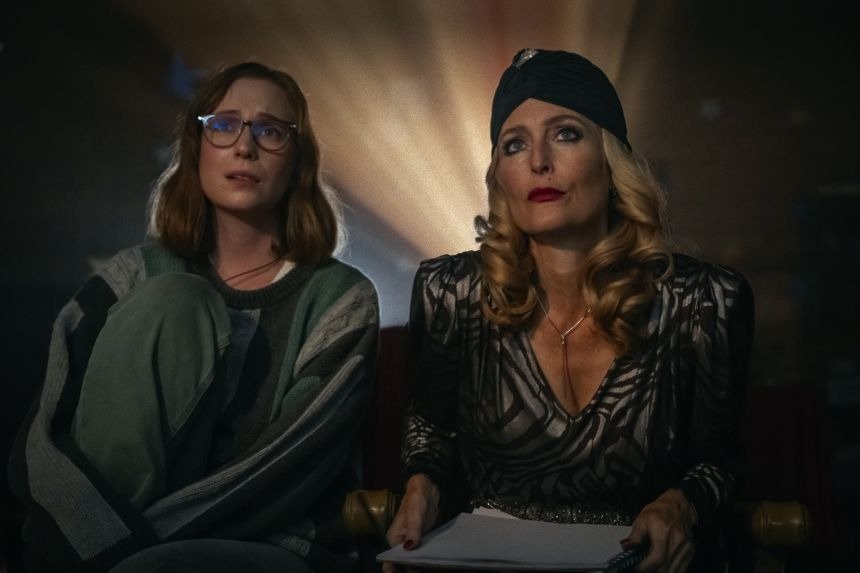
The story follows Kris, a queer filmmaker played by Einbinder, who is tasked with revitalizing a stagnant 1980s film franchise. Her agent, played by Sarah Sherman, highlights the industry’s demand for “elevated” or “woke” content. In her search for creative inspiration, Kris tracks down Billy, the “final girl” from the original production, portrayed by Anderson as a mysterious recluse living on the desolate grounds where the original movie was filmed. Their developing romance serves as a lens through which they explore their disparate approaches to life, art, and desire.
The film addresses the concept of dissociation through the character of Billy, whose first sexual experience is framed as a haunting, hollow event where she felt forced to detach from her own body. This experience is juxtaposed with the film’s silent antagonist, “Little Death,” a figure wearing a helmet modeled after a ventilation duct—a symbol for the detached, observational perspective often felt during unsatisfying sexual encounters. By using horror tropes as a metaphor for the struggle to stay present, the film suggests that, much like a roller coaster, horror can provide a form of “safe danger” that allows individuals to confront and heal vulnerable parts of themselves.
Throughout the production, Schoenbrun sought to capture the vulnerability of queer intimacy, moving away from the lurid or clichéd representations found in historical cinema. She described the process of directing these scenes as emotionally visceral, paralleling the characters’ growth toward self-actualization. For Kris and Billy, the horror set becomes a space of reclamation, where they can discard restrictive scripts and redefine their interactions. The film ultimately portrays this journey as a “sugar rush” that remains tender at its core, emphasizing that reclaiming one’s narrative—whether in sex or in life—is an act of personal empowerment.
According to film critic Payton McCarty-Simas, the work effectively captures the specific struggle of being queer and the difficulties involved in achieving intimacy. By blending elements of a stoner romantic comedy with an erotic thriller, Schoenbrun critiques the transphobic history of horror while creating a space for characters to explore their identities. The film suggests that true intimacy is found not by retreating into the safety of fantasy, but by learning to inhabit one’s own reality, even when that process feels as frightening as any on-screen monster. The report also notes that in her eyes, you can see that she’s not entirely there – she’s somewhere else, like a spectator, outside her body looking in. The report also notes that director Jane Schoenbrun’s slick new slasher fantasy film, “Teenage Sex and Death at Camp Miasma,” paints the banalities of bad sex like the one Billy (the aforementioned teen, played by Amanda Fix) has as a villain on par with Jason Voorhees or Michael Myers – and makes an argument for pursuing fantasy and pleasure as a path to self-actualization. The report also notes that but it’s sex — and the struggle to be present enough to have it well — that provides the most fertile material for Schoenbrun to play with. The report also notes that “ I Saw the TV Glow ” helmer Schoenbrun has become something of a cult sensation for their reference-rich experiments in horror, which are at once cerebral – Foucault references are dropped deftly – and emotionally hefty. The report also notes that she finds the older star – played by Anderson as an elegant femme fatale with a luxurious Southern twang – living as a mysterious recluse a la Norma Desmond on the real abandoned camp where the original movie was filmed. The report also notes that flirting over junk food and discussing their approaches to life and art, the tension between the two is alive and pulsing as they dance around each other on Billy’s eerie compound. The report also notes that things don’t quite work, but when they first fall in bed together.