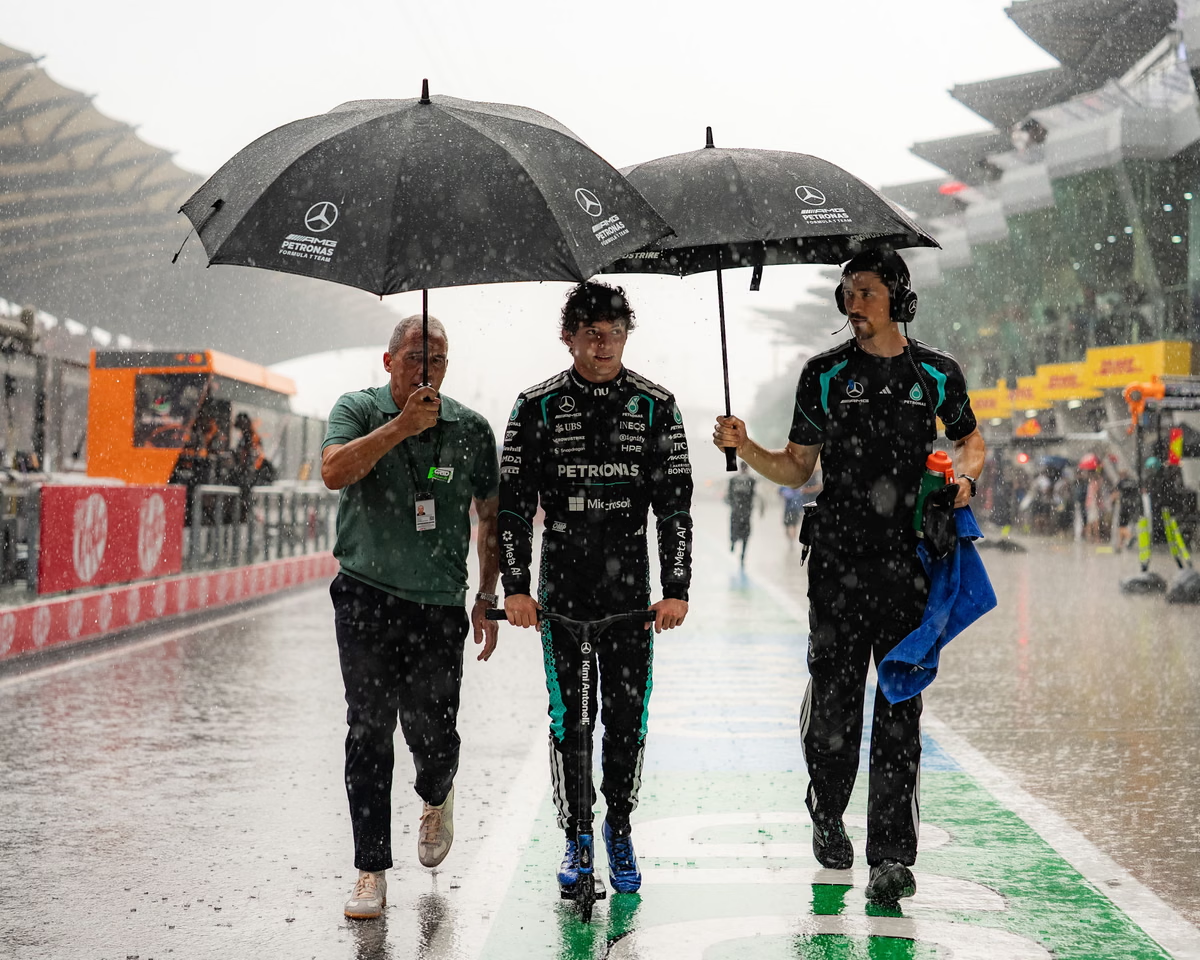
Formula One’s current engine regulations faced severe backlash from the grid following the chaotic Bahrain Grand Prix at Sepang. The event was marred by technical failures that left cars struggling to move during the formation laps, resulting in a 53-minute delay as teams scrambled to address software issues exacerbated by wet track conditions. Red Bull’s Max Verstappen won in Sepang but only after F1 suffered the embarrassment of a host of cars barely able to complete two formation laps in the wet as they were making their way to the grid. I’ve never done that before,” he said, while Verstappen reiterated his previous criticism of the engine regulations. “What can you say. The start had to be aborted and the field returned to the pit lane to have the software.
Championship leader Kimi Antonelli of Mercedes described the situation as “insane,” noting that cars were moving five-wide on the straight because drivers were confused about the erratic behavior of their vehicles. Lewis Hamilton also reported needing to stop his car and perform a full power-unit restart on the track, an experience he noted as unprecedented in his racing career.
The root cause was identified as software designed to manage engine power that had not undergone sufficient testing for low-grip, wet-weather scenarios. The FIA categorized the result as “an unintended loss of power.” Lando Norris, the defending world champion, labeled the ordeal “just horrible,” arguing that the current electronic-heavy formula represents a significant misstep for the sport.
Max Verstappen, who secured the win in Sepang, reiterated his longstanding frustrations with the power unit rules, questioning the direction the sport has taken and expressing hope that lessons would be learned from the embarrassment. Williams’ Carlos Sainz echoed these sentiments, suggesting that the governing body needs to re-evaluate how it arrived at such an overly complicated regulatory environment that taxes drivers, manufacturers, and teams alike.
Nikolas Tombazis, the FIA’s single-seater director, admitted that the governing body was caught off-guard by the software bug. He explained that a lack of wet-weather running throughout the season prevented comprehensive testing. The error occurred when cars slowed significantly during the formation lap, creating a concertina effect that prevented power from being properly redeployed, effectively causing the machines to stall. “We didn’t manage to test the software as extensively as we would have liked because there’s been very little wet running this year and there was a bit of a combination of circumstances which caused this bug to kick in,” he said. “Basically, the formation lap, some cars went very slowly, almost came to a standstill.
While the FIA managed to push through a software update to resolve the immediate crisis, the incident has reignited debates regarding the current 50-50 split between combustion and electronic power. Although no changes are planned for the remainder of this season and only minor adjustments are expected for next year, the sport is looking toward more substantial regulatory overhauls in 2028. The formula, an almost 50-50 split between electronic and combustion power, will not be changed this season with a minor adjustment next year and more serious change in 2028, but the issue had once more raised the question of how the sport reached this point.