
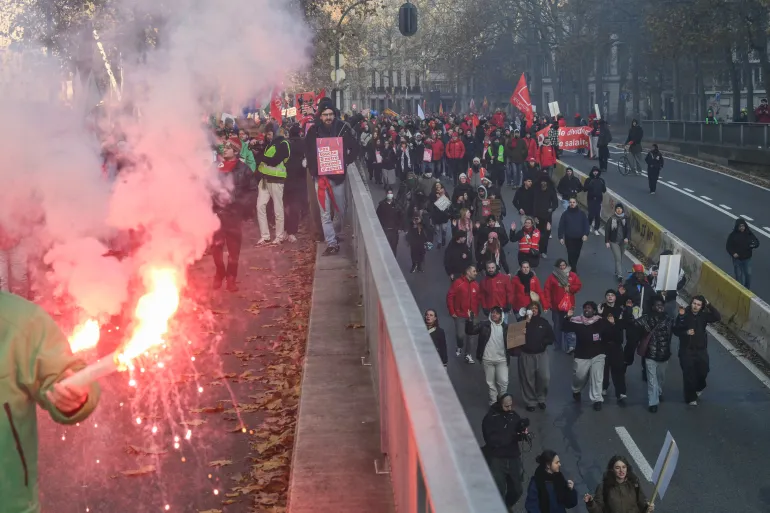
A national strike organized by trade unions against the Belgian federal government’s proposed austerity measures has brought public transport and flight operations across the country to a standstill. The nationwide walkout on Monday severely disrupted train and bus services while impacting schools and multiple public services. Trains, schools, and other public services, the national strike has also caused disruption to buses.
Air travel experienced major turmoil after the national air traffic control agency, Skeyes, declared it could not maintain normal operations. Brussels Airport announced that “unfortunately, all departing and arriving flights from 7am to 9pm local time (06:00-20:00 GMT) will have to be cancelled.” Flight operations were similarly suspended at Brussels’ Charleroi airport, a key hub for low-cost carriers such as Ryanair. The Board of Airline Representatives in Belgium, representing approximately 25 airlines, noted that this event marks the 11th strike action affecting Belgian airspace within the past 11 months.
The labor action comes amid heightened public anger targeted at Prime Minister Bart De Wever over fiscal belt-tightening. His administration is attempting to trim 10 billion euros ($10.9bn) from the national deficit in the coming years. Proposed measures include healthcare spending reductions and a value-added tax (VAT) increase. In contrast, trade unions demand higher taxes on high earners to protect public services amid rising living costs affecting Belgium and broader Europe. But the issue is dividing the ruling coalition and threatens to collapse the government, the Belgian government is trying to save 10 billion euros ($10.9bn) in the coming years to reduce the country’s high deficit.
The political stalemate over fiscal strategy threatens the survival of the governing coalition. After a week of unsuccessful negotiations, Prime Minister De Wever tendered his resignation to King Philippe, who declined to accept it to allow further budget discussions. De Wever has now established a deadline of December 31 for the coalition to agree on next year’s budget. A statement from the prime minister’s office warned, “Should we not have a budget agreement [before the end of the year], the government will effectively be unable to govern, thereby bringing its existence to an end.” But the monarch refused to accept it, giving him more time to find a solution to the budget impasse, de Wever has already offered King Philippe his resignation.