South Korea’s Minister of Education, Choi Kyo-jin, has officially resigned following a chaotic period leading up to the nation’s crucial university entrance exams, known as the suneung. The departure follows a public outcry sparked by a major cheating scandal involving artificial intelligence, which left the government scrambling to implement last-minute security measures. South Korea goes to great lengths to ensure the smooth running of the suneung.
The controversy began last Sunday when the individual who achieved the top score in a national tax accountancy exam confessed to using illicit technology to cheat. The person admitted to using a micro-camera to photograph exam questions, transmitting them to an AI system, and then receiving answers via a smartphone. The confessor admitted that their top placement was not the result of legitimate effort.
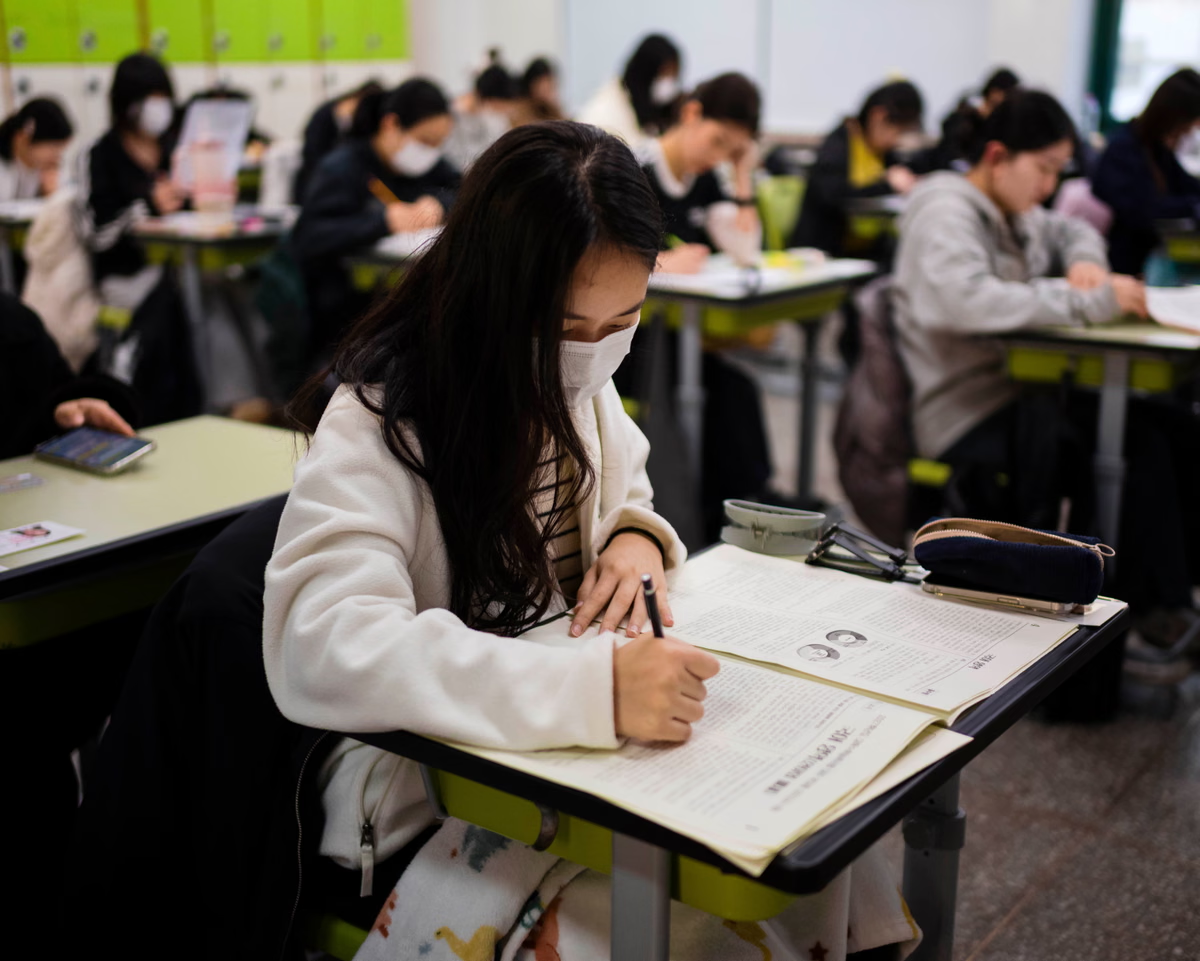
This confession triggered widespread alarm just four days before the Suneung, which determines a student’s university prospects and future career paths. In response, authorities implemented extreme security measures to prevent similar incidents. These included blocking public Wi-Fi near testing centers, doubling the number of supervisors, and sending mandatory, high-volume emergency alerts to all mobile phones in the country to identify devices that had not been surrendered. Well-paid jobs and even better marriage prospects in the highly competitive country, it is widely seen as a ticket to prestigious universities. The scandal has rattled a country where standardised tests largely dictate social mobility and career trajectories.
Students were restricted to using only pencils, with test centers providing erasers to minimize the risk of digital devices hidden within stationery. Candidates were also instructed to avoid clothing with buttons; those who failed to comply faced having stickers applied over their buttons to mask potential hidden cameras. Furthermore, officials performed manual inspections of candidates’ glasses, watches, sleeves, and collars. As authorities tried to reduce the chances of concealed digital devices disguised as stationery, erasers were provided by the test centres.
The intensity of the suneung, an eight-hour exam, is such that South Korea takes extreme precautions annually: aircraft are grounded during the English listening portion, military maneuvers are suspended, the stock market opens late, and traffic is diverted near centers. Following the recent scandal, the government went further, offering a reward of at least $75,000 for reports of misconduct and promising reduced penalties for those who identified accomplices. The government promised a reward of at least $75,000 (£57,300) for anyone reporting cheating or misconduct, with reduced penalties for those who turned in their accomplices. While artillery fire and tank movements are suspended, aircraft takeoffs and landings are rescheduled during the 25-minute English listening paper to minimise noise. The stock market opens an hour late and cars are stopped 200 metres from every centre.
Minister Choi, 72, faced heavy criticism after a parliamentary hearing on Monday where he was asked if he was confident that authorities could prevent cheating. His response—”Due to my age, I am not confident I could”—drew significant backlash from the public and teachers’ unions, who felt the official response was too slow. Choi ultimately did not appear at pre-exam press conferences, leaving a vice-minister to announce the new protocols.
In a statement posted to X, Choi wrote: “The exam concluded without any major incidents … However, as the minister in charge, I do not believe I am immune from public criticism that we failed to prepare adequately in advance. Now that the exam is over, I take full responsibility and hereby offer my resignation.” President Lee Jae Myung has since accepted the resignation.
Official data indicates that 111 cases of misconduct involving electronic devices were identified during the exam held last Thursday, with nearly half of these detections attributed to the emergency alert system. Additionally, a high-school student had previously filed a constitutional petition to stop the exam from proceeding as planned, but the court rejected the request due to a lack of evidence of irreparable harm.
Moving forward, authorities have underscored the severity of these infractions. Under current guidelines, any student caught cheating on the suneung may face criminal prosecution and be barred from retaking the examination for a period of 10 years.