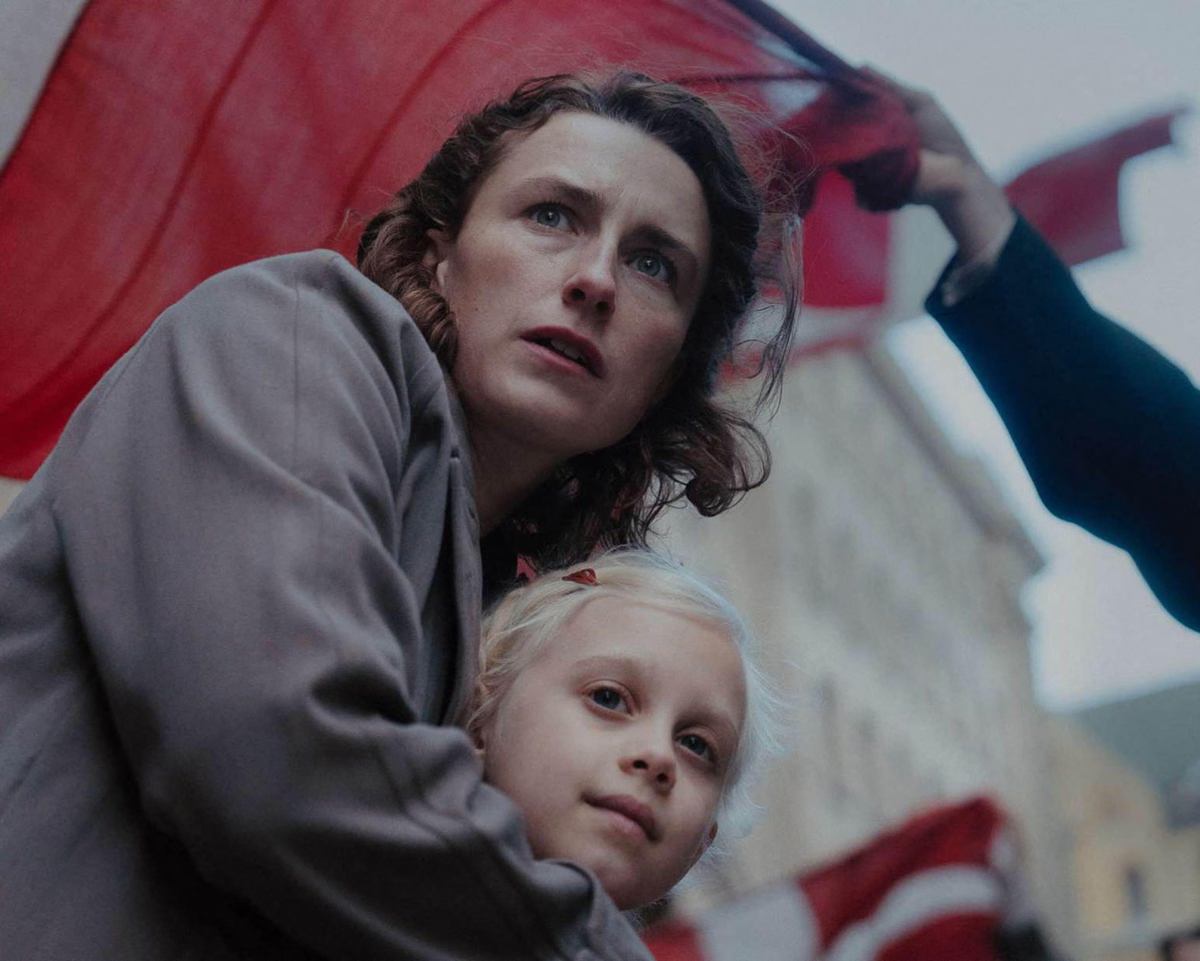
A young maid busies herself in a vast, high-ceilinged apartment, serving her master steaming coffee in fine china and polishing the hefty family silver as she moves across checkerboard parquet floors. The trauma of wartime violence comes rushing back in occasional bursts, where blurry flashbacks show shadowy figures pointing guns at temples and bodies thudding to the floor. However, when the red fabric of the Dannebrog billows through the fog of Copenhagen, it signals not peace, but the beginning of a fresh nightmare. To the maid, Marie, who carried on a sexual relationship with an occupying German officer, liberation day does not mark the end of terror. Instead, she lives in constant fear of the public, ritualised humiliation directed at female “horizontal collaborators” on the streets of Denmark’s capital. However, the film asks, was her wartime conduct any more shameful than that of her factory-owning employer, who shored up his wealth by continuing to do business with the Germans.
Directed by May el-Toukhy, the movieWoman Unknownscheduled for UK release in March 2027—is part of a new raft of high-profile cinematic productions revisiting Nazi-occupied Europe through the eyes of turncoats and collaborators. Other recent projects include Emmanuel Marre’s filmA Man of His Timewhich was released in France earlier this year, Xavier Giannoli’s forthcoming adaptationRays and Shadowsand the Dutch television seriesThe Shadow of Resistance. For decades, postwar European cinema treated resistance and collaboration in stark, black-and-white terms, focusing primarily on heroic freedom fighters while treating despicable traitors as unmitigated villains. This new slate of films, however, chooses to linger in uncomfortable moral grey zones. Released in France in September as Notre Salut, tells the story of a careerist bureaucrat clambering up the administrative rungs of the Vichy regime, while Xavier Giannoli’s Les Rayons et les Ombres, or Rays and Shadows, paints a controversially sympathetic portrait of Jean Luchaire, a pacifist advocate of Franco-German reconciliation, who ended up a fervent pro-collaboration, emmanuel Marre’s A Man of His Time. But for most of the postwar era directors have approached them from the point of view of those who stood up against totalitarian rule: the resistance fighters of Roberto Rossellini’s Rome, Open City, filmed on the streets of the Italian capital just months after liberation; the Montmartre theatre-owners who hide Jews in their basement in, resistance and collaboration are hardly taboo subjects for European film. François Truffaut’s The Last Metro; or a Jewish spy infiltrating Nazi ranks in Dutch director Paul Verhoeven’s Black Book.
Exploring the Moral Grey Zones of Occupation
This nuanced cinematic shift reflects a broader historical re-evaluation. Giannoli’s film, for example, takes direct inspiration from a famous line by Victor Hugo: “Every man on earth has two faces, Good and Evil. To blame everything is to understand nothing.” In 1974, when director Louis Malle releasedLacombe, Luciena provocative feature detailing a 17-year-old French country boy who casually joins the Gestapo after being rejected by the local resistance—it scandalised France. Malle was widely accused of failing to choose a moral side. Yet, as far-right nationalist political parties gain ground across Europe, some critics wonder if there is something troubling about films that prompt audiences to empathise with those who aligned with oppressors rather than those who fought them. He is sceptical of those who say yes. “I have a problem with that kind of moral grandstanding,” he says. “If you haven’t lived under a dictatorship, how do you know what you would have done?”. The bureaucrat decides to give them only five trucks, with half the amount, instead of supplying the German side with the 25 trucks they have demanded in order to vanish French Jews off to concentration camps in the east.
Many prominent historians argue that these contemporary films simply offer a far more realistic portrayal of everyday life under Nazi occupation. “One of the biggest myths people told themselves after 1945 was that Europe liberated itself,” explains historian Halik Kochanski, author ofDaily Life in Occupied Europe. Kochanski notes that armed resistance across the continent was “generally much smaller than people tend to think,” estimating that active combatants comprised “no more than 5% of the population in most countries.” The willingness and capacity to fight back depended heavily on geography, local governance, and brutal reprisals.
Varied Contexts Across Occupied Nations
The nature of occupation differed radically across European borders. In Poland, German forces executed a ruthless policy to partition the nation, eliminate its intelligentsia, and erase Polish culture entirely, leaving little room for compromise. Conversely, western European nations faced vastly different circumstances. The Netherlands possessed no recent history of foreign occupation and had a flat terrain that rendered armed resistance a massive logistical challenge. Meanwhile, in neutral Denmark, which the Nazis seized in 1940 primarily to secure access to the Baltic Sea, King Christian X remained on the throne and the domestic political system was initially permitted to hold free elections. Consequently, Danish resistance remained notably low-key until the German military instituted strict martial law in 1943.
Even within intellectual and artistic spheres, the lines of collaboration were frequently blurred. Literary historian Narve Fulsås recently discovered that Norwegian literature Nobel laureate Sigrid Undset—an iconic anti-fascist figure who fled to the United States when German troops invaded—continued to be published and read in Germany right up until 1940, despite her explicit opposition to the regime.
Moral Compromise and the Concept of Civil Resistance
In France, a nation that actively mythologised its underground resistance after the war, public dissent was not widespread until the Nazi regime instituted forced labour policies in 1942. Like Henri Marre, the protagonist featured inA Man of His Timenumerous French citizens harboured distrust toward the occupiers but easily persuaded themselves that working alongside them served the greater national interest. “We can’t let the Germans call the shots,” Marre tells a colleague in the film, justifying his administrative cooperation.
As historian Kochanski points out: “The Vichy regime and the collaborating administrations in the Low Countries all said, ‘We are the shield that will protect our populations from the worst of German depredations.’” However, active civilian resistance carried terrifying consequences for entire communities. On 10 June 1944, a German Waffen-SS unit slaughtered 642 civilians in the French village of Oradour-sur-Glane as direct retaliation for the French resistance killing a Nazi officer nearby.
Because armed opposition carried such devastating costs, non-violent and subtle resistance proved essential. “One mistake people make,” Kochanski emphasizes, “is that they see resistance as meaning armed resistance.” In occupied Norway, widespread resignations among judicial and religious authorities, sports associations going on strike, and ordinary citizens inundating the Quisling education ministry with formal protest letters successfully undermined the regime’s Nazification agenda.
Dual Roles and the Complexities of Heroism
Visual records from the era also illustrate these deep historical contradictions. An exhibition dedicated to Dutch photographer Violette Cornelius at the Nederlands Fotomuseum in Rotterdam highlights how artists operated during wartime. Initially formed to assist fellow creatives, Cornelius’s underground group eventually forged over 80,000 official documents and ration cards to help individuals hiding from the Gestapo. Yet, even in these heroic acts, moral ambiguity persisted. One of a handful of artists in the Nazis’ notorious “degenerate art” exhibition who were also fully paid-up members, fulda caused a stir in Berlin in 2019 with an exhibition about the political affiliations of Emil Nolde.
“Photographers played a kind of double role in the resistance,” explains Loes van Harrevelt, curator of the Rotterdam exhibition. “Some used their official press passes or commercial studios as covers while secretly capturing evidence of Nazi atrocities or forging identity papers.” This duality demonstrates that survival and defiance were constantly intertwined, challenging simplified postwar narratives.
Reflecting Modern Perspectives on History
Historians suggest that today’s audiences are far more willing to engage with historical moral grey areas than previous generations were. “In the 1980s,” notes historian Daniel Fulda, “the moral righteousness that is required to say, ‘You guys would have supported the fascists and I wouldn’t’ came much more easily to people.” Modern cinema reflects a growing recognition that ordinary individuals were caught in impossible, terrifying predicaments.
Filmgoers will have ample opportunity to explore these complex historical themes in upcoming releases. BothA Man of His TimeandRays and Shadowsare featured in screenings at the French Film Festival in London. The exhibition on Violette Cornelius remains open at the Nederlands Fotomuseum through 28 February 2027, while May el-Toukhy’sWoman Unknownarrives in UK cinemas in March 2027.