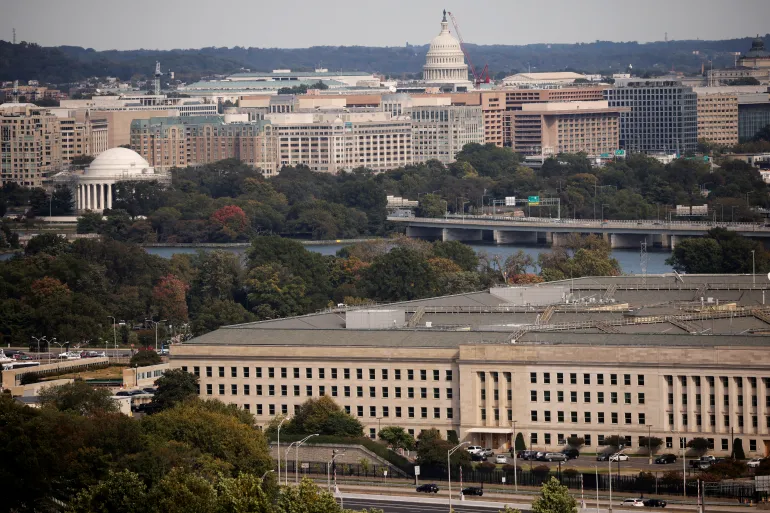
Following a significant performance in the United States midterm elections, lawmakers are exploring their capacity to remove a contentious provision from a massive Pentagon funding package. The measure, currently embedded in the Fiscal Year 2027 National Defense Authorization Act (NDAA), would formalize the integration of American and Israeli military industrial sectors. In July, Senator Chris Van Hollen joined six colleagues in rejecting the provision.
The NDAA is a sprawling $1.15 trillion legislative package. Earlier this year, Democratic leadership signaled opposition to the bill, citing concerns over funding for President Donald Trump’s military initiatives, including the “Golden Dome” missile defense system and the “Trump-class” battleship program. Senate Minority Leader Chuck Schumer and other top officials have previously tied their resistance to the broader costs impacting American citizens and the administration’s ongoing military engagement in Iran. But while a version of the funding package passed the Republican-controlled House of Representatives in May, Democrats delayed the Senate version via a procedural vote in July. To be sure, Democrats, eager to show they are delivering on voter affordability concerns, have signalled they will seek some overhaul to the current NDAA and related supplemental bills. Who wrote in a July “dear colleague” letter that Republicans were seeking a Pentagon funding bill “that would dump billions more into the defense industry while long overdue investments in American communities wait”, he echoed Schumer. Fuelled by the genocide in Gaza, bendaas also pointed to public opinion polls suggesting widespread opposition to US military support for Israel.
Controversy centers on Section 219 of the Senate version of the bill, which mandates the establishment of the “United States-Israel Defense Technology Cooperation Initiative.” The provision aims to accelerate and expand bilateral cooperation in research, development, testing, and evaluation of defense technologies. Critics warn that this could entrench Israeli technology within the US defense base, potentially hindering future policy shifts and creating long-term dependencies.
Cavan Kharrazian, a senior policy adviser at Demand Progress, noted that Democrats have substantial leverage to demand changes before the December 11 deadline, when existing stopgap funding expires. Since the NDAA requires 60 votes to pass, Democratic opposition could stall the bill entirely. Kharrazian emphasized that mere amendments are insufficient, urging leadership to block the bill until the integration provision is removed. Because the NDAA requires 60 votes to pass, Democrats can exercise outsized leverage in the remaining days of this congressional session, Kharrazian explained. “An amendment vote alone is insufficient if Democrats then let the bill advance with the provisions intact.”. “So I think that’s a good sign that a good amount of Democrats are ready to really stand against those provisions in the NDAA,” he told.
Internal support for this stance is growing. A letter circulated earlier this week was signed by 12 senators, including progressive figures like Bernie Sanders and moderates such as Ron Wyden and Tammy Duckworth. Hamid Bendaas, communications director for the Institute for Middle East Understanding Policy Project, suggested that this bipartisan group of signatories represents a broad cross-section of the Democratic Caucus ready to challenge the status quo.
Critics argue the initiative creates an opaque channel for Pentagon funds to support Israel while circumventing standard congressional oversight.
Matthew Duss, executive vice president at the Center for International Policy, described Section 219 as an attempt to insulate the US-Israel military relationship from democratic scrutiny. He noted that while party leadership, including Schumer and House Minority Leader Hakeem Jeffries, has historically been staunchly pro-Israel, there is growing awareness that the broader caucus holds different ideological views. According to “The whole point of Section 219, let’s understand, is to move the US-Israel aid relationship … further outside the purview of Congress, which is to say to sort of inoculate it from democracy,”, Matthew Duss, the exec.
Representative Adam Smith, the ranking Democrat on the House Armed Services Committee, recently reiterated the need for a more sustainable national security strategy that avoids reliance on trillion-dollar defense budgets and cuts to domestic programs. While Smith previously supported the integration provision, he has since shifted his position. According to “We must push for the development of a more realistic and sustainable approach to our national security – one that does not require a defense budget in excess of $1 trillion or one paid for with draconian cuts to critical domestic programs,” Representative Adam Smith, currently the ranking Democrat on the House Armed Services Committee,, In a statement shortly after the November 3 election results rolled in.
Despite this, the path forward remains complex. Defense analysts have predicted significant pressure on Pentagon funding, which is further complicated by a stalled $360 billion supplemental package. As the December deadline approaches, lawmakers must choose between passing a new stopgap measure or negotiating the final terms of the NDAA.
Some analysts suggest the pushback is a response to policies pursued by the Israeli government in Gaza and the West Bank, which many lawmakers now consider inconsistent with American interests. The coalition of 12 senators warned that embedding these technologies could ultimately undermine US national security by granting Israel excessive influence over American weapons systems.
With Republicans facing a timeline that expires when Democrats assume control of both congressional chambers in January, the next few weeks are critical. Advocates insist that failing to remove the provision now would be a strategic error, especially as political discomfort with direct military aid to Israel continues to rise.
Ultimately, the challenge for party leadership lies in balancing traditional alliances with the evolving priorities of their members. Whether Schumer and Jeffries will publicly commit to stripping the provision remains uncertain, but the current legislative window provides an unprecedented opportunity to force a debate on the future of US-Israeli military integration. Advocates say the leadership must also send the message that the US-Israeli defence production integration is a non-starter.