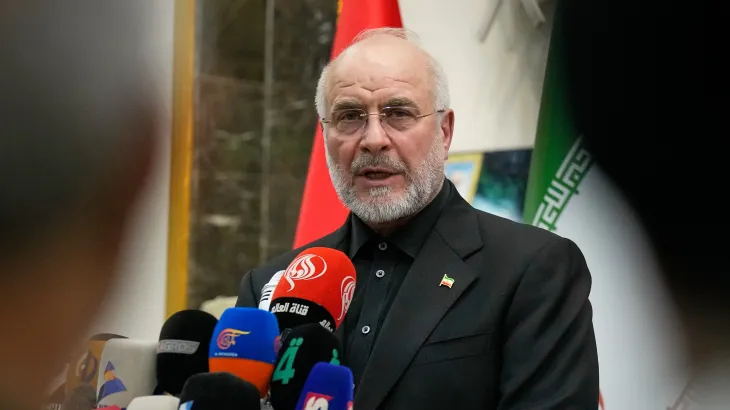
Mohammad Bagher Ghalibaf, the speaker of Iran’s parliament and its lead negotiator, has declared that the Strait of Hormuz will never return to its pre-war operational status. In an exclusive interview, Ghalibaf revealed that Iran and Oman have established an understanding to oversee the vital waterway, a move framed as part of Tehran’s seven-point proposal aimed at concluding the eight-month-long conflict.
Addressing the legal status of the passage, Ghalibaf asserted that the Strait does not constitute international waters and rejected the application of the 1982 UN Convention on the Law of the Sea to the area. He maintained that regulations within the strait are exclusively governed by the two bordering littoral states.
Tehran has formally transmitted its peace conditions to the United States through a Qatari mediator and is currently awaiting an official reply. Ghalibaf emphasized that the ball is now in the American court regarding the next steps for potential negotiations.
These conditions, which were originally outlined in a June memorandum of understanding in Islamabad, include ending fighting on all fronts, lifting the naval blockade and international sanctions, releasing frozen Iranian assets, and issuing a definitive declaration that the war is over. Implementation of these points is a prerequisite for any bilateral talks.
Ghalibaf identified a profound lack of trust in the United States as the primary barrier to reaching a formal agreement.
He indicated that if the US adheres strictly to the agreed terms without imposing excessive demands or engaging in provocative behavior, a deal remains possible. Furthermore, he disclosed that US officials had previously requested that Russian President Vladimir Putin facilitate direct negotiations between Washington and Tehran. “If America limits itself to what has been agreed upon without making excessive demands or engaging in behaviour that breeds distrust, then, naturally, reaching an agreement is possible,” he said.
Looking toward the future, Ghalibaf cautioned that any further US military aggression would result in another defeat for President Donald Trump, compounded by political pressure from the new Congress taking office in January. Iran remains committed to exiting its current position of no war and no peace by prioritizing sustainable deterrents and enhanced military capabilities.
Regarding the conflict in Yemen, the Iranian speaker insisted that outside parties should refrain from interfering in the struggle between the Houthis and Saudi-backed government forces. He clarified that Iran would only provide assistance to resolve the dispute if explicitly requested by both the Yemeni government and Saudi Arabia. Iran has previously offered to facilitate talks between Saudi Arabia and Yemen’s Houthi group in October following a series of deadly attacks on the kingdom. According to on the ongoing fighting in Yemen between the Saudi-backed internationally recognised government forces and the Houthis, an armed group also known as Ansar Allah (Arabic for “Supporters of God”), Ghalibaf, “no on.