In “Teenage Sex and Death at Camp Miasma,” director Jane Schoenbrun crafts a unique slasher fantasy that reimagines the genre’s traditional tropes. The film juxtaposes the mundane awkwardness of poor sexual experiences with the terrifying imagery of iconic horror slashers like Jason Voorhees and Michael Myers. Schoenbrun, a 39-year-old trans filmmaker, posits that the film serves as a meditation on the essential skill of learning to engage in healthy, fulfilling intimacy.
Reflecting on their own journey, Schoenbrun noted that for many years prior to transitioning, they struggled with dissociation and avoidance regarding intimacy. The filmmaker emphasizes that genuine sexual connection is difficult to achieve without being fully grounded in one’s identity—a sense of self that was largely inaccessible before their transition. The film seeks to transform classic horror iconography into a medium for liberation, suggesting that just as a horror movie provides a safe environment to explore fear, intimacy offers a space to confront vulnerability.
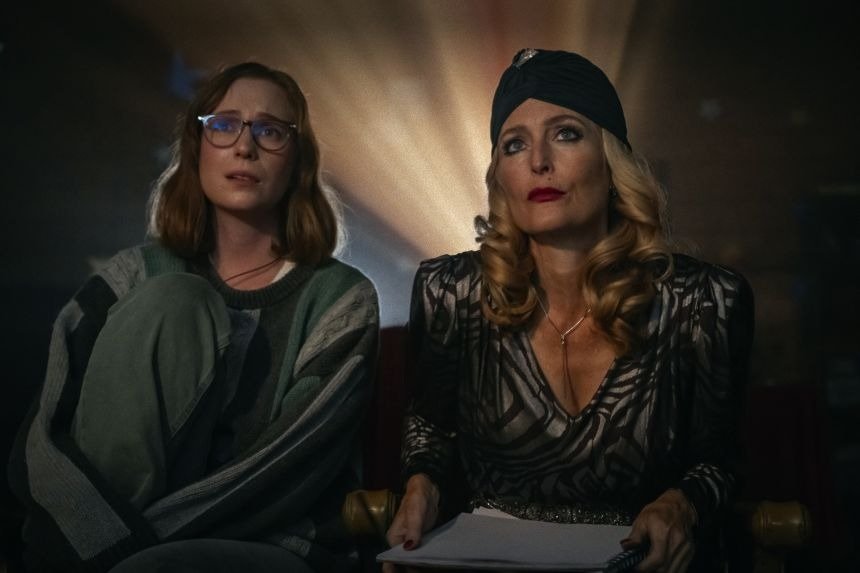
The film, which earned the Queer Palm at the Cannes Film Festival, marks a major milestone in Schoenbrun’s career. It features notable performances from Hannah Einbinder, who portrays a self-described intellectual and filmmaker named Kris, and Gillian Anderson, who appears as a mysterious recluse living on the site of a defunct film set. The narrative follows Kris as she attempts to reboot a transphobic 1980s horror franchise, only to find herself drawn into a complex, tender romance with the original film’s star, Billy, played by Amanda Fix.
Central to the story is the struggle to remain present during moments of intimacy. Both Kris and Billy grapple with the tendency to dissociate, viewing themselves from the outside during encounters that are meant to be deeply personal. This feeling is given a physical manifestation through the character “Little Death,” a voyeuristic antagonist who wears a vent-shaped helmet, symbolizing the detached gaze often felt during unsatisfying sexual encounters. In one flashback, Billy recalls her own loss of virginity as a hollow experience, one that led her to attempt to vanish from her own body to endure the discomfort.
Schoenbrun employs a mix of genres, combining the campy, gory aesthetic of 1980s slashers with the beats of a stoner romantic comedy. The director described the process of filming these sequences as emotionally visceral, serving as an extension of the broader themes of self-actualization and the discovery of one’s creative and sexual agency. By treating the set of a horror film as a playground, the characters are able to subvert the rigid, often traumatizing expectations placed upon them.
As the narrative progresses, the line between the film’s reality and the legendary “Camp Miasma” slasher set begins to dissolve, leading to an explosion of romance and surrealist horror. Schoenbrun likens the experience to a “sugar rush that is still tender,” aiming to showcase that when one is truly honest about their desires—regardless of the initial fear—the result can be joy rather than destruction. Ultimately, the film argues that the ability to play, take risks, and be present represents the key to healing and authentic connection. The report also notes that but reluctantly, a teenage girl named Billy is having sex for the first time – sex she consented to verbally. The report also notes that in her eyes, you can see that she’s not entirely there – she’s somewhere else, like a spectator, outside her body looking in. The report also notes that it’s an experimental love letter to the schlocky slasher films of the ‘80s (with gore that leans camp) and a stoner romantic comedy dressed up as an erotic thriller that critiques horror’s transphobic tropes. The report also notes that in film critic and writer Payton McCarty-Simas ’ words, “it’s about how sometimes when you’re queer, it’s hard to get off.”. The report also notes that “ I Saw the TV Glow ” helmer Schoenbrun has become something of a cult sensation for their reference-rich experiments in horror, which are at once cerebral – Foucault references are dropped deftly – and emotionally hefty. The report also notes that transphobic ‘80s franchise, the titular “Camp Miasma,” with her stamp of queer approval. “They’re looking for elevated, aka woke,” quips Kris’ agent, played by a perfectly annoying Sarah Sherman, she’s a rising star who’s been recruited to resuscitate a stagnant. The report also notes that as part of the research for her remake, Kris goes searching for actress Billy, who played the “final girl” in the original film-within-a-film and helped trigger her own sexual awakening. The report also notes that she finds the older star – played by Anderson as an elegant femme fatale with a luxurious Southern twang – living as a mysterious recluse a la Norma Desmond on the real abandoned camp where the original movie was filmed.