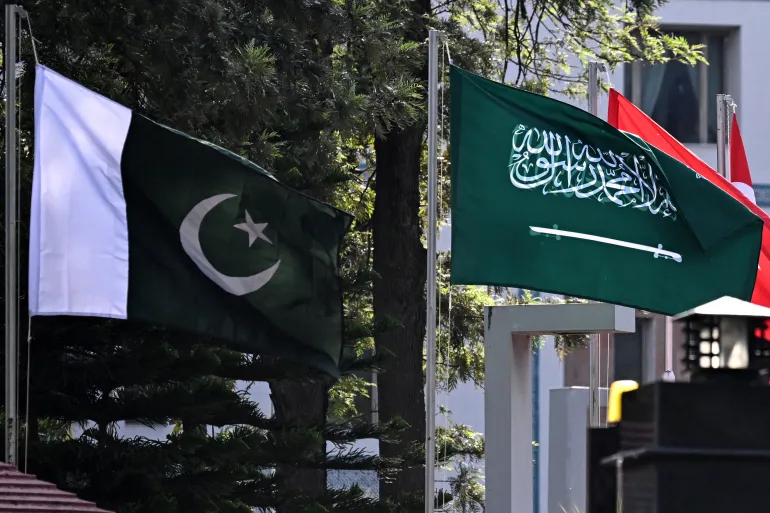
A senior Pakistani military official has stated that his country is prepared to defend Saudi Arabia against any aggression to the fullest extent. Lieutenant-General Ahmed Sharif Chaudhry, who serves as the director-general of the Pakistani military’s media wing, emphasized during an interview with the Saudi newspaper Arab News that Islamabad’s support for the kingdom is both diplomatic and physical.
Highlighting the depth of this commitment, Chaudhry noted that Pakistani forces are currently deployed to safeguard the kingdom as well as Islam’s two most sacred sites in Mecca and Medina. He stated, “We are there to protect them, and we will go to any extent further as required by the Saudi leadership and the people of Saudi Arabia.” He specifically underscored the term “physically” when describing the nature of the support available to Riyadh.
These assurances arrive as the efficacy of regional security agreements is being tested by intensified attacks from Yemen’s Houthi rebels. The Strategic Mutual Defence Agreement, finalized by Islamabad and Riyadh in September 2025, dictates that an act of aggression against one nation is considered an assault on both. While Pakistan’s Defence Minister Khawaja Asif indicated earlier this month that the pact covers unprovoked aggression or conflict spillover from Yemen, he refrained from detailing specific military protocols.
Earlier this year, in April, Pakistan deployed fighter and support aircraft to King Abdulaziz Air Base following attacks on the kingdom by Iran and its regional allies. Additionally, both Pakistan and Turkiye entered into the Mecca Strategic Mutual Defence Agreement last month, though this specific pact is not yet operational. Turkish Foreign Minister Hakan Fidan has likened the Mecca agreement to NATO’s collective defense clause, requiring the targeted nation to request assistance from its partners.
Despite these arrangements, both Pakistan and Turkiye remain eager to act as mediators in the volatile Middle East. Consequently, there is perceived hesitation regarding direct military involvement in ongoing hostilities. Pakistan’s Foreign Office recently noted that no specific military response is currently under discussion, though Islamabad maintains its intention to act when the time is appropriate. Meanwhile, the military maintains ongoing communication with Iran, which provides support to the Houthi movement.
The current security climate has been further strained by allegations regarding a Houthi drone directed toward Mecca. While the Saudi-led coalition reported intercepting the craft, Houthi leader Abdel-Malik al-Houthi dismissed the claim as a “heinous lie.” Tensions continue to rise, with the Houthis promising retaliation after accusing Saudi Arabia of conducting approximately 37 air strikes across Yemen over the past few days.
According to reports from Sanaa, these recent strikes targeted the governorates of al-Jawf, Saada, Hajjah, Taiz, and Lahj, resulting in five deaths, including three children. Sources also suggest that telecommunications infrastructure was hit by aircraft launched from Saudi bases. In response, the Houthi group has vowed to continue targeting Saudi military installations, explicitly naming the King Khalid and King Fahd Air Bases. A recent overnight strike on the latter reportedly caused damage to an Italian fighter jet, as confirmed by Italian Defence Minister Guido Crosetto. The Houthi rebels further warned of potential attacks on oil facilities located away from holy sites. The report also notes that peaceful outcome” to the regional crisis triggered by the United States and Israel war on Iran, chaudhry also stressed that Pakistan continues to work with regional partners towards “a negotiated. The report also notes that the Houthis say they will stay on their current course, for their part. The report also notes that on Friday, the group said Saudi Arabia had carried out about 37 air strikes across Yemen in recent hours, promising to respond by “striking deep inside Saudi territory”. The report also notes that the strikes also allegedly targeted telecommunications towers in several localities and were carried out by jets launched from Saudi airbases, Yousefi cites local sources as saying.