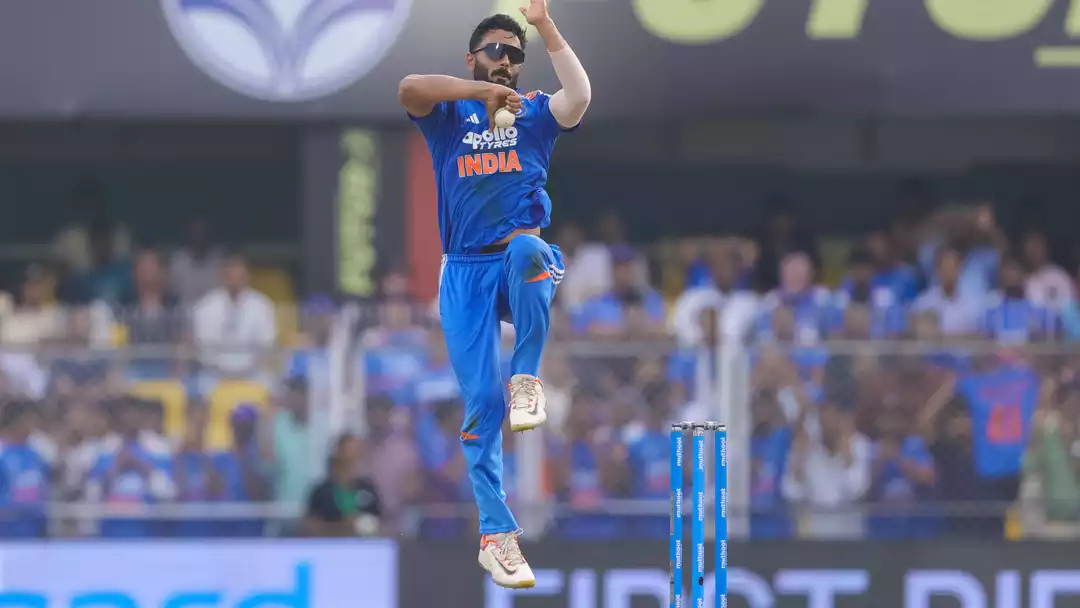
India’s T20I series against the West Indies served as an ideal platform to test bench strength. While seamers Mayank Yadav and Prince Yadav made strong arguments with the ball, Naman Dhir stood out as the most intriguing multi-format revelation of the tour. After showcasing his off-spin capabilities early on, Dhir delivered a explosive six-ball cameo in Bengaluru that highlighted his immense power-hitting potential.
During a rain-curtailed nine-over match in Bengaluru, the pitch was kept under covers, creating tricky conditions. India was struggling at 88/4 with only 17 balls remaining in their 46-ball innings when Dhir walked out to bat ahead of the established Shivam Dube. The West Indies seamers had found success by shortening their length after fuller deliveries were hit; Abhishek Sharma, Ishan Kishan, Sanju Samson, and Shreyas Iyer all fell to varied lengths and off-pace deliveries.
Dhir immediately seized the initiative against Keemo Paul. He launched an off-pace leg delivery over deep mid-wicket and then leveraged his high bat grip and tall frame to clear long-off on a wider delivery, bringing up 10 runs off two balls. After Paul sent down a 140 kph wide, Dhir adjusted across his stumps against a 137 kph delivery, striking it cleanly over long-off. He capped his electrifying knock by dispatching a fuller ball from Shamar Springer over the ropes, finishing with 24 runs off just six balls with three sixes.
While his hitting in Bengaluru turned heads, Dhir’s bowling progression across the tour offered even greater strategic value. During the preceding ODI series—where spinners generally struggled and conceded 6.55 runs per over—Dhir posted a remarkably tight economy rate of 6.30 across 16.3 overs. This was the third-best economy overall, trailing only Kuldeep Yadav (5.56) and Matthew Forde (5.90). And they bowled much more dots,” he said. He has bowled regularly in other tournaments, while the IPL has made his bowling skills largely redundant.
In the T20Is, Dhir demonstrated exceptional mental resilience on surfaces offering minimal spin assistance. Despite conceding 12 sixes—the second-most in the series—he bounced back to take a wicket on the very next ball on five separate occasions. This ability to reset instantly earned praise from West Indies head coach Daren Sammy, who pointed out that both Dhir and Roston Chase limited boundary balls by maximizing dot balls. Dhir logged a dot-ball percentage of 35%, second in the series only to Mayank Yadav’s 43.3%. Against the tournament average of 27.7%, chase had the best economy rate at 9.06 and a boundary percentage of 19.1. Not going for too many runs by the boundary routes.
Drafted late into the squad as a replacement for Washington Sundar, Dhir brought a wider speed variation ranging from the early 80s to late 90s kph, unlike Sundar’s typical mid-90s to 100-plus kph deliveries. On his T20I debut in Lucknow, he entered the attack in the ninth over to stem a partnership between Shai Hope and Sherfane Rutherford. He conceded just six runs in his opening over, contrasting sharply with Kuldeep and Axar Patel, who yielded 15 and 18 runs respectively in adjacent overs.
Dhir’s tactile adjustments paid off against key West Indies hitters. After Hope hit a 94 kph ball for six, Dhir widened his line and slowed his pace by 5 kph, drawing a miscue to deep mid-wicket. He then outmaneuvered Romario Shepherd by dropping his speed to 85 kph with 2.93 degrees of drift, inducing a catch at long-off right after giving up a six down the leg side. He wrapped up his spell by changing his angle to over the wicket against Springer to deny him elevation. In Indore, after being hit for three sixes by Kamil Pooran, Dhir pulled his length back to cramp the batter, forcing a miscue to deep square leg. But Springer – the best bowler of the night – erred in line and length, delivering a fuller delivery outside off with mid-off inside the circle, west Indies were protecting the boundaries in front of the square on a slower surface.
Four of Dhir’s five series wickets came from deliveries within the 80–90 kph range, a crucial variation that set him apart from Axar, who tended to bowl faster when targeted. Captain Shreyas Iyer lauded Dhir’s proactive attitude, noting his eagerness to bowl in crucial moments and exploit turn. Teammate Tilak Varma also praised his willingness to bowl off-spin under pressure against power-hitting right-handers. His bowling development stems from extensive preparation with the Mumbai Indians support staff in Navi Mumbai prior to the tour. Dhir remains ambitious about his dual role, stating during the Hyderabad T20I that while he prioritizes scoring with the bat, he is determined to develop into a genuine all-rounder who can solidify India’s lower-middle order. He showed no rustiness, despite having had little opportunity to bat on the tour. I think that’s the key here on good wickets. He put in the hard yards with the Mumbai Indians squad at Reliance Corporate Park in Navi Mumbai, bowling hundreds of overs, before joining the Indian team ahead of the ODIs.