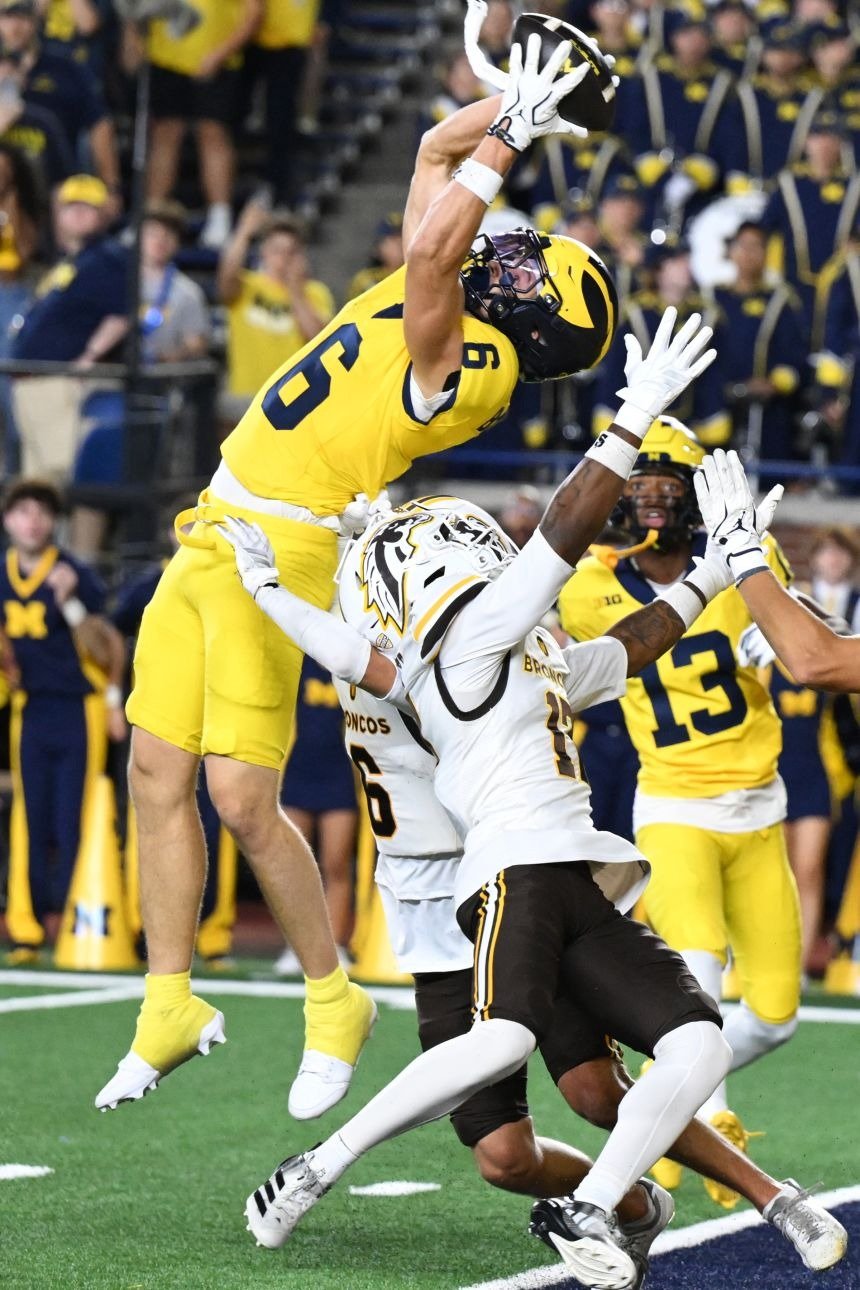
The Michigan Wolverines secured a narrow 13-12 victory over Western Michigan this past Saturday, but the game’s conclusion has ignited a firestorm of controversy. With the clock appearing to hit zero as a final pass fell incomplete, officials intervened to add one second back to the game time. This extra opportunity allowed Michigan quarterback Bryce Underwood to complete a 47-yard Hail Mary pass to JJ Buchanan, snatching a win that Western Michigan appeared to have already secured.
Western Michigan head coach Lance Taylor expressed clear frustration after the game, noting that the stadium clock had clearly expired before the ball touched a defender’s hand. Despite the visible evidence, the Big Ten conference defended the decision, releasing a statement and video claiming a Western Michigan player had touched the ball with one second remaining. The explanation has faced skepticism, particularly because the clock used by officials in the review appeared to differ from the broadcast and stadium feeds, and the specific moment of contact remains difficult to verify due to camera angles.
The financial disparity between the two programs has further fueled the debate. According to the U.S. Department of Education’s Equity in Athletics data, Western Michigan’s entire athletic department operates on an $8 million budget. In contrast, reports suggest that Michigan quarterback Bryce Underwood’s individual NIL package is valued between $10.5 million and $12.5 million over four years. Critics argue that this widening chasm between wealthy programs and smaller schools, compounded by questionable officiating, undermines the competitive integrity of the sport.
This incident is not the first time Michigan has benefited from a late-game clock adjustment at the Big House. In 2005, officials added two seconds to the clock during a matchup against No. 8 Penn State, which allowed Michigan to score a game-winning touchdown on a pass from Chad Henne to Mario Manningham. While Penn State managed to overcome that setback to reach the Orange Bowl, Western Michigan faces a much steeper path, with upcoming games against Monmouth, Rice, and Boise State before conference play begins.
The Big Ten’s decision to uphold the result was expected by many observers, who noted that the league was unlikely to reverse a victory given the historical context of Michigan’s program. Even so, the controversy has left many calling for better synchronization between stadium clocks and official review systems. Western Michigan and the MAC have opted to accept the league’s explanation, with Taylor maintaining a professional demeanor in his post-game comments, even as the outcome remains a bitter pill for the Broncos.
The broader landscape of college football, currently grappling with the impacts of NIL and shifting conference power dynamics, remains under scrutiny. As schools and conferences continue to navigate legal and financial pressures, incidents like this highlight a growing public perception that the playing field is becoming increasingly uneven. For Western Michigan, the game represented a potential historic upset that was ultimately erased by a single, disputed second of game time. The report also notes that apparently, the Big House is the land where time stands still, where clocks melt like a Salvador Dalí painting and Deloreans wind back the minute hand just enough for the home team to get another chance. The report also notes that where football takes 60 minutes and one second and days are 24 hours and one second, it’s where games end but somehow continue. The report also notes that where teams already afforded every advantage are now given the gift of imaginary time. The report also notes that that is the real travesty in Western Michigan’s 13-12 “loss” to Michigan. The report also notes that this entire offseason has felt like a protracted exercise in gluttony. The report also notes that schools, players and coaches who already have so much still want more, and when they can’t get it, they go to court to get their way, the conferences. The report also notes that and somehow still thinks it needs the assistance of would-be-but-couldn’t-make-it NFL dudes, lSU poleaxed a team that used to win national championships on the regular. The report also notes that looking for ways to curtail outrageous spending and put guardrails up on the college athletics Autobahn, the SEC and Big Ten asked Congress for help to bail them out of the mess they had created.