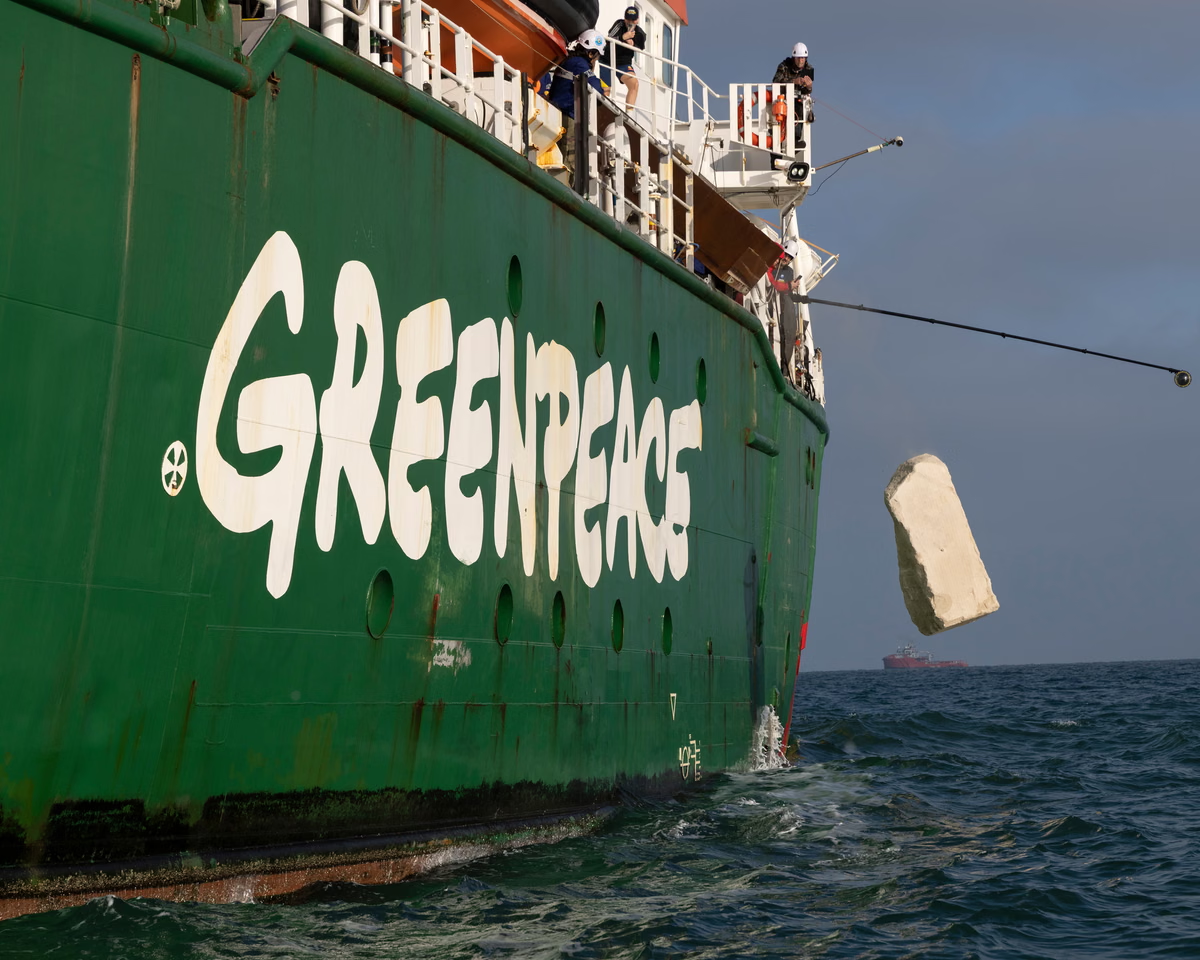
Greenpeace activists have inadvertently created a hurdle for a major offshore wind project after dumping 15 tonnes of stone off the Norfolk coast. The giant offshore windfarms backed by Andy Burnham this week may face unexpected stumbling blocks after Greenpeace activists unwittingly dumped about 15 tonnes of boulders on to the site as part of a campaign against seabed trawling in the North Sea. Each weighing up to 2 tonnes, on to the sea floor to prevent a method of fishing known as bottom trawling, greenpeace created the “boulder barrier” to safeguard harbour porpoises off the Norfolk coast by dropping giant stone blocks.
The environmental group established the “boulder barrier,” consisting of blocks weighing up to two tonnes each, to prevent bottom trawling in the southern North Sea, an area they describe as one of the most heavily trawled in the region. The action was timed to align with the premiere of the BBC’s Blue Planet III documentary.
This protest action occurred just days before the prime minister announced at the Cop31 summit that the UK would invest £1bn of public funds into the Vanguard West and Vanguard East windfarms. This development is part of a broader £12bn agreement between renewable energy developers and the government, with construction scheduled to commence next year.
While Greenpeace reportedly checked the seabed for pipelines, shipwrecks, and cables, the organization was unaware that the specific site had been earmarked for the Norfolk Vanguard East windfarm. Consequently, the boulders sit directly in the path of the planned infrastructure.
Some of the stones bear the signatures of notable figures who support the campaign, including Benedict Cumberbatch and Simon Pegg, who have previously provided voiceovers for marine conservation documentaries. The barrier is intended to safeguard harbour porpoises by deterring industrial fishing vessels from dragging heavy nets across the seafloor.
The German utility company RWE, which is overseeing the offshore wind project, is currently in discussions with Greenpeace to pinpoint the precise location of the boulders. RWE intends to update its existing seabed surveys, initiated last summer, and is evaluating the potential impact of the rocks on construction and the installation of subsea cables.
An RWE spokesperson characterized the ongoing dialogue with Greenpeace as “constructive” and stated that the company remains committed to investigating the implications for the project. Meanwhile, Will McCallum, co-executive director of Greenpeace UK, dismissed concerns that the boulders would pose a significant obstacle to the energy project.
McCallum argued that the idea of the stones hindering construction is “absurd,” noting that energy firms routinely relocate natural seabed boulders—some significantly larger than those placed by activists—during the development of offshore wind sites. He reiterated that Greenpeace continues to support offshore wind energy while maintaining that the boulders remain necessary to protect the seabed from destructive industrial trawling until the windfarm is operational. “Some of these boulders can be 10 times heavier than those we placed.