Cybercriminals have successfully hijacked supermarket refrigeration units across Europe twice in less than a month, causing significant food spoilage and millions of euros in damages. The initial breach occurred on October 11 and 12, when attackers remotely increased temperatures at roughly 700 French supermarkets to as high as 50C (122F). This was followed by a second wave of incidents on November 2, impacting retail chains and food businesses across nine European nations, including Ireland, the Netherlands, Belgium, Italy, Sweden, Finland, Estonia, Portugal, and Luxembourg. It is not yet clear who was behind the second wave.
French authorities have attributed the first campaign to the Shahid Kaveh cyberunit, a group linked to the Islamic Revolutionary Guard Corps (IRGC), marking the first instance of large-scale sabotage-focused cyber warfare on French soil. The origin of the subsequent November attacks remains under investigation. These incidents highlight the precarious state of internet-connected equipment, ranging from domestic appliances to critical industrial control systems. Essentially, anything connected via the internet could potentially be hacked.
Common Security Vulnerabilities in Smart Devices
- Exposed: Devices were directly linked to the public internet without adequate security barriers.
- Weak passwords: Many systems relied on factory-default or easily guessable credentials.
- Outdated: Numerous units were running legacy software that no longer receives essential security patches.
Supermarket refrigeration systems are typically connected to the internet to allow remote management by contractors, a setup mirroring the connectivity of modern home smart fridges. Attackers have reportedly utilized Shodan, a specialized search engine for connected hardware, to locate vulnerable systems. Once access is gained, hackers can manipulate temperatures, steal sensitive data, or move laterally through a network to compromise other connected hardware, such as smart locks or personal computers. Vincent Strubel, head of France’s National Cybersecurity Agency (ANSSI), warned the French Senate on October 21 that identical equipment is frequently utilized in healthcare facilities to store vaccines and hazardous laboratory materials. Once inside, hackers can switch a fridge off, raise its temperature or steal account details. In France, they simply used the controllers’ own defrost function.
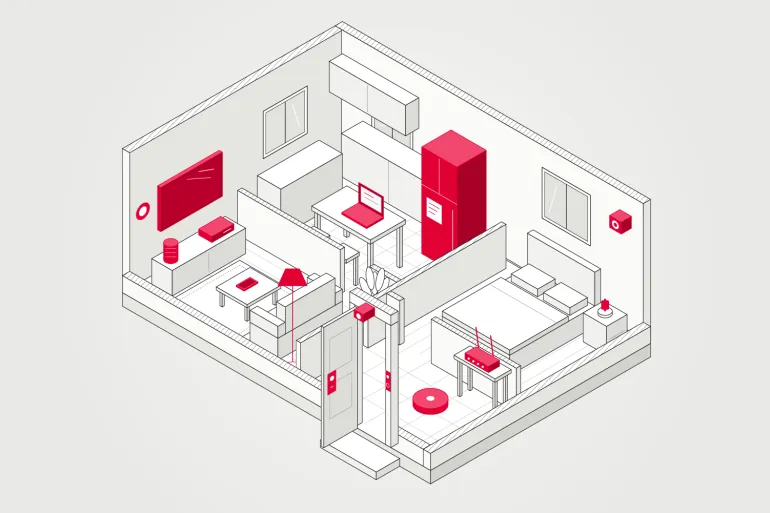
The global proliferation of internet-connected technology is massive. The Digital 2027 Global Overview Report by Kepios estimates there are approximately 21 billion short-range connected devices, such as smartwatches, and 5.4 billion long-range monitoring systems in use worldwide. In the United States, Parks Associates reports that the average internet-enabled household now possesses 18 connected devices, a figure that has doubled over the past decade. This expansion has created a vast attack surface, with home routers being particularly prized targets due to their constant online status. Earlier this year, the UK’s National Cyber Security Centre (NCSC) reported that hackers associated with Russia’s GRU military intelligence were hijacking routers to manipulate DNS settings, thereby redirecting users to malicious sites for credential theft. And what you can do to protect yourself, illustrates the devices at risk in your home and the essential services you rely on. And what a hack on each could mean for you, the graphic below shows some of the key ones.
Entertainment and convenience devices are also points of entry. Researchers found in June that over a third of applications on certain Samsung and LG smart TVs could be exploited to hijack a home’s internet connection for illicit activity. Similarly, concerns were raised when a programmer demonstrated that thousands of DJI robot vacuums could be controlled via a PlayStation 5 controller, granting access to live camera feeds and private home layouts. A programmer reportedly found he could control almost 7,000 DJI Romo robot vacuums with a PlayStation 5 controller, earlier this year. An AI coding tool made by Anthropic, to work out how the vacuums talked to DJI’s servers, he gained access to their live camera feeds, audio and floor plans of people’s homes, using Claude Code. According to US cybersecurity firm CrowdStrike, The attacker was likely a China-based individual who also used Claude Code, an assessment it made with moderate confidence.
The same fundamental weaknesses endangering a kitchen appliance can threaten national security. Industrial control computers are frequently reachable online, leaving critical infrastructure susceptible to interference. Amidst current geopolitical tensions, government agencies have noted an increase in attacks on power plants and water systems. For instance, an attack in July affected over 30 community water systems across Minnesota. While the FBI and CISA have warned of systemic threats to water and wastewater facilities in 12 states, they have also pointed to suspected Iran-aligned actors. Another July attack, attributed to hackers with links to Iran, successfully forced a small British power plant to go offline, representing the first major breach of its kind against UK energy infrastructure. Led by health, finance, telecommunications, transport and energy, followed by defence firms, manufacturing, research and digital service providers, critical infrastructure is the second most targeted sector. Companies, schools, civil society groups and media outlets make up most of the rest.
Financial institutions remain prime targets, with data breaches hitting at least seven South Korean firms in late September and early October, compromising the records of roughly 68,000 individuals.
Industry experts, including analysts from CrowdStrike, suggest that hackers are increasingly using advanced AI tools like the open-source ARTEX platform to test for network vulnerabilities.
According to the European Repository of Cyber Incidents (EuRepoC), there were 4,932 major political cyberattacks between January 2000 and November 2026, with incidents peaking at 795 in 2024. Peaking at 795 in 2024, the number of incidents has grown sharply in recent years. Which industries are most politically targeted.
About two-thirds of all recorded incidents since the turn of the millennium have occurred since 2022, with state institutions—including government ministries, military, and law enforcement—accounting for nearly 40 percent of targets. With about 40,000 and 25,000 customers affected, respectively, yegaram Savings Bank and Shinhan Bank were hit hardest.
Experts like Professor Awais Rashid of the University of Bristol emphasize that while digitization increases disruption risks, the world continues to function because core cybersecurity measures remain effective. But, he added, “the world works because cybersecurity works effectively”.
In response to rising threats, the UK has launched the ‘Be Ready’ campaign, advising citizens to maintain a three-day supply of essentials like food, water, and medicine.